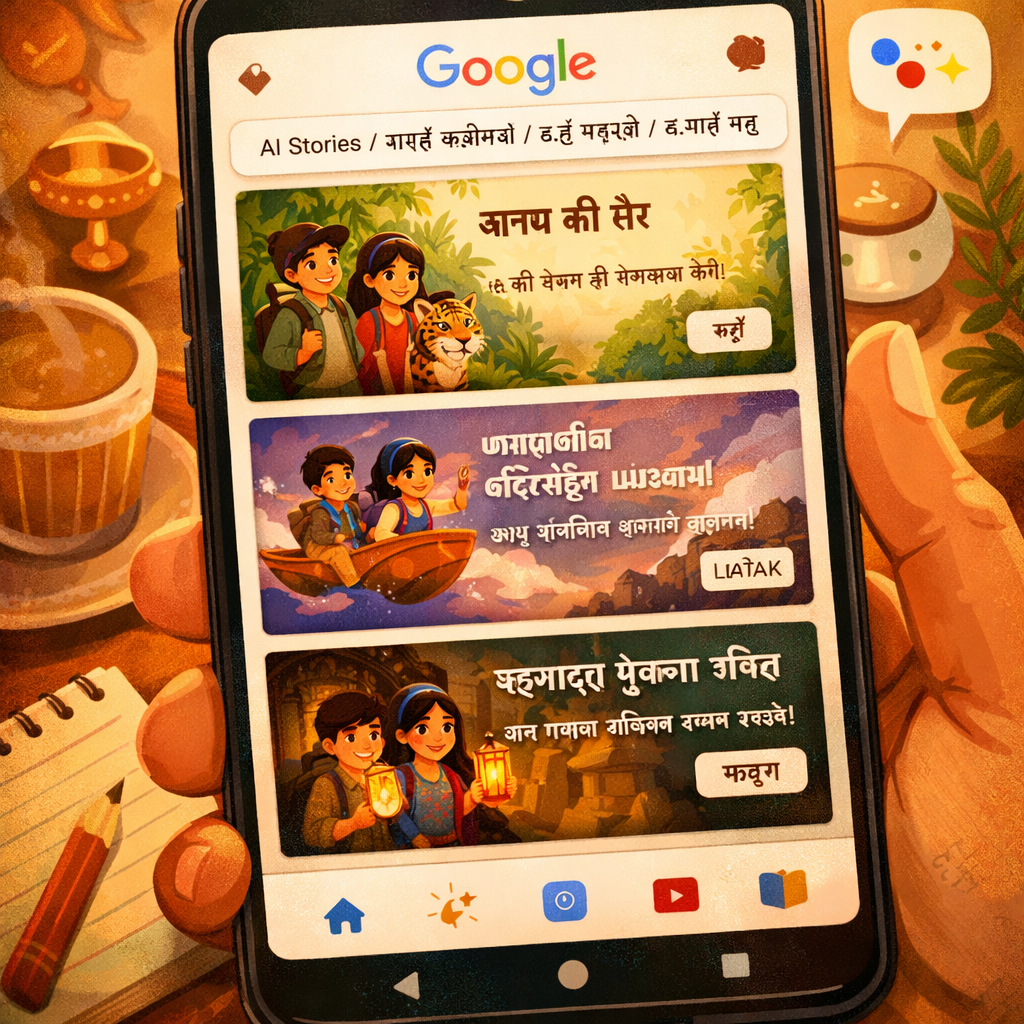
Google has rolled out its experimental app Dreambeans in India—the company’s first market outside the U.S.—offering AI-generated personal stories derived from users’ activity across Google services. The app is now available on Android and iOS in India, with support for thirteen major Indian languages including Hindi, Punjabi, Tamil, Telugu, and Bengali, along with English.
Launched in June, Dreambeans automatically builds illustrated narratives using data from Google Calendar, Gemini, Gmail, Photos, Search, and YouTube. It doesn’t wait for user prompts; instead, it proposes stories proactively based on user behavior and engagement. Initially limited to static graphics, Dreambeans recently added animation features powered by Google’s Veo video-generation model for some stories.
Why India Was Chosen for the First Global Expansion
India represented a strong opportunity for Dreambeans’ international debut thanks to heavy demand and widespread adoption of Google’s services. A Google product manager cited the convergence of users who already use Gmail, Google Photos, and Gemini as a key factor in selecting the country for launch. The bilingual and multilingual makeup of India also influenced development—though the app currently supports only one language at a time, even when users’ connected services are in multiple languages.
Metrics, Limitations & Privacy Concerns
Since the U.S. launch in June, Dreambeans has seen about 55,000 downloads as of last month, sources estimate. That number surged following the app’s opening to all U.S. users aged 18+ in September, making up nearly two-thirds of total downloads in that month. But interest dipped sharply in October, with downloads falling by approximately 84% month-over-month to about 5,500.
By way of comparison, in their first 30 days post-launch, Dreambeans drew far fewer users than other AI-powered apps: about 29,000, compared with Meta’s Muse at 7.4 million, ChatGPT at 2.8 million, Grok Bot at 362,000, and Claude at 155,000. Experts point out that Dreambeans’ narrow focus on personalized, narrative storytelling—as opposed to broad AI query handling—is likely behind its slower uptake.
Language mode is a current weak spot. India’s many multilingual users often toggle between languages or use mixed forms like Hinglish; Dreambeans, even though it supports content in multiple Indian languages, forces users to pick a single one, and doesn’t yet mix them within stories.
Another concern is data privacy. Dreambeans uses Google’s Personal Intelligence technology to gather info from connected services and personalize stories. Users – but only those with personal Gmail accounts, not enterprise ones – can control which Google services to link, disconnect them later, and delete their Dreambeans data. Deleted content is also purged from Dreambeans’ personalization engine. Users can also tell the app to avoid certain topics—such as business—or to omit memories of deceased individuals, akin to memory controls in Google Photos.
Looking ahead, Google is exploring ways to make Dreambeans more actionable. Rather than just building narratives or recommendations, the company intends to help users act on suggestions—potentially closing the gap between story and behavior.
Analysis: Introducing Dreambeans to India marks a critical test for Google’s narrative-driven AI strategy. India’s linguistic diversity, strong Google service penetration, and interest in localized AI content present immense opportunity—but also unique friction points. For Dreambeans to succeed, it must address mixed-language storytelling (a norm for many Indians), clarify data transparency, and deepen engagement beyond novelty. If Google can smooth out these hurdles, Dreambeans could prove a model for expanding AI personalization globally in culturally nuanced ways.