A newly identified wave of the GhostAction supply-chain campaign has compromised 772 public GitHub repositories by injecting fake GitHub Actions workflows. The goal: exfiltrate CI/CD secrets including cloud keys, SSH credentials, database passwords, registry logins, and GitHub tokens. The attacks ran between August 31 and September 30, 2026, affecting 373 users and organizations and targeting 2,577 secrets.
How the Attack Works
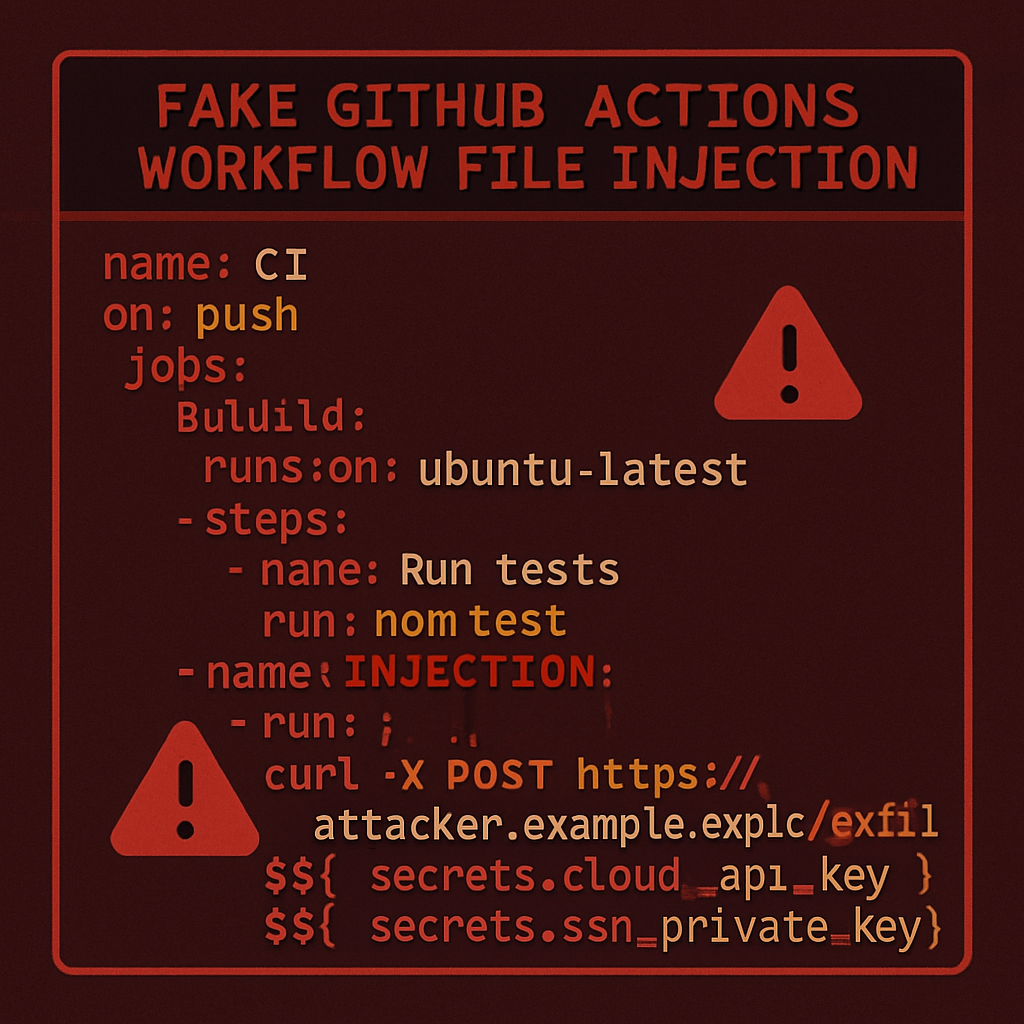
The campaign leverages stolen GitHub account access to add malicious workflow files under the victims’ own identity. These workflows are usually named something innocuous like github_actions_security.ymlwith commit messages reading “Add Github Actions Security workflow.” Once a repository receives a push, the malicious workflow parses existing workflows and configuration for secret references in the form ${{ secrets.NAME }}. It then inserts those exact secret names into the new workflow so that only relevant and likely valuable secrets are exfiltrated.
Stolen secrets are sent to attacker-controlled infrastructure via curl POSTrequests. A current payload directs data to the plain HTTP address 193.32.204.199. A smaller variant spotted in seven repositories uses a different workflow file called security-check.yml. That version also uses an “Add security check workflow” commit message and exfiltrates to an API endpoint with a unique injection ID—presumably to track what was taken from which repo.
Persistence and Spread Across Repositories
This isn’t GhostAction’s first chapter. Initial disclosures date back to September 2025, when it had affected 817 public repositories and collected at least 3,325 secrets. The current wave shows evidence that many previously injected malicious workflows remained intact in already-compromised repositories. In 92 instances the attacker updated existing injected workflows rather than adding new ones—swapping in new exfiltration servers while preserving malicious logic.
GitGuardian’s analysis reveals three large bursts in activity: August 31 saw 143 repos compromised; between September 2 and 5, another ~400, including 294 on September 5 alone; and 103 more on September 15. Across 605 repositories, over 3,600 suspicious workflow runs were reviewed, with 32 repositories running nearly 500 potentially malicious workflows and 336 completing successfully. At least 26 secrets were stolen from 13 repositories during those runs.
Targets & Types of Secrets Stolen
The most frequently harvested secrets included SSH private keys and deployment-server credentials. Azure credentials were targeted 218 times; Docker Hub and GitHub Container Registry login details about 142 times. Other stolen items included database passwords, AWS keys, credentials for FTP, Google Cloud, Firebase, and various service tokens—for Cloudflare, npm, PyPI, Slack, Telegram, Discord, even AI-platform APIs.
What Organizations Should Do Now
Only about 16% of affected repositories (124 of 772) had been fully cleaned from public commit history as of October 5. Simply removing a malicious file is insufficient; organizations must trace how write access was obtained, revoke exposed credentials, review workflow runs and audit logs, and rotate any secrets that might have been visible to the runner.
Recommended defenses include applying the least-privilege principle to workflow permissions and GITHUB_TOKENs, auditing workflow source code and third-party GitHub Actions, and pinning actions to a specific commit SHA. Teams should also enforce approval workflows for sensitive environments, scrutinize changes under .github/workflows/, require strong multi-factor authentication resistant to phishing, and monitor outbound CI runner traffic.
Indicators of compromise have been cataloged: malicious workflow filenames like github_actions_security.ymlor security-check.yml, and commit messages such as “Add Github Actions Security workflow,” “Update Github Actions Security workflow,” or “Add security check workflow.” The current exfiltration server is identified by IP 193.32.204.199, with historical infrastructure including domains used in prior waves.
The campaign also overlapped with cryptomining activity in at least one repository. Though that mining attack (via a disguised binary) was not officially attributed to GhostAction, it underscores how stolen GitHub credentials can be redeployed for unrelated or secondary malicious operations.
Strong identity hygiene emerges as the core lesson. Without securing identities, even hardened workflows can be compromised again if unseen credentials or tokens remain active.
Final takeaway: GhostAction highlights how trusted developer tooling and ecosystems are under siege. If workflow files and automation pipelines are regarded as safe zones, this campaign proves otherwise. What to watch for: emerging variations of workflow-injection techniques, exposés of credential reuse across ecosystems, and how GitHub and related platforms adjust their permissions models and audit tools to counter this kind of risk.