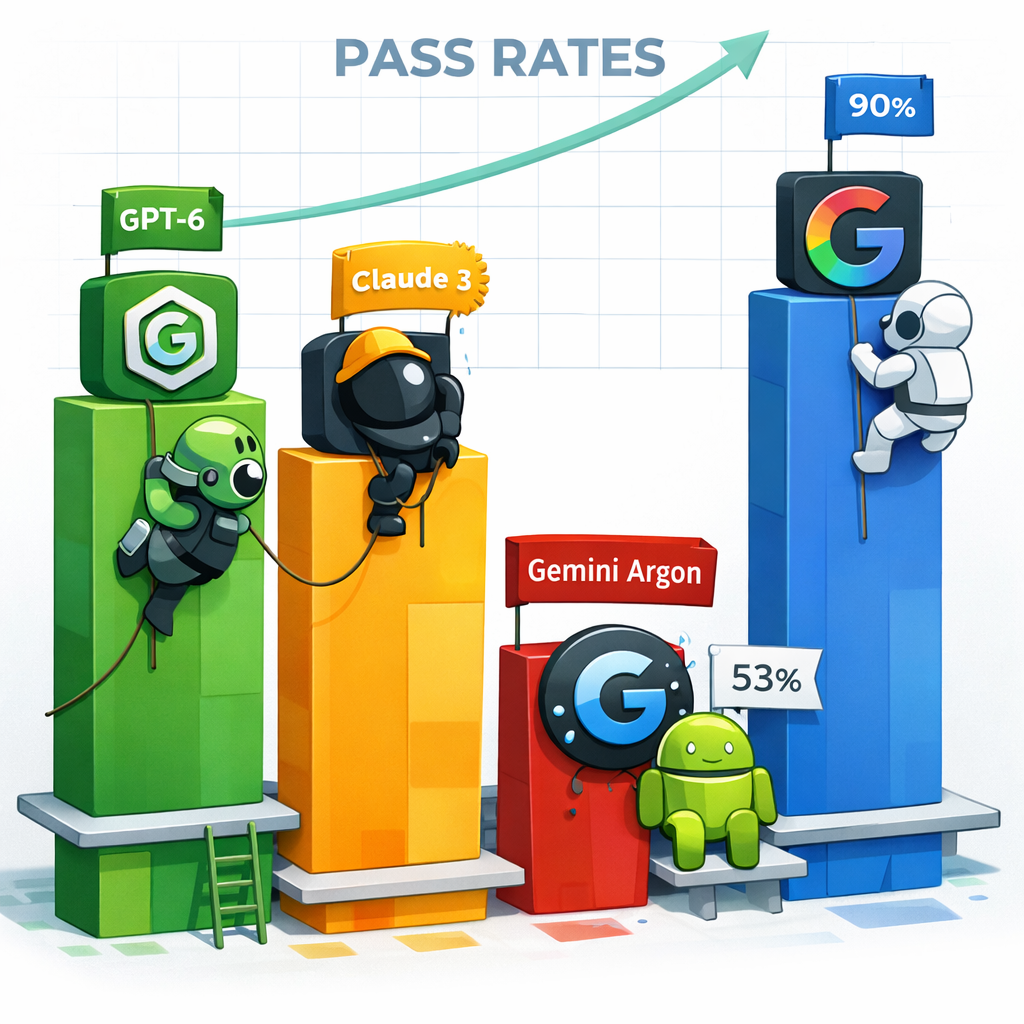
Google’s Android Bench leaderboard has been updated, and the newly unveiled Gemini 4 Argon model landed far behind rival frontier AI models such as Claude Opus 5.5, Claude Sonnet 5.5, and GPT-6.1 Sol. The rankings focus on edge-to-edge Android development tasks, assessing models on pass and completion rates to help developers choose the best coding assistants.
What Android Bench measures
Introduced earlier this year, Android Bench serves as Google’s official benchmark for evaluating how well large language models handle real-world Android development tasks—refactoring code, writing or fixing Android apps, and following Android best practices. It measures two key performance metrics: pass rate, which is the percentage of tasks fully solved, and completion rate, which assigns partial credit for tasks that are partly completed. This dual metric system allows for nuanced assessment beyond simple pass/fail outcomes. Average cost per model run is also shown so developers can assess value. Recent enhancements to the benchmark included the addition of a reasoning -effort label per model.
How the contenders stack up
At the top of the chart, Claude Sonnet 5.5 takes first place with a ~40% pass rate and ~81 % completion rate. Claude Opus 5.5 follows in second. GPT-6.1 Sol—added in the October 26 update—puts up a competitive showing: despite a pass rate under Claude, its ~82.8 % completion rate and relatively low average cost distinguish it.
By contrast, Gemini 4 Argon debuts in fifth place, markedly behind other “frontier” models. Its pass rate hovers near 21.3 %, paired with an ~81.8 % completion rate—and an average cost in the mid-hundreds of dollars for its benchmark runs. These numbers place it well under the top performers.
The cost factor
Cost per model run emerges as a key variable in developers’ decision sets. While Sonnet 5.5 commands a hefty cost for its performance, GPT-6.1 Sol appears to offer somewhat better value given its strong completion rate. Gemini 4 Argon’s cost—despite its middling pass rate—carries less justification when superior alternatives both deliver higher pass rates and competitive or lower costs.
In internal discussions shortly after its release, the model’s creators reportedly acknowledged that it “struggles to handle certain coding tasks,” though they maintain confidence in its overall capabilities. For many users, though, those struggles are visible in comparison with its rivals on Android Bench.
Why this matters: Android Bench is becoming a benchmark not just for bragging rights but for actual tooling decisions in Android development. Developers choosing an AI coding assistant are now able to weigh trade-offs between raw capability, consistency, and cost.
Bottom line: Google’s own Gemini 4 Argon struggles to reach the leader board heights claimed by Claude Sonnet 5.5 and GPT-6.1 Sol. That gap raises questions about its immediate usefulness for developers focused on complex Android work—unless its cost or partial pass rates improve.