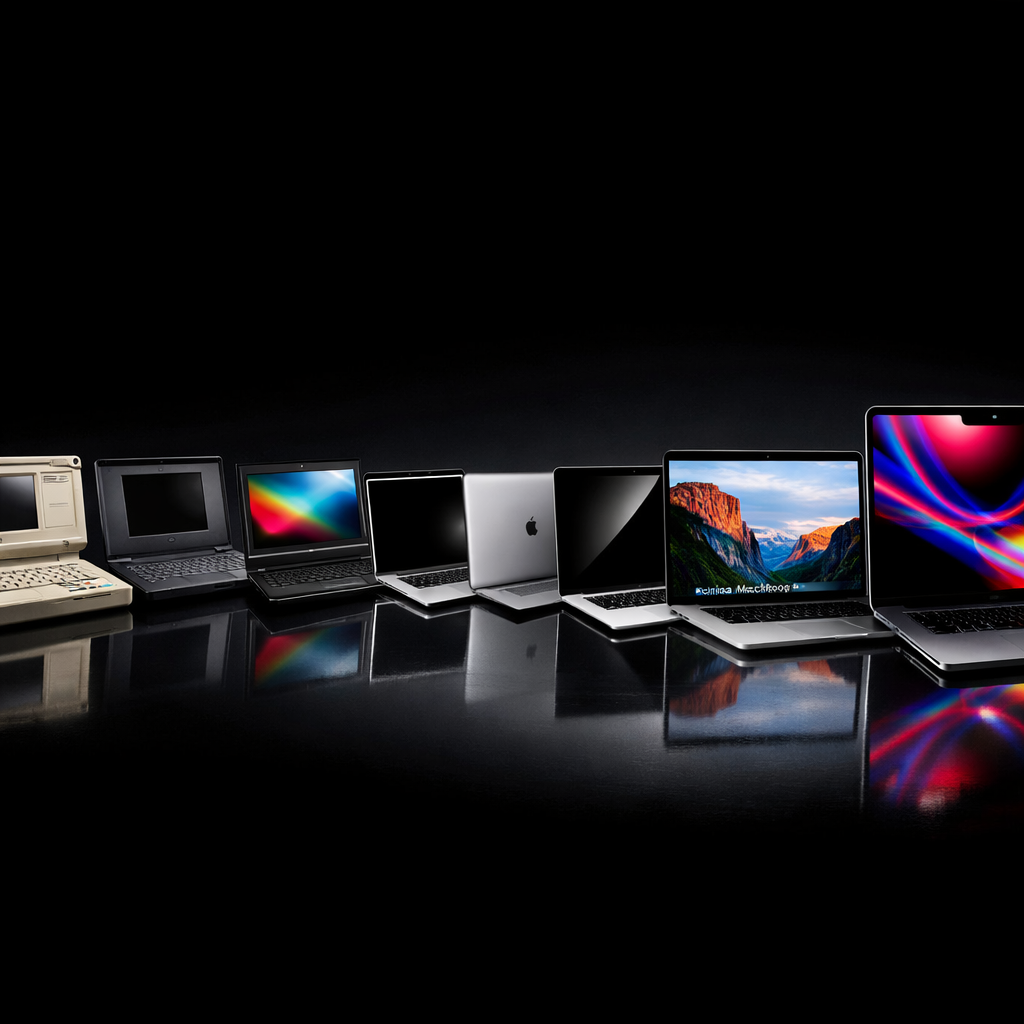
The journey from Apple’s first battery-powered laptop to the new MacBook Pro with PROLED XDR Display spans more than three decades—years marked by bold design shifts, chip architecture transitions, and persistent efforts to redefine what “portable” truly means.
The Early Years: Weight, Wrist Straps, and Windows
Apple’s portable ambitions began in earnest in 1989 with the Macintosh Portable, a machine that carried both promise and burden. Powered by a Motorola 68000 processor running at 16 MHz, it shipped with just 1 MB of RAM (expandable to 9 MB), a 1.44 MB floppy disk drive, and the option of a 40 MB SCSI hard drive. Displayed on a 9.8-inch active-matrix LCD that lacked a backlight, its lead-acid battery enabled up to 10 hours of use in non-backlit models. Yet all this came at a hefty cost: approximately $6,500 and nearly 16 pounds in weight—very much not the sleek laptop most envision today.
Shifts in Form and Function: PowerBook, MacBook, and Beyond
Throughout the 1990s and early 2000s, Apple refined its portable offerings. The PowerBook line—starting in 1991 with the PowerBook 100 series and onward through models like the PowerBook G4—introduced slimmer profiles, more practical I/O arrangements, color, and better portability without sacrificing too much performance. The MacBook models of the mid-2000s broadened the appeal further: from the polycarbonate shells of early MacBooks to aluminum designs, reflecting both aesthetic and durability improvements. Then came the MacBook Air in 2008—a machine that shrank size and weight, sacrificing heft for portability while still aiming to maintain enough power for everyday use.
Apple Silicon and the Entry-Level Divide
In 2020, Apple introduced ARM-based Apple Silicon with the M1 chip in the MacBook Air, marking the beginning of the end for Intel-powered Macs. The M1 models blurred the lines between performance and portability, offering fanless designs and dramatic improvements in efficiency. Earlier this year, Apple launched the MacBook Neo—an entry-level machine powered by the A18 Pro chip. Aimed at users who don’t need the full power of MacBook Pro hardware, the Neo starts around $599, includes 8 GB of memory, offers up to 512 GB of storage, and features a 13-inch Liquid Retina display with 500 nits of brightness.
Enter the PROLED Era: A Touchscreen, OLED, Dynamic Island
The latest milestone came in late October 2026 with the announcement of the MacBook Pro with PROLED XDR Display. These new 14- and 16-inch models mark several firsts: they’re Apple’s first MacBooks with tandem OLED displays, their first to support touch input, and the first to replace the traditional notch with a Dynamic Island interface.
Under the hood, the PROLED models use either the M5 Pro or M5 Max chips, support up to 128 GB of unified memory, and can have up to 16 TB of storage. While the physical dimensions remain similar to their predecessors, reduced weight, improved display contrast, and enhanced interaction aim to justify the premium. Pricing starts at $2,899 for the new 14-inch version in the U.S., with shipments beginning November 6.
Looking back over these 35 years, Apple’s idea of a “true portable Mac” has evolved—from a battery-powered beast that was too hefty to carry, to polished machines that balance power, design, and new input models. The PROLED MacBook Pro isn’t just another iteration—it’s the culmination of lessons learned from failed pros, colorful clamshells, and years of pipeline transitions. Its success will depend on whether users find touch on macOS more useful than gimmicky, whether OLED delivers enough real-world payoff, and whether the premium cost feels worth it for creative pros willing to pay for those last measurable improvements.