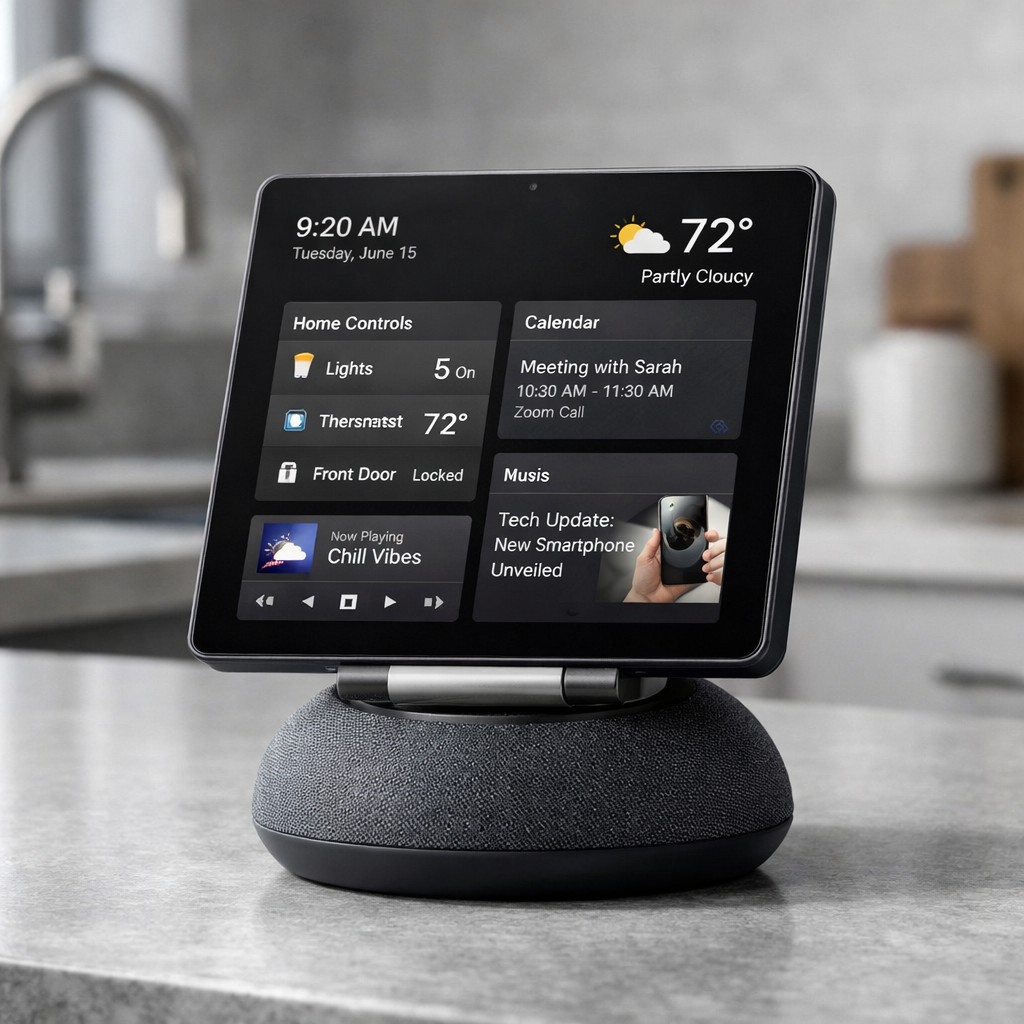
Apple’s new HomeView, a high-end smart home hub priced at $299 and launching November 13, has finally arrived for public review. Designed with a square 7-inch Liquid Retina display perched on a domed speaker base and connected via a stainless steel hinge, HomeView comes in both tabletop and wall-mounted versions and offers a central hub experience aimed at controlling smart devices, making video calls via FaceTime, interacting with Siri AI, and more.
Hardware Design and Audio Experience
The tabletop model features an aluminum design—reminiscent of the classic iMac G4—with the display mounting to a speaker base via a sturdy tilting hinge that feels premium and moves smoothly yet holds its position well. Available in Silver, Starlight, Rose Pink, and Space Gray, its aesthetic, weight, and proportions make it well suited for nightstands, kitchen counters, or desk corners.
Sound quality stands out. The speaker base of the tabletop model houses a down-firing woofer and dual passive radiators to augment bass, while the display carries additional full-range drivers. The wall-mounted variant drops the base (and the extra bass components), but Apple’s computational audio tuning helps preserve sound balance. A18 chip–powered audio delivers impressively loud, clean sound with minimal distortion, especially in the speaker-base edition.
Software, Siri AI & Use-Day Features
Powered by Apple Intelligence, HomeView’s version of Siri AI adds a layer of conversational ability, including access to personal context such as calendar and message content—when used in conjunction with a compatible iPhone or iPad. The device supports recognizing up to six users and shifts to a user’s profile when they approach, offering personalized apps, photos, calendars, and more. But guest users only get non-personal features like weather, music playback, and smart home control.
Useful functions already demonstrated include recipe handoff from Safari, timers controlled hands-free, intercom for household messaging, and FaceTime with Center Stage. The display adapts brightness—from 500 nits in bright light down to 0.3 nits for night-time—along with FaceTime camera adjustments, distance sensing for interface scaling, and a “mirror” mode with ring-light for grooming.
Limitations and Trade-offs
Many reviewers felt the product’s design and audio deliver on Apple’s promises, but certain features are still unproven in home settings. For example, real-world performance of voice and face recognition under varied lighting and noise remains untested, and much of Siri AI’s context awareness depends heavily on having a nearby Apple Intelligence–enabled device. Guest user limitations and the lack of a full App Store were noted as factors that might reduce long-term appeal.
The wall-mounted version does not include the speaker base (and its bass hardware), which results in noticeably weaker low end—though still usable for voice, music, and smart home notifications. Also, the full utility of HomeView seems tilted toward users deeply embedded in Apple’s ecosystem; outside of that, its distinguishing features lose some impact.
Overall, HomeView makes a strong first impression thanks to its elegant build, strong audio in the speaker base model, brilliant display, and richer Siri AI—but it comes with trade-offs for feature completeness, wall-mount sound quality, and dependence on other Apple devices for full functionality. Those evaluating it should carefully consider which version fits their space, how much they value these trade-offs, and whether they are ready to lean further into Apple’s smart home vision.