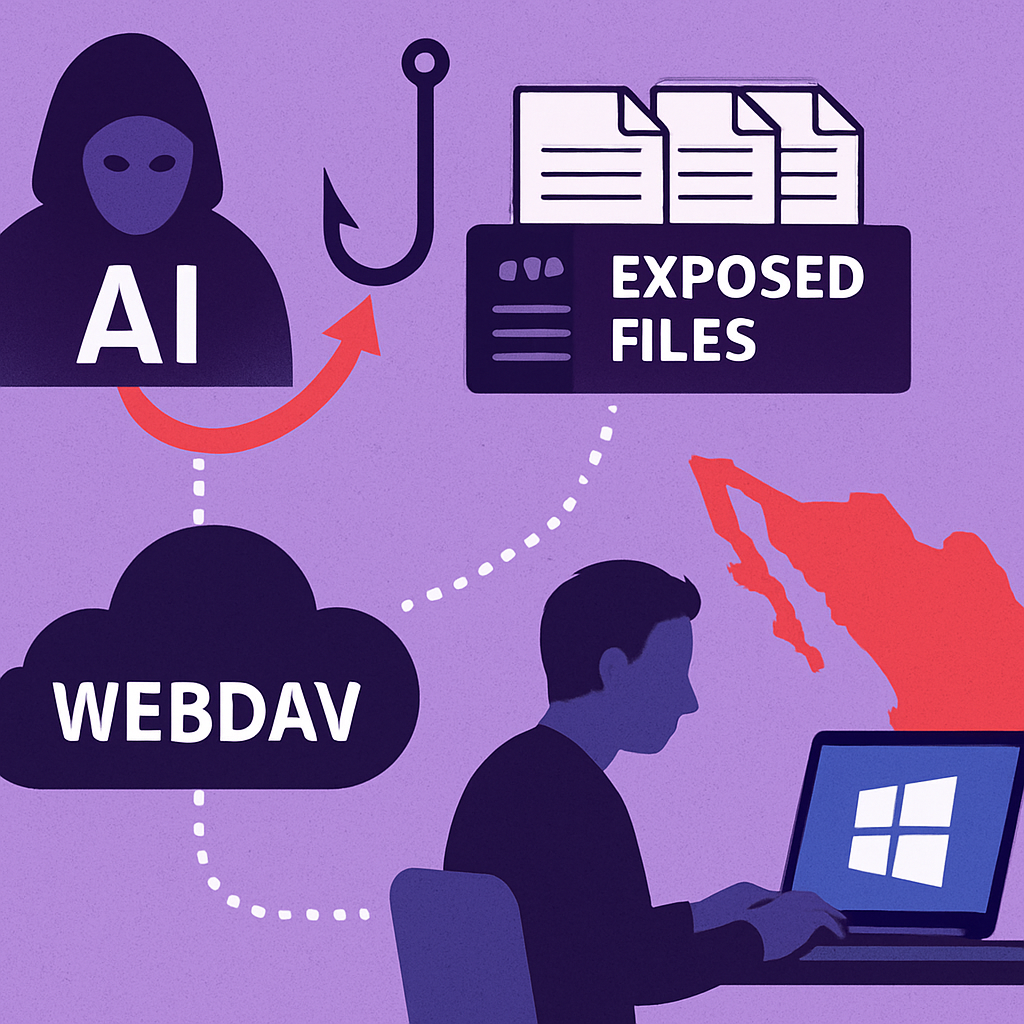
A recent security lapse has exposed a sophisticated phishing operation leveraging artificial intelligence (AI) to enhance its malware delivery mechanisms. Security researchers discovered an unsecured server containing over 1,000 files, including lure templates, filename-spoofing tests, execution experiments, droppers, and builder notes. This comprehensive toolkit provides a rare glimpse into the development and deployment of a live malware campaign targeting Windows users in Mexico.
The campaign employs a fake government ID-lookup website to distribute an infostealer via the Web Distributed Authoring and Versioning (WebDAV) protocol. Notably, the exposed materials reveal the operator’s use of generative AI tools to rapidly produce, test, and document phishing delivery methods. This integration of AI streamlines the creation of sophisticated attack vectors, enabling the operator to scale their efforts efficiently.
Exploitation of CVE-2025-33053
A significant focus of the operator’s testing was on CVE-2025-33053, a vulnerability with a CVSS score of 8.8, which has been added to the Cybersecurity and Infrastructure Security Agency’s Known Exploited Vulnerabilities catalog. This flaw involves a WebDAV working-directory hijack, previously documented in 2025. The technique exploits a `.url` shortcut to launch a legitimate, signed Windows binary while redirecting its working directory to an attacker-controlled WebDAV share. This redirection causes Windows to execute malicious code from the remote share instead of the intended system binary.
The operator’s documentation claims that this method executes without triggering security warnings such as SmartScreen or Mark-of-the-Web alerts, effectively bypassing user defenses. Although Microsoft addressed this vulnerability in June 2025, the operator’s continued testing suggests an effort to adapt the technique for newer Windows versions, including Windows 11 24H2, where certain components like Internet Explorer have been deprecated.
Comprehensive Testing and AI Integration
The uncovered files include a “comprehensive test kit” consisting of 59 `.url` files targeting various signed binaries, including .NET tools like `InstallUtil` and `RegAsm`, as well as other living-off-the-land binaries (LOLBAS). Each file is accompanied by a theoretical explanation of its potential effectiveness and a prioritized testing order. This systematic approach indicates a methodical effort to identify and exploit multiple vectors for malware delivery.
Documentation within the toolkit exhibits templated formatting, verbosity, and emoji-laden structures characteristic of outputs from large language models (LLMs). Additionally, the phishing site’s JavaScript code contains similar stylistic elements, suggesting the use of AI tools in its development. Russian comments and folder names, such as `testik` (a diminutive of “test”), point to a Russian-speaking operator but do not provide definitive attribution.
Further analysis indicates that the operator likely utilized an open-source AI coding agent named Coderrr, inspired by tools like Claude Code, GitHub Copilot CLI, and Cursor. This AI-assisted workflow enables the attacker to function akin to a modern software development team, rapidly iterating and deploying sophisticated phishing campaigns.
The exposure of this server underscores the evolving landscape of cyber threats, where attackers increasingly harness AI to enhance the efficiency and effectiveness of their operations. This development highlights the critical need for organizations to implement robust security measures, including timely patching of known vulnerabilities, to defend against such advanced threats.