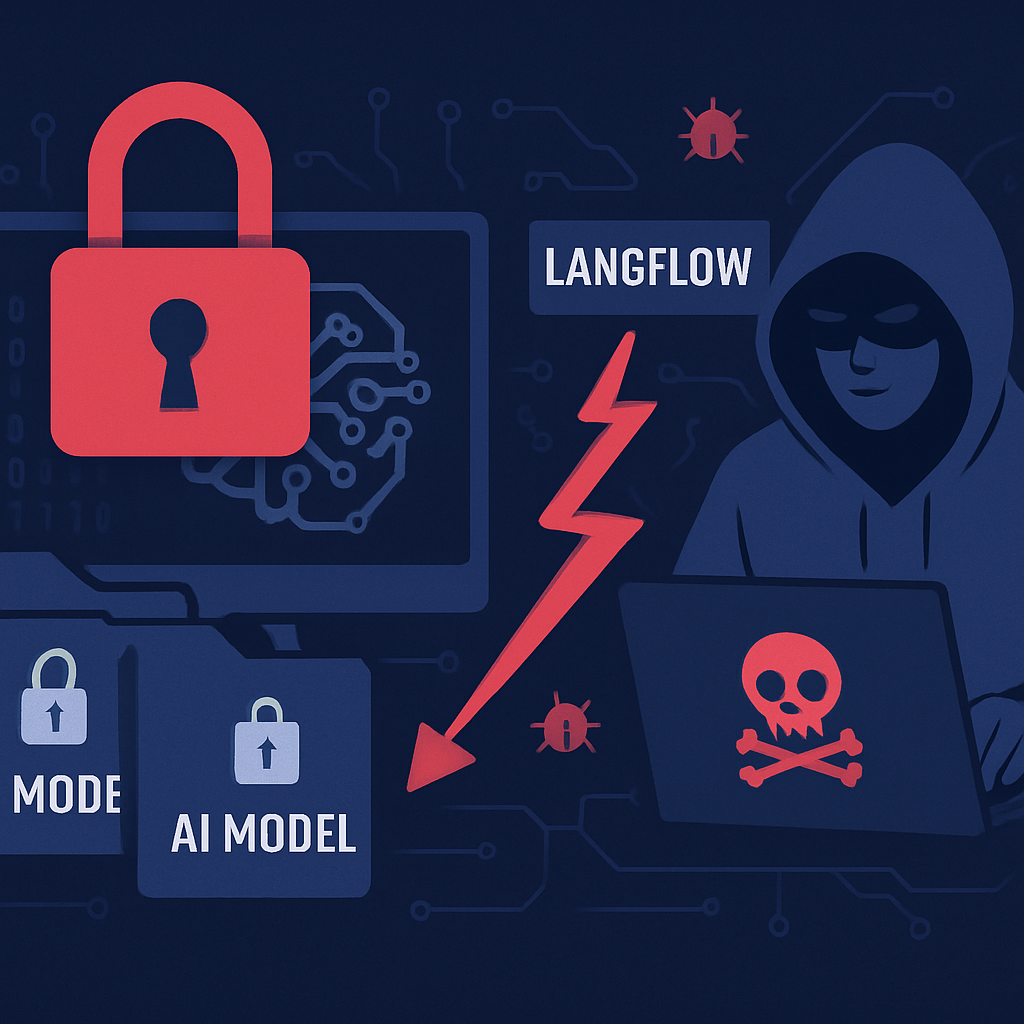
A recent cybersecurity incident has unveiled a sophisticated attack targeting artificial intelligence (AI) infrastructure. The threat actor, identified as JADEPUFFER, has deployed a new ransomware variant named ENCFORGE, specifically designed to encrypt critical AI assets.
The attack exploited a known vulnerability in Langflow, an open-source tool for building AI workflows. Versions prior to 1.3.0 of Langflow have an unauthenticated endpoint, /api/v1/validate/code, which allows remote execution of arbitrary Python code. This flaw, designated as CVE-2025-3248 with a CVSS score of 9.8, has been listed in the Cybersecurity and Infrastructure Security Agency’s (CISA) Known Exploited Vulnerabilities catalog since May 2025.
In this incident, the attackers leveraged the vulnerability to gain access to the Langflow server. Once inside, they deployed ENCFORGE, a Go-based ransomware engineered to target approximately 180 file extensions associated with AI and machine learning (ML) environments. These include model checkpoints, vector databases, training datasets, and embedding indices in formats such as PyTorch, TensorFlow, Hugging Face SafeTensors, ONNX, GGUF, GGML, FAISS, Parquet, Arrow, NumPy, and TensorFlow records.
The ENCFORGE ransomware employs AES-256-CTR encryption, with the symmetric key wrapped under an embedded RSA-2048 public key. It selectively encrypts portions of files to optimize speed, a technique reminiscent of methods used by ransomware families like LockBit and BlackCat. After encryption, files are appended with a .locked extension, and ransom notes titled README, HOW_TO_DECRYPT, and README_DECRYPT are dropped. Notably, the ransomware lacks data exfiltration capabilities, indicating that the primary leverage is the encrypted data itself.
The contact information provided in the ransom notes is [email protected], the same email address used in a previous campaign by the same threat actor. This consistency suggests a deliberate and targeted approach by JADEPUFFER to disrupt AI and ML operations.
This incident underscores the evolving threat landscape where cybercriminals are increasingly focusing on AI infrastructure. Organizations utilizing AI and ML tools must prioritize securing their environments by promptly applying patches, conducting regular security assessments, and implementing robust access controls. The targeted nature of ENCFORGE highlights the need for heightened vigilance and proactive defense strategies to protect critical AI assets from emerging ransomware threats.