Eka Robotics, founded by MIT’s Pulkit Agrawal and Tuomas Haarnoja (formerly of Google DeepMind), has secured a $150 million Series A funding round that brings its valuation to $1.45 billion. This leap is driven by its new physical AI model combining force detection and vision that has impressed experts across robotics. (Funding led by a16z and F-Prime.)
An AI Model That Can Really Feel
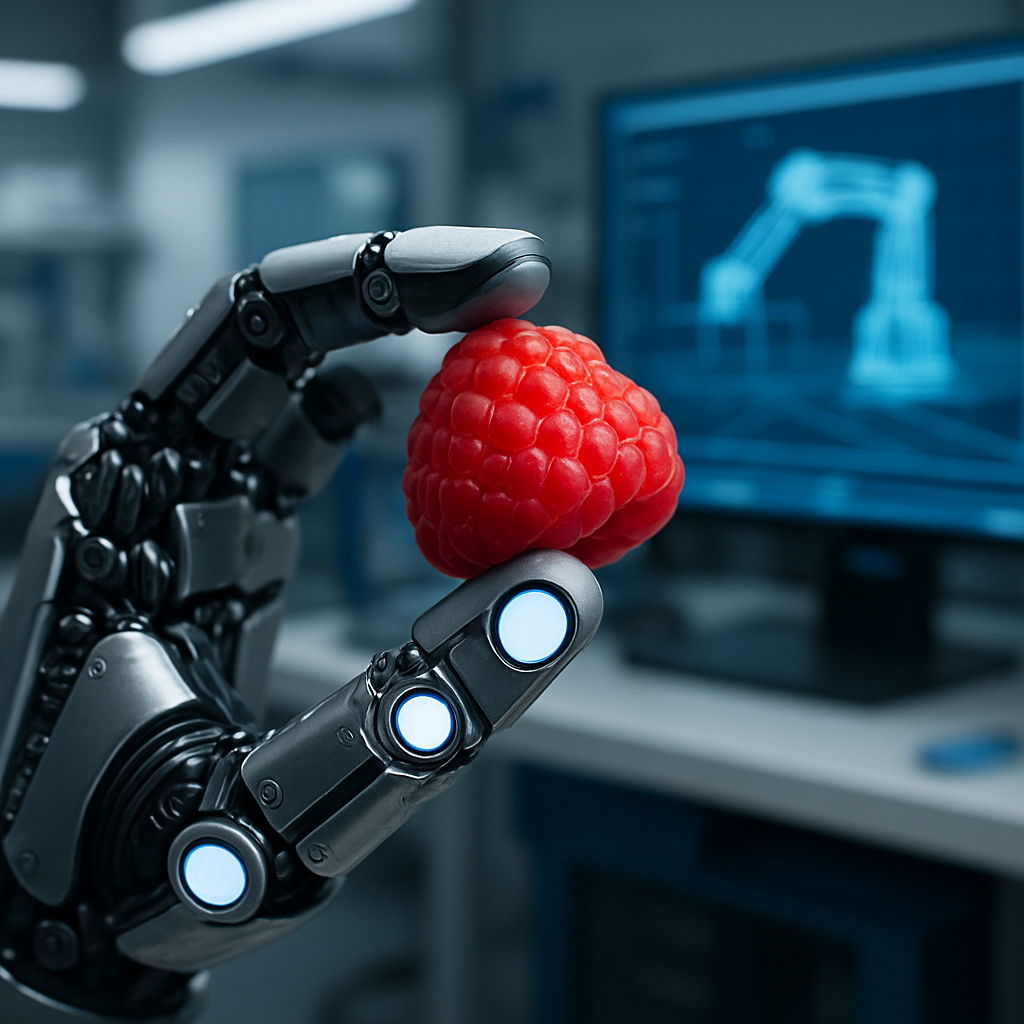
Traditional robot learning setups often emphasize vision-language-action models that interpret what something looks like, what it is, and then decide how to move. Eka takes a different route: its system is built around vision-force-action, meaning the robot not only sees and interprets but also senses pressure, touch, and force. That’s what enables gentle interaction with delicate objects—like avoiding squashing a raspberry—while behaving with speed and strength. Robot hands built by Eka have more force sensors, designed to feel contact and adapt accordingly. A physics simulator generates thousands of hours of experience quickly, and an RL environment helps the model exceed human performance in manipulation tasks.
Why It’s Turning Heads in Robotics
Veteran roboticists describe Eka’s demonstrations as having a “wow factor” because the robot adapts to many different objects without retraining. It repeats attempts if it fails, showing persistence and flexibility. In raw throughput, the robot picks up to 1,500 objects weighing up to 1 kilogram per hour, compared to about 600 by a human, with over 95% success in gripping operations. Observers noted how the robot was strong enough to damage itself when operating fast—an indication of confidence in its control and algorithms.
Still, challenges remain. Eka is working with industrial partners in discreet pilot projects—tasks like pick-and-place and wire manipulation—but transitioning from lab prototypes to production-grade assembly lines is a major hurdle. Durability, consistency across different tasks, and generalization beyond pick-and-place are open questions. Currently, Eka’s gripper costs under $1,000 and is rated for 5 million cycles; its goal is to reach 20 million, matching standard industrial arms.
Putting Simulation & Reinforcement Learning to Work
Eka’s founders leverage large-scale simulation with force modeling to generate diverse training data far faster than would be possible with real-world collection alone. Reinforcement learning allows the robot to exceed human demonstration-based performance. Rather than learning human behavior or copying sequences, the AI acquires control through trial and adaptation—enabled by simulated interactions that model real-world forces.
Where many robotics projects focus on high-level planning—often via large language or vision models—Eka is building from the bottom up, starting with the physicality of manipulation and dealing with uncertainty in touch and force first, then layering in the higher-level reasoning.
Valued now at $1.45 billion post-money, the startup is backed by a16z and F-Prime, who believe that in the coming months, Eka will hit “superhuman performance” on many manipulation tasks. But it needs to prove reliability: running onboard grippers for an entire year in production settings, handling a wider set of industrial tasks beyond pick-and-place, and maintaining consistent performance over millions of cycles.
Its gripper hardware, currently less than $1,000, already holds up to 5 million duty cycles. That said, reaching the industry benchmark of 20 million cycles is central to scaling for industrial adoption. Eka plans to make its mark first in wire handling and arranging workflows—areas where its force-sensitive AI appears already strongest.
Analytical angle: This development marks a notable shift in robotics toward integrating touch—not just vision—into foundational AI models. By blending force sensing with vision and using reinforcement learning in simulated environments, Eka could bridge the gap between lab what-if demos and real-world industrial automation. What to watch: whether its solutions handle long-term durability, adapt to varied tasks beyond pick-and-place, and can be deployed cost-effectively in real factory settings. If those boxes get checked, Eka may set a new standard for what physical AI can deliver.