A high-severity vulnerability in TeamViewer has been uncovered that could enable remote hosts to take control of support sessions and compromise technician machines. Designated CVE-2026-111585, this flaw allows a malicious remote system—once connected in a support session—to crash the viewer and potentially execute arbitrary code on the technician’s computer. Security scores place it at 8.8 on the CVSS scale.
How the Attack Unfolds
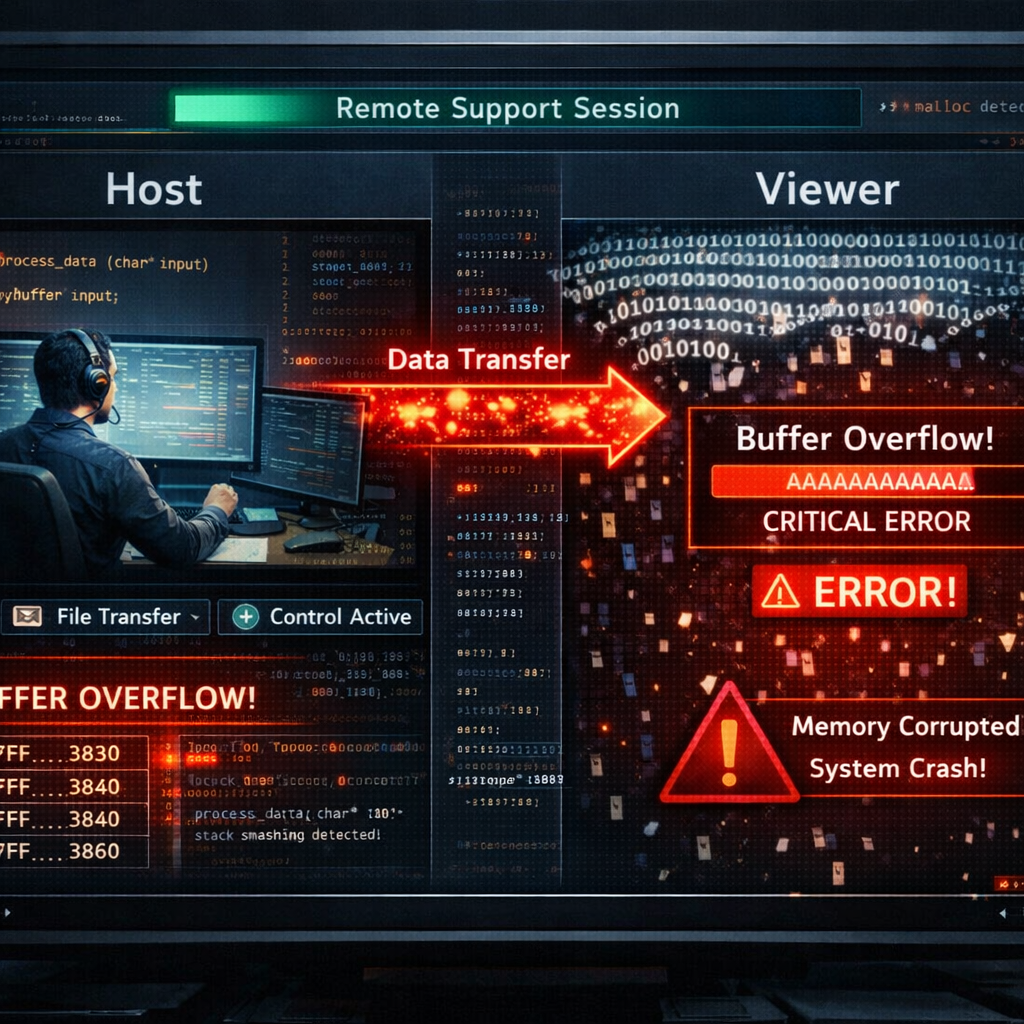
The exploit takes advantage of how TeamViewer splits a session between the host (who shares the screen) and the viewer (who displays it). A hostile host can send specially crafted screen data to the technician’s viewer using a message type called DisplayParams, which includes parameters like screen dimensions and color depth. If the host refuses modern video codecs like AV1 and H.264, the software falls back to bitmap updates, triggering the vulnerable path.
The core of the issue lies in 32-bit arithmetic used to calculate the on-screen buffer size. When oversized dimensions are supplied, the arithmetic overflows, causing a much smaller memory area to be allocated than needed. Although TeamViewer believes the buffer can hold the entire screen image, it’s too small—allowing incoming pixel data to overwrite adjacent memory. That leads to crashes and opens a route to arbitrary code execution.
Platform Impact, Fixes, and Mitigations
All platforms using the Full Client version of TeamViewer prior to 15.83 are affected—this includes Windows, Linux, macOS, Windows Portable, and Android Remote Control editions. While the vulnerability allows code execution, it depends heavily on the operating system and user privileges of the viewer process (it does not automatically grant full system or root access).
TeamViewer released a patch in version 15.83 on October 27 that resolves the issue. Users still running older versions should update immediately, and admins managing large or distributed deployments should ensure all instances—including portable and legacy installations—are patched.
According to the discoverers, there’s no evidence the bug has been exploited in the wild. The vulnerability was publicly disclosed on August 14. Still, support staff are urged to avoid remote support sessions with untrusted hosts until patched rather than relying solely on session approval steps.
While TeamViewer has patched CVE-2026-111585, the bug underscores critical risks in remote access tools. Even trusted workflows—like helpdesk sessions—can be weaponized if underlying protocols aren’t bullet-proof. Organizations need to check update policies, monitor remote access paths, and isolate support environments. Going forward, expect pressure on all remote tools to offer safer fallback modes and stricter memory handling to eliminate similar overflow-based exploits.