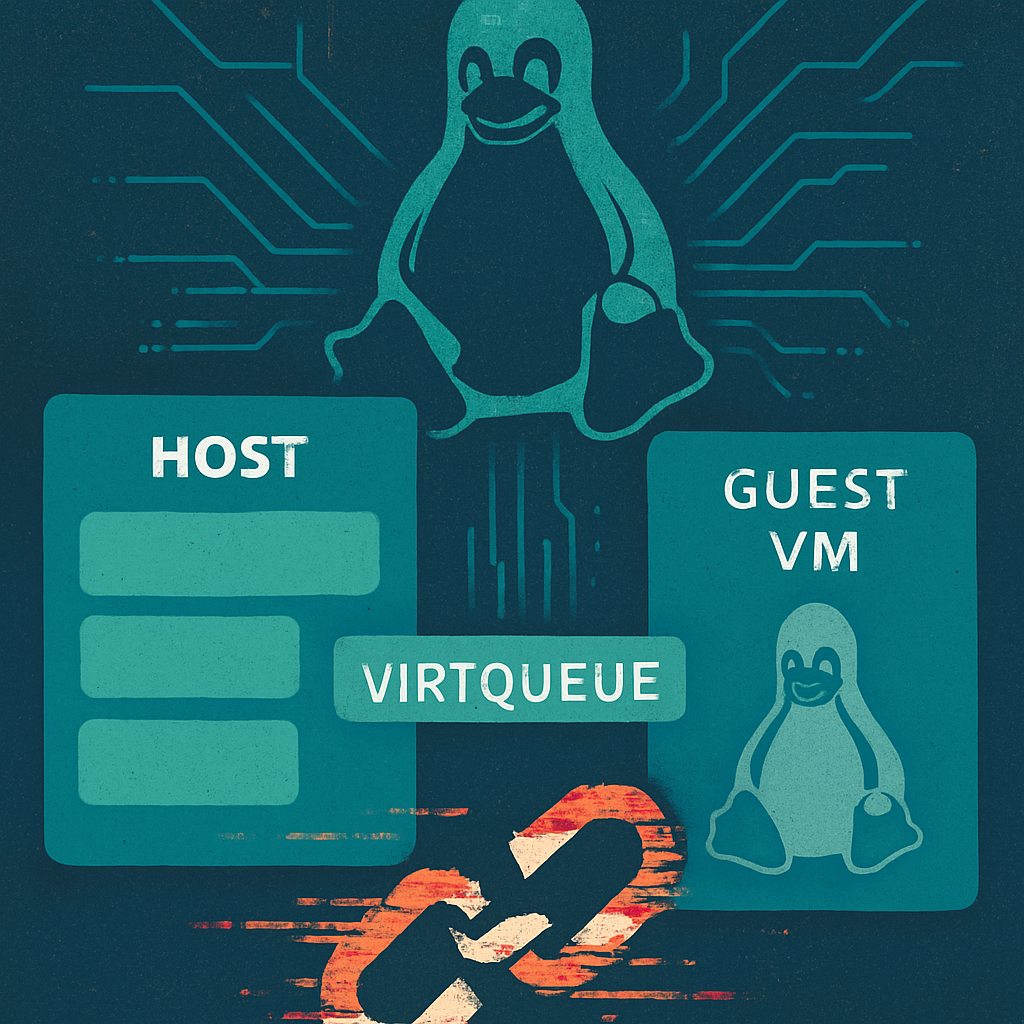
A newly published proof of concept (PoC) demonstrates a serious Linux kernel vulnerability in the vhost subsystem, now tracked as CVE-2026-74580. Dubbed “Vghost,” the flaw allows a local non-privileged user to gain full root privileges—or, in certain virtual machine configurations, break out from the guest to compromise the host.
What Went Wrong in vhost
Vhost accelerates guest-to-host device I/O performance for virtualization by using shared virtual queues called virtqueues. This defect stems from how vhost caches IOTLB (Input/Output Translation Lookaside Buffer) mappings, which are used to locate virtqueue memory structures, such as the descriptor, available, and used rings. When the virtqueue’s address or size is changed, the kernel updates the configuration but neglects to clear the old cached mappings. If the ring is later accessed, the stale mapping may skip proper checks and translate to invalid addresses, leading to a dangerous kernel pointer.
How the Exploit Works
Two main attack paths are detailed in the PoC. The first enables privilege escalation on the host: an attacker who can open devices like /dev/vhost-netor /dev/vhost-vsockprimes the metadata cache, then changes virtqueue settings without clearing stale entries. Triggering the queue allows arbitrary kernel memory reads and writes. In one example, attackers derive the kernel address randomization offset, alter modprobe_pathin the kernel, and eventually execute a helper program with root privileges.
This exploit was successfully reproduced on multiple Linux distributions, including Ubuntu 26.04, RHEL 9.8, Amazon Linux 2023, Azure Linux 3.0, and Oracle Linux 10.2. Access permissions vary: Ubuntu limits vhost devices to the “kvm” group, while others exposed them to all users. That makes group membership a key risk factor—but not an alternative to applying the patch.
VM Escape Risk in Certain Virtualization Setups
The second path targets hosts from within a guest VM. It requires support for virtual IOMMU (iommu_platform) and the virtio queue reset feature, VIRTIO_F_RING_RESET. Here, a guest resets and re-enables a virtqueue; since the host’s metadata cache retains stale mappings, the guest can craft a used-ring write that overflows past the guest’s allocated region into the QEMU process heap. The result can be a crash or even malicious control over the QEMU heap—constituting a VM escape, though only when specific features are enabled.
Fixes, Mitigations, and What to Do Now
The official patch fixes the issue by clearing vring metadata cache entries whenever virtqueue address or size changes—and enforcing IOTLB validation on the new configuration. Fixed kernels for multiple series have been released: 5.10.265; 5.15.216; 6.1.183; 6.6.152; 6.12.104; 6.18.45; 7.1.9; and 7.2. Administrators should deploy updated kernels or vendor backports and reboot into them.
Until systems are patched, various precautions are advised. Tighten permissions on vhost device nodes—including /dev/vhost-net, /dev/vhost-vsock, /dev/vhost-scsi, and the /dev/vhost-vdpa-*family—and avoid exposing these to untrusted users or containers. For virtualization hosts, don’t pass through vhost devices with iommu_platformunder virtual IOMMU settings. Be aware that revoking permissions doesn’t close already open file descriptors, nor does it stop guest-based exploit paths once permissions exist.
Security impact score and status:CVE-2026-74580 carries a CVSS v3.1 severity of 8.8—the high level reflects both the chance of root compromise and risk of VM escape in certain environments.
Administrators running Linux kernels in affected series should check version numbers, kernel changelogs, or vendor advisories for inclusion of the fix. Be especially cautious if using virtualization environments that rely on vhost, virtual IOMMU, and virtio reset features.
This vulnerability underscores the challenges of balancing performance and security in hypervisor I/O acceleration. Kernel caching mechanisms like IOTLB metadata can optimize speed—but unless carefully cleared and validated, they turn into dangerous liability. What to watch now are how vendors deploy backports, how cloud providers update hypervisor stacks, and whether attackers weaponize this PoC in the wild. Staying up to date is essential.