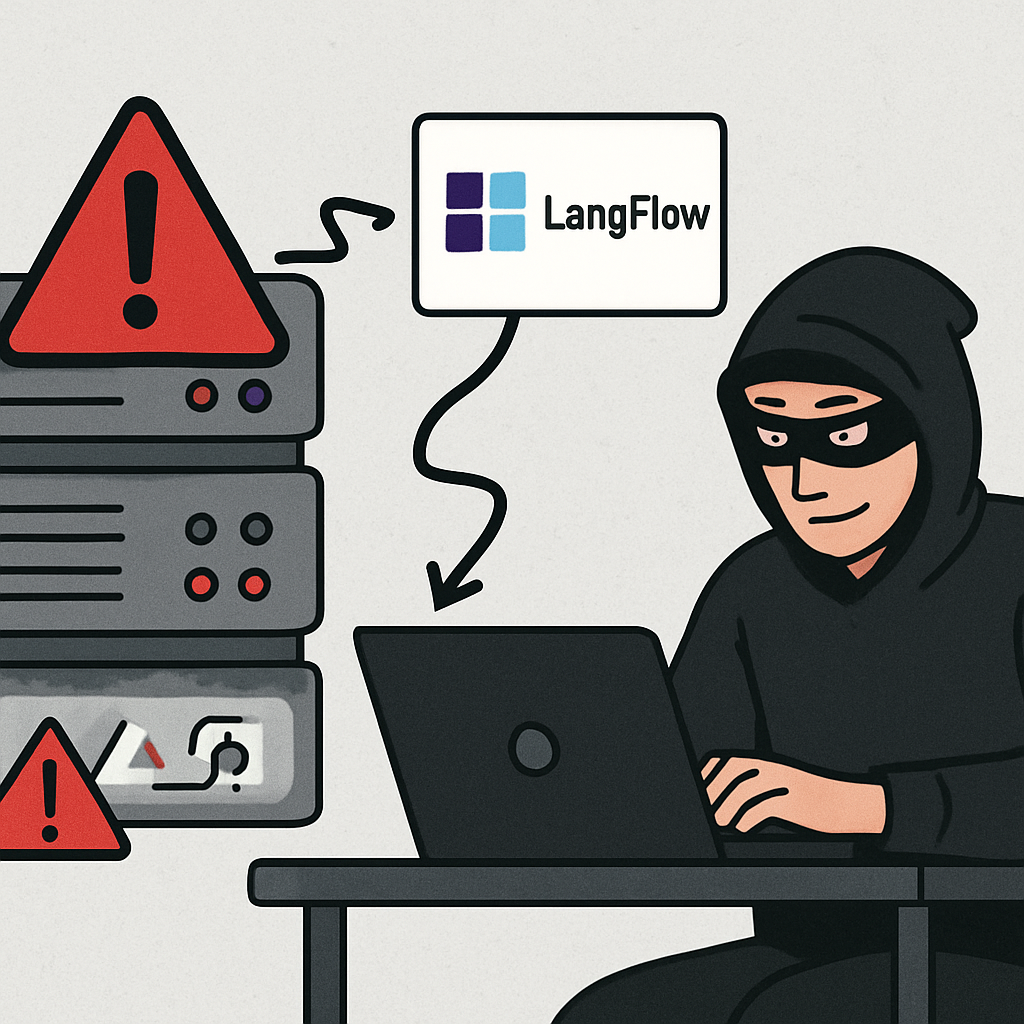
A critical security flaw in Langflow, identified as CVE-2026-5027, has been discovered, allowing attackers to execute malicious code on affected systems. This vulnerability arises from inadequate input validation in the application’s file upload functionality, permitting path-traversal attacks that can lead to arbitrary file writes.
The issue specifically affects the POST /api/v2/files endpoint, where the filename parameter from multipart form data is not properly sanitized. This oversight enables attackers to manipulate file paths using traversal sequences like ../, allowing them to write files to unintended locations on the server’s filesystem.
Langflow Vulnerability Exploit
In practical terms, this flaw can be exploited to overwrite critical files or deploy malicious payloads, potentially resulting in remote code execution. Security researchers have highlighted the vulnerability’s severity due to its low complexity and network-based attack vector.
According to Tenable’s advisory, the flaw has a CVSS v3 score of 8.8, indicating high severity. The attack requires minimal privileges and no user interaction, making it easier for threat actors to exploit in exposed environments. Threat intelligence and exploit tracking teams have started flagging the issue as a high-priority risk.
Discussions on LinkedIn indicate that attackers are actively exploiting the Langflow path traversal flaw to achieve remote code execution on exposed instances. These early exploitation signals suggest that opportunistic scanning and automated exploitation are likely to increase as proof-of-concept code spreads within the security and attacker communities.
The vulnerability was discovered and reported by researcher Joshua Martinelle. However, despite multiple disclosure attempts starting on January 20, 2026, the vendor did not respond within the expected timeframe. Follow-up communications were sent on January 27 and February 4, with a final notice issued on March 23 indicating that the advisory would be made public. The vulnerability was officially disclosed on March 27, 2026. At the time of disclosure, no official patch or fix had been released for the vulnerability.
This significantly increases the risk for organizations using Langflow, especially those that expose the application to the internet or integrate it into production environments. Security teams are advised to implement temporary mitigations such as restricting access to the vulnerable endpoint, applying strict input validation controls, and monitoring systems for suspicious file activity.
The lack of a vendor response also raises concerns about patch management and coordinated disclosure practices. While Tenable emphasizes its commitment to responsible disclosure and rapid response, this case highlights the risks associated with delayed remediation in widely used tools.
Given the nature of the vulnerability, attackers could potentially chain this flaw with other weaknesses to escalate privileges or establish persistence within compromised systems. Organizations should prioritize threat hunting and log analysis to detect any signs of exploitation attempts.
As Langflow is widely used for AI workflow orchestration, this vulnerability underscores the critical need for robust security measures in AI development tools. Organizations must remain vigilant, apply necessary patches promptly, and consider implementing additional security controls to safeguard their systems against such exploits.
Source: CyberSecurityNews.com