Critical Vulnerability in VS Code’s Remote-SSH Extension Enables Attackers to Infiltrate Cloud Servers
A recently uncovered vulnerability in Visual Studio Code’s (VS Code) Remote-SSH extension presents a significant security risk, allowing attackers to transition from compromised developer machines to cloud and production environments. Given the extension’s widespread use in modern development workflows, this flaw poses a substantial threat to organizations relying on remote infrastructure access.
Understanding the Vulnerability
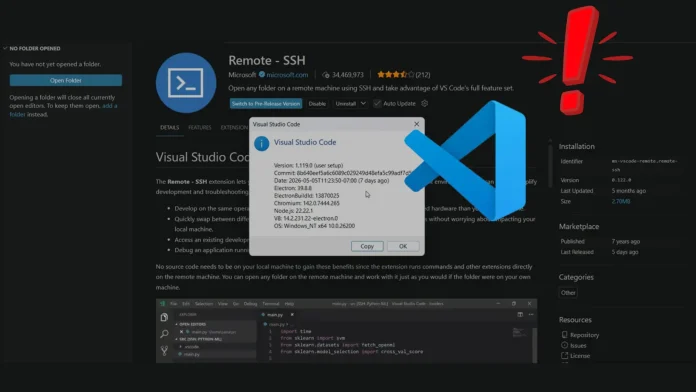
VS Code is a widely adopted development platform that facilitates seamless connections to AWS EC2 instances, Azure virtual machines, and on-premises servers through its Remote-SSH extension. This functionality effectively establishes a trusted link between local developer systems and sensitive remote infrastructures.
However, recent research has identified a critical flaw in how VS Code manages the initialization of Remote-SSH sessions. When a connection is initiated, the application generates a bootstrap shell script locally, storing it in a user-writable temporary directory. This script is then transferred and executed automatically on the target remote system.
The core issue lies in the absence of integrity validation, file locking, and signature verification during this process, leading to a Time-of-Check to Time-of-Use (TOCTOU) race condition. An attacker with access to a compromised developer machine can monitor the temporary directory, intercept the generated script, and inject malicious payloads before execution. Consequently, when the developer initiates a Remote-SSH session—even those protected by multi-factor authentication—the tampered script executes on the remote server, granting the attacker code execution capabilities.
Implications of the Flaw
This vulnerability represents a significant trust boundary violation, where a compromised local environment can directly influence execution within cloud or production infrastructure. In practical terms, this enables attackers to move laterally from a developer workstation into AWS, Azure, or internal servers without requiring additional exploits.
Proof-of-concept demonstrations have shown successful exploitation across various environments, including Azure virtual machines, AWS EC2 instances, and local servers. Notably, the attack does not bypass authentication mechanisms; instead, it executes after successful login, rendering multi-factor authentication ineffective against this technique.
The scale of exposure is considerable, with affected extensions collectively accounting for more than 76 million installations. These include Remote-SSH, Remote Explorer, AWS Toolkit, and Azure integrations. Other development platforms, such as Cursor IDE, may also be affected due to shared extension dependencies.
Microsoft’s Response and Mitigation Strategies
Microsoft has acknowledged the report but classified the behavior as consistent with the product’s design, leaving mitigation largely in the hands of users and organizations.
Security experts emphasize that this vulnerability is not a traditional pre-authentication flaw but a reliable post-compromise technique that aligns with modern attack chains. It underscores how trusted developer workflows can become conduits for cloud compromise.
To mitigate the risk associated with this vulnerability, organizations should consider implementing the following strategies:
1. Monitor Temporary Directories: Regularly monitor user-writable temporary directories for unauthorized changes or suspicious activity.
2. Implement Integrity Checks: Introduce integrity validation and signature verification for scripts generated during Remote-SSH session initialization.
3. Restrict Permissions: Limit write permissions to temporary directories used by VS Code to prevent unauthorized modifications.
4. Educate Developers: Raise awareness among developers about the potential risks associated with Remote-SSH sessions and encourage adherence to security best practices.
5. Regular Updates: Ensure that all development tools and extensions are kept up to date with the latest security patches and updates.
By proactively addressing these areas, organizations can enhance their security posture and reduce the likelihood of exploitation through this vulnerability.