Enhancing Phishing Defense: Strategies Every CISO Should Implement
Phishing attacks have become a predominant threat in the cybersecurity landscape, with statistics indicating that nine out of ten cyber incidents originate from such schemes. These attacks exploit human vulnerabilities, often leading to significant breaches when a single employee’s error compromises the entire organization. This scenario underscores the necessity for Chief Information Security Officers (CISOs) to implement robust defense layers that minimize reliance on human judgment alone.
The Evolving Nature of Phishing Threats
Modern phishing campaigns have evolved to employ sophisticated techniques designed to evade detection and create uncertainty among security teams. Attackers now utilize QR codes, redirects, CAPTCHAs, and AI-generated content to obscure their malicious intent. These methods complicate the identification of the attack’s objective, whether it be credential theft, infrastructure intrusion, or malware delivery. The ambiguity introduced by these tactics can lead to delays in threat assessment and response, increasing the risk of successful breaches.
Recent trends highlight the escalating danger posed by advanced phishing attacks:
– 20% of phishing campaigns now incorporate QR codes to conceal malicious links.
– Tycoon2FA attacks, which exploit two-factor authentication processes, have increased by 25% between Q1 and Q3 of 2025.
– According to Gartner, 62% of companies experienced a deepfake attack in 2025, demonstrating the growing sophistication of phishing tactics.
These developments indicate that phishing attacks are becoming more adaptive and evasive, making rapid and accurate investigation increasingly challenging.
Addressing Visibility Gaps in Phishing Defense
A critical issue in combating phishing attacks is the visibility gap within Security Operations Centers (SOCs). This gap arises when security analysts lack comprehensive insight into the full attack chain, leading to extended triage cycles, decreased confidence in decision-making, increased escalation volumes, and delayed responses during critical moments.
To bridge this gap, CISOs can implement the following strategies:
1. Restoring Full Attack Chain Visibility
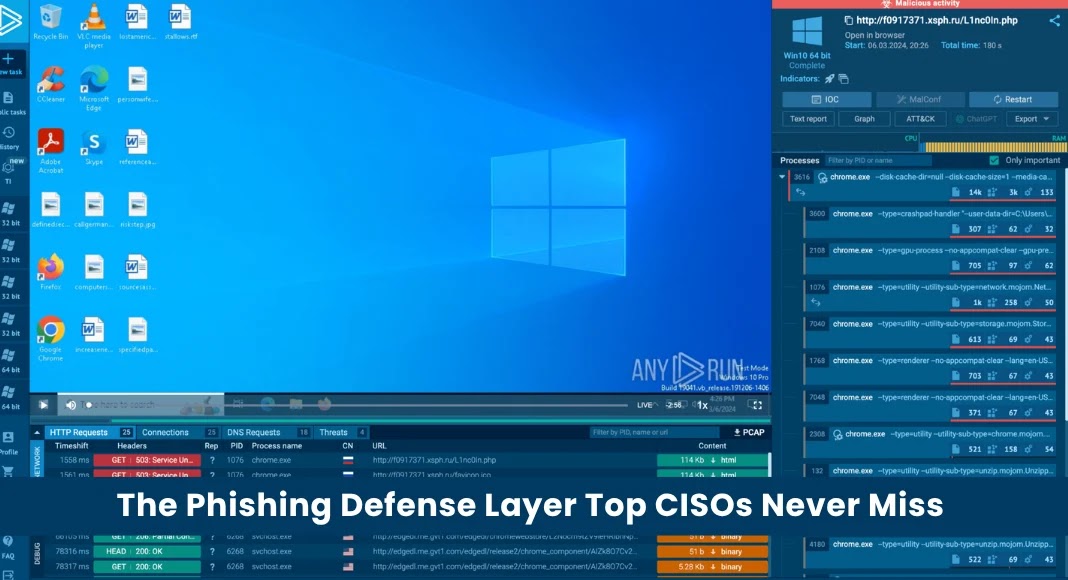
Gaining a complete understanding of the attack flow is essential for effective threat assessment. Interactive analysis tools, such as ANY.RUN’s Interactive Sandbox, provide a safe environment to observe and analyze the behavior of suspicious files and URLs in real-time. This approach allows analysts to:
– Analyze files and URLs to detect phishing attempts promptly, achieving an average Mean Time to Detect (MTTD) of 15 seconds.
– Inspect redirects and open attachments to observe threat behavior comprehensively.
– Uncover content hidden behind QR codes and CAPTCHA-protected flows.
By eliminating guesswork, analysts can validate threats and investigate suspicious behavior efficiently, obtaining all necessary context for further escalation.
2. Implementing Automated Interactivity
Automated interactivity functions can simulate analyst behavior, enhancing the efficiency of threat analysis. These functions can:
– Automatically interact with phishing pages.
– Scale the volume of analysis and reduce manual effort.
– Traverse redirect chains.
– Bypass CAPTCHA barriers.
– Reveal hidden stages without delay.
This capability enables teams to navigate through evasive phishing stages more rapidly, reaching the core malicious behavior sooner and allowing for quicker mitigation.
Additional Strategies to Strengthen Phishing Defenses
Beyond restoring visibility and implementing automated interactivity, CISOs should consider the following measures to fortify their organization’s defenses against phishing attacks:
1. Employee Education and Training
Regular training sessions can significantly reduce the risk of successful phishing attacks. Educating employees on recognizing phishing indicators, such as urgent language, generic greetings, and misspelled URLs, empowers them to act as the first line of defense. Simulation exercises provide practical experience in identifying and responding to phishing attempts.
2. Advanced Email Filtering
Deploying robust email filters can intercept potentially harmful emails before they reach users’ inboxes. Advanced filtering solutions analyze incoming messages for known phishing indicators and quarantine them automatically, reducing the likelihood of accidental clicks on malicious links.
3. Multi-Factor Authentication (MFA)
Implementing MFA adds an additional layer of security by requiring users to verify their identity through multiple methods. This approach significantly reduces the risk of unauthorized access, even if credentials are compromised.
4. Regular Software Updates and Patch Management
Keeping software, operating systems, and applications up-to-date addresses known vulnerabilities that cybercriminals may exploit. A structured patch management process ensures that security flaws are corrected promptly.
5. Network Segmentation
Dividing the network into controlled segments restricts user access to only the resources essential to their roles. This strategy limits the potential impact of a compromised system and makes it more challenging for attackers to move laterally within the network.
6. Email Authentication Protocols
Implementing protocols such as SPF (Sender Policy Framework), DKIM (DomainKeys Identified Mail), and DMARC (Domain-based Message Authentication, Reporting, and Conformance) helps verify the legitimacy of emails sent within the organization’s domain. These protocols prevent email spoofing and reduce the effectiveness of phishing attempts.
7. User Behavior Analytics
Monitoring user behavior can detect anomalies that may indicate compromised accounts. Behavioral analytics tools identify deviations from normal patterns, enabling early detection and response to potential threats.
8. Incident Response Planning
Developing and regularly updating an incident response plan ensures that the organization can respond swiftly and effectively to phishing attacks. A well-defined plan outlines roles, responsibilities, and procedures for mitigating the impact of an incident.
Conclusion
Phishing attacks continue to pose a significant threat to organizations, exploiting human vulnerabilities and evolving to bypass traditional security measures. By implementing comprehensive strategies that include restoring full attack chain visibility, leveraging automated interactivity, educating employees, deploying advanced email filtering, enforcing multi-factor authentication, maintaining regular software updates, segmenting networks, adopting email authentication protocols, analyzing user behavior, and planning for incidents, CISOs can significantly enhance their organization’s resilience against phishing threats. These proactive measures not only reduce the likelihood of successful attacks but also minimize the potential impact on the organization’s operations and reputation.