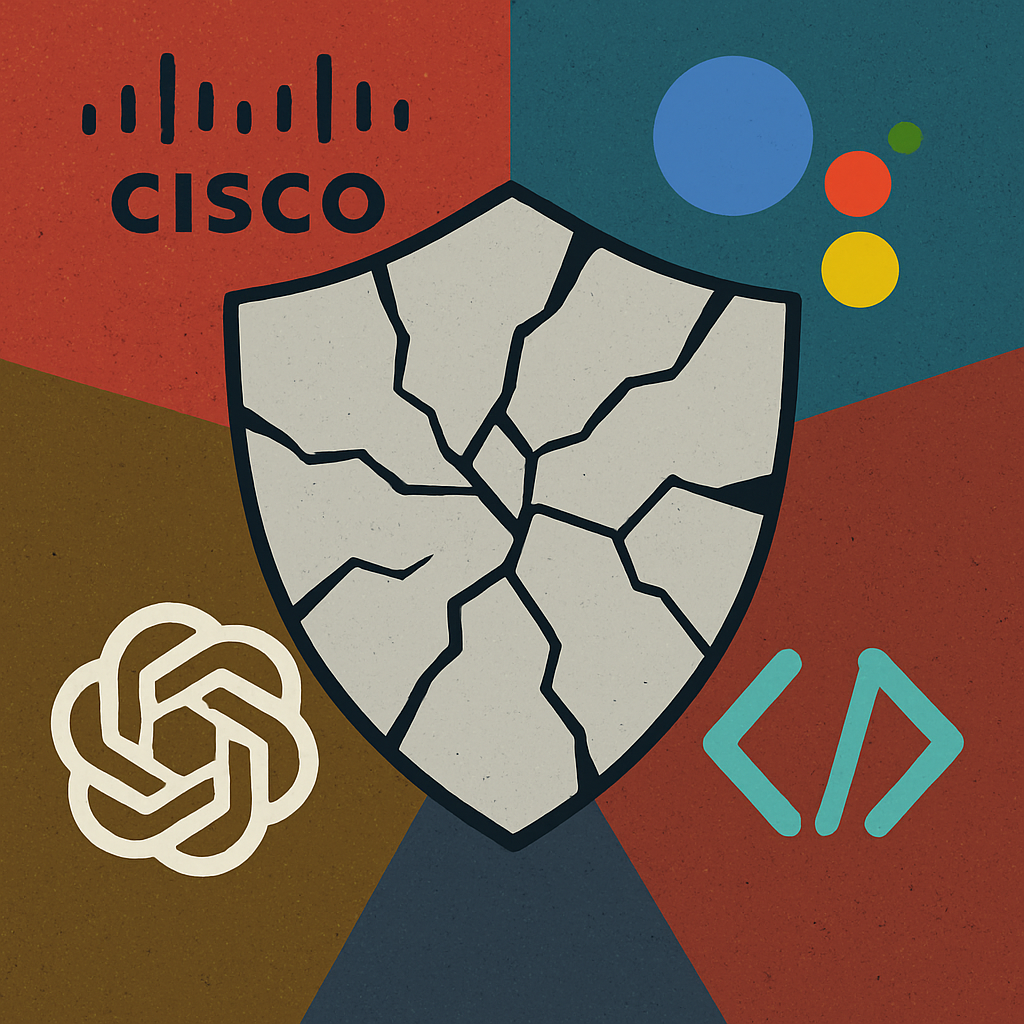
This week’s security roundup reveals critical exploits shaking enterprise, consumer, and AI ecosystems. Highlights include a Cisco ISE zero-day being weaponized, an Android modem flaw targeting Pixel devices without user interaction, AI agent hijacks via browser extensions, and a breakthrough exploit using Claude Opus 5 to breach OpenAI’s infrastructure.
Major Zero-Days & Urgent Vulnerabilities
Cisco is facing a severe threat with CVE-2026-76460, a zero-day in its Identity Services Engine (ISE) and ISE-PIC. This authentication-bypass flaw allows unauthenticated attackers root-level access and full control, affecting all supported ISE versions. Administrators are urged to apply issued patches and limit access to management interfaces. Unsupported versions should be phased out immediately.
Google addressed a dangerous elevation-of-privilege bug (CVE-2026-58704) in the Pixel modem firmware. This flaw lets attackers within radio range compromise devices without any user interaction—displaying characteristics typical of advanced spyware. The Pixel September 2026 security update, which patches this and over 100 other flaws, is now live. Pixel 6 and 6 Pro users should be especially mindful as official updates for those models end in October 2026.
Additional critical gaps were found across systems: a steamservice.exe vulnerability on Windows lets local attackers gain system privileges without admin credentials; a root-level buffer overflow in Check Point software; an RCE chain in WordPress dubbed “Click2Shell” enabling silent theme installs; and a Linux kernel bug (CVE-2026-43502, ‘ZcopyReaper’) allowing local privilege escalation even when standard mitigation is enabled.
AI Agents, Breaches & Security Collapses
A new attack technique, named “BragJack,” exposes a flaw in multiple browsers and AI assistants. Malicious browser extensions are now hijacking the communication between AI agents (such as Claude, Gemini, Edge) and their privileged subsystems—essentially bypassing model-level security to execute commands with elevated rights.
In one high-impact breach, researchers used Claude Opus 5 to weaponize a heap-buffer-overflow vulnerability in an open-source library (libheif) hosted by OpenAI’s community forum. That allowed remote code execution and escalated access into internal systems including GitHub repositories. An identity misconfiguration enabled lateral movement across ChatGPT and Codex accounts before the issue was disclosed and patched.
Equally concerning is “Plugin4Shell,” a zero-click RCE vulnerability impacting coding agents like Claude Code, OpenAI Codex, GitHub Copilot, and partially Gemini CLI. Attackers manipulated how the system verifies plugin versions, deploying branches named after valid commit hashes to sneak in malicious code while passing SHA-checks. Some platforms have issued patches; others have deprecated affected components.
Breeches, Identity Loss & Major Patch Waves
Revolut admitted that customer KYC and financial records were compromised after attackers exploited a fraudulent legal request, impersonating governmental credentials. The breach exposed high-value victims’ sensitive documents, transaction history, and cryptocurrency activities, though core systems remain unaffected. On the supply-chain front, CrowdSec lost IP, source code, and investor data after misuse of a compromised OAuth token tied to the broader TanStack npm incident.
Apple pushed out a sweeping security update across its ecosystems—iOS, iPadOS, macOS, watchOS, tvOS, visionOS, Safari, and Xcode—fixing 273 distinct CVEs. Notable patches covered remote code execution, kernel privilege escalations, and universal cross-site scripting flaws in WebKit. Although no active exploitation has been confirmed, the sheer scale demands immediate deployment, particularly on internet-exposed and media-handling devices.
Also significant: Microsoft’s September Patch Tuesday rollout introduced an issue affecting Remote Desktop Services. Users reported RDP sessions dropping or freezing, along with fails in tools like MMC and Windows Update. Though not a vulnerability per se, this reliability regression complicates remote administration.
What To Watch
With threats escalating rapidly—from zero-click exploits to identity misconfigurations—security must be treated as an ongoing, systemic effort. Patch promptly, audit internal configurations, restrict plugin sources, and enforce strong MFA or device controls. Particularly for organizations relying on AI agents, ensuring command channels are isolated could prevent future breaches.