The U.S. Cybersecurity and Infrastructure Security Agency (CISA) has recently expanded its Known Exploited Vulnerabilities (KEV) catalog by including three critical security flaws that are currently being actively exploited.
Details of the Newly Added Vulnerabilities
The vulnerabilities added to the KEV catalog are as follows:
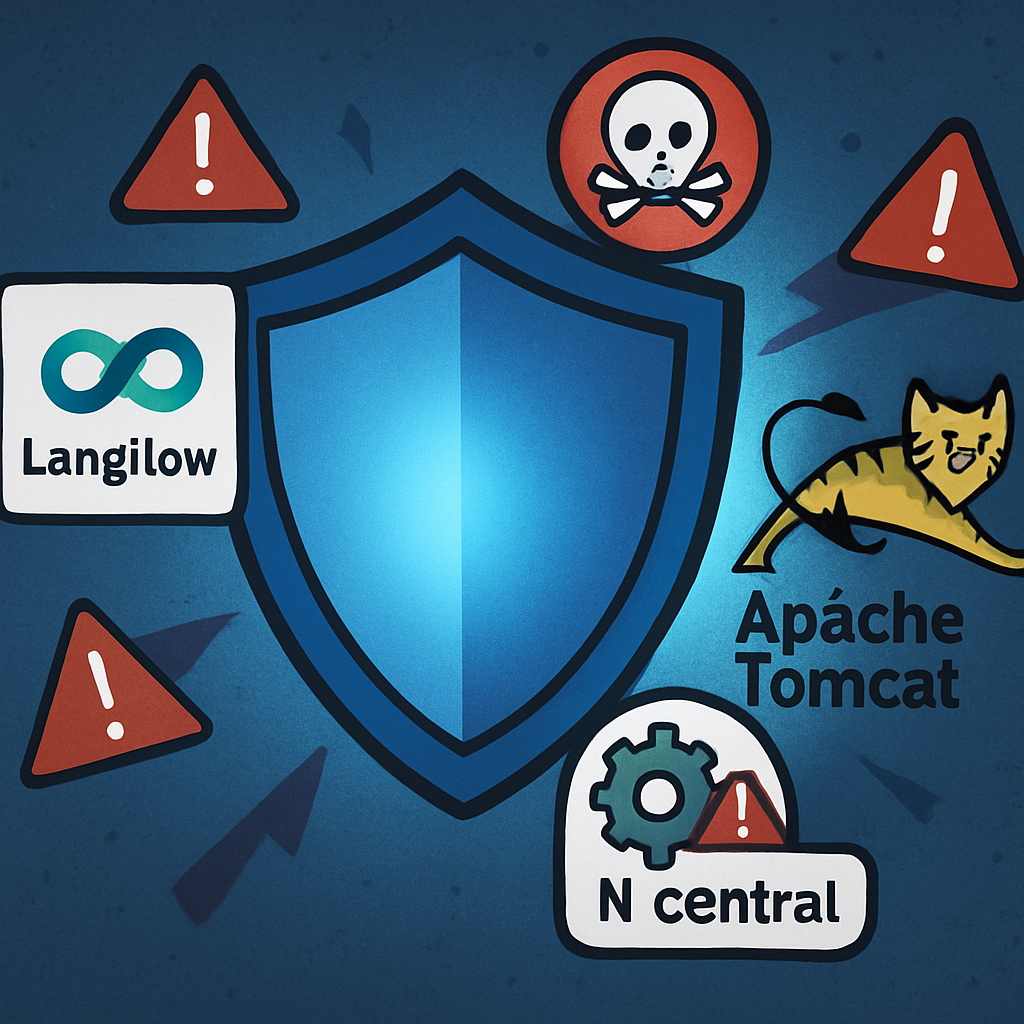
- CVE-2026-9198: This is a code injection vulnerability in Langflow, an open-source AI workflow orchestration platform. It allows unauthenticated attackers to execute arbitrary code remotely on default Langflow deployments. The issue has been addressed in version 1.10.1, released in July 2026.
- CVE-2026-34486: This flaw pertains to Apache Tomcat, a widely used open-source implementation of the Java Servlet, JavaServer Pages, and Java Expression Language technologies. The vulnerability involves the missing encryption of sensitive data, enabling attackers to bypass the EncryptInterceptor—a component responsible for adding pre-shared key encryption to messages exchanged between cluster nodes. The vulnerability has been patched in versions 11.0.21, 10.1.54, and 9.0.117, released in April 2026.
- CVE-2026-18556: This is an authentication bypass vulnerability in N-able N-central, a remote monitoring and management platform. An initial patch was found to be incomplete, leading to the issuance of a new fix tracked as CVE-2026-18577. Both vulnerabilities have been exploited by threat actors, prompting their inclusion in the KEV catalog.
Exploitation and Threat Actor Activity
While specific details on the exploitation of the Langflow vulnerability (CVE-2026-9198) remain scarce, there has been a notable trend of security flaws in Langflow being targeted by malicious actors in recent months. This underscores the importance of promptly applying patches to mitigate potential risks.
The exploitation of the Apache Tomcat vulnerability (CVE-2026-34486) has been linked to an AI-enabled autonomous hacking campaign orchestrated by a Chinese-speaking threat actor known by the aliases knaithe and KnYuan. Operating out of Zhuhai, China, this adversary has utilized DeepSeek, via the Hermes Agent framework, to target internet-exposed devices. Notably, when initial attempts to exploit a Langflow flaw (CVE-2026-33017) were unsuccessful due to restrictive configurations, the AI agent autonomously identified other high-value vulnerabilities, including those in n8n, to gain access.
Additionally, this threat actor has been observed conducting manual operations exploiting known vulnerabilities in various systems, including Citrix NetScaler (CVE-2026-3055), Marimo (CVE-2026-39987), Apache Tomcat (CVE-2026-34486), and IKE VPN (CVE-2026-33824) endpoints. Reports indicate that the actor attempted to exploit over 460 targets, employing a combination of autonomous and manual techniques. The autonomous process of target identification and narrowing of scope is particularly noteworthy, as it demonstrates the capability to perform extensive targeting analysis rapidly while managing computational resources efficiently.
Implications and Recommendations
The inclusion of these vulnerabilities in the KEV catalog highlights the evolving landscape of cyber threats, where adversaries are increasingly leveraging AI and automation to enhance the efficiency and scale of their attacks. Organizations must remain vigilant, ensuring that they promptly apply security patches and updates to mitigate the risks associated with these vulnerabilities. Federal Civilian Executive Branch (FCEB) agencies have been given a deadline of August 7, 2026, to implement the necessary fixes and protect their networks from active threats.
As cyber threats continue to evolve, it is imperative for organizations to adopt proactive security measures, including regular vulnerability assessments, timely patch management, and continuous monitoring of their systems. Staying informed about emerging threats and understanding the tactics employed by adversaries can significantly enhance an organization’s ability to defend against sophisticated attacks.