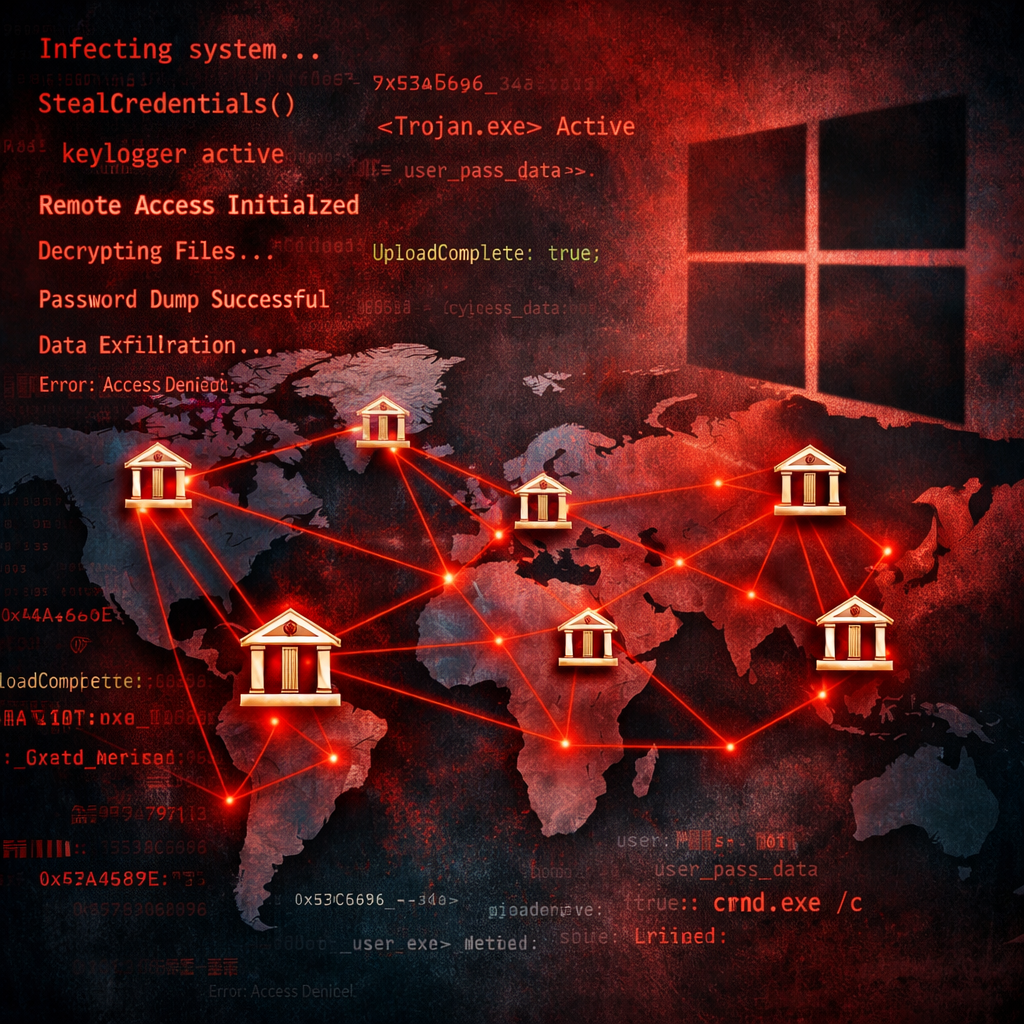
Chinese state-sponsored hacking groups are increasingly aiming at global banks not to steal money, but for intelligence about governments and trade. Cybersecurity specialists have logged attacks leveraging Microsoft 365 accounts and tools like ShadowPad, revealing a shift in the focus of state-linked cyber operations.
These operations were outlined in a report by Team Cymru published on November 17, 2026, which builds on findings from CrowdStrike’s 2026 Financial Services Threat Landscape. It shows that from January through June 2026, researchers identified 64 command-and-control servers associated with the ShadowPad backdoor and 115 servers linked to the remote access tool Vshell. These tools are being used by China-connected Advanced Persistent Threat (APT) groups with labels such as HOLLOW PANDA, GENESIS PANDA, MURKY PANDA, VAULT PANDA, and VERTIGO PANDA. Their targets span the Americas, the Middle East, and Southeast Asia.
Modus Operandi: Backdoors, VPNs, and Email Surveillance
One method used by these threat actors involves exploiting edge devices and VPNs. For example, HOLLOW PANDA has compromised Check Point VPNs in financial firms in South America and Southeast Asia, then deployed ShadowPad to gain persistent access. The malware’s modular design allows it to configure a range of malicious functions once inside the network.
GENESIS PANDA has targeted both a Southeast Asian bank and a North American fintech company, using Vshell for remote access and Fscan for network reconnaissance. Team Cymru uncovered evidence of Vshell-tagged servers hosting files named “fscan” and “vs,” linked to Fscan and Vshell respectively. Meanwhile, MURKY PANDA has established what’s known as an Operational Relay Box (ORB) network, routing traffic through compromised devices to mask access to Microsoft 365 mailboxes globally. Banks are among its primary targets.
Motivations, Shared Infrastructure, and What Banking Institutions Can Do
The goal of these operations is to gain visibility into trade flows, currency movements, foreign investment, debt and financial obligations associated with Belt and Road Initiative countries, and data about high-profile individuals via bank customer records. These insights offer leverage in diplomatic engagement and trade negotiations.
Attribution is difficult. Infrastructure like ShadowPad, Vshell, and ORB networks are shared by multiple China-linked groups, blurring lines between separate campaigns. Researchers use methods such as examining NetFlow data to monitor internal scanning and unusual communications, and spotting ShadowPad’s IIS listener module, which turns infected servers into relays.
To defend against these threats, financial institutions should rapidly patch VPN and perimeter devices, enforce strong multifactor authentication on Microsoft 365 accounts, and regularly review sign-in logs for abnormal access. Blocking known command-and-control servers, checking for open directories serving tools like Fscan and Vshell, and using threat intel platforms to track ORB networks are also key. A project named ORBITAL, launched in July 2026, aims to help disrupt ORB infrastructures used by these actors.
This intelligence-led targeting of banks marks a dangerous evolution in cyber operations: from theft to espionage on economic affairs. For banks and regulators, it’s a wake-up call. Watch for stricter security protocols, enhanced anomaly detection, and greater collaboration in threat intelligence over the next year.