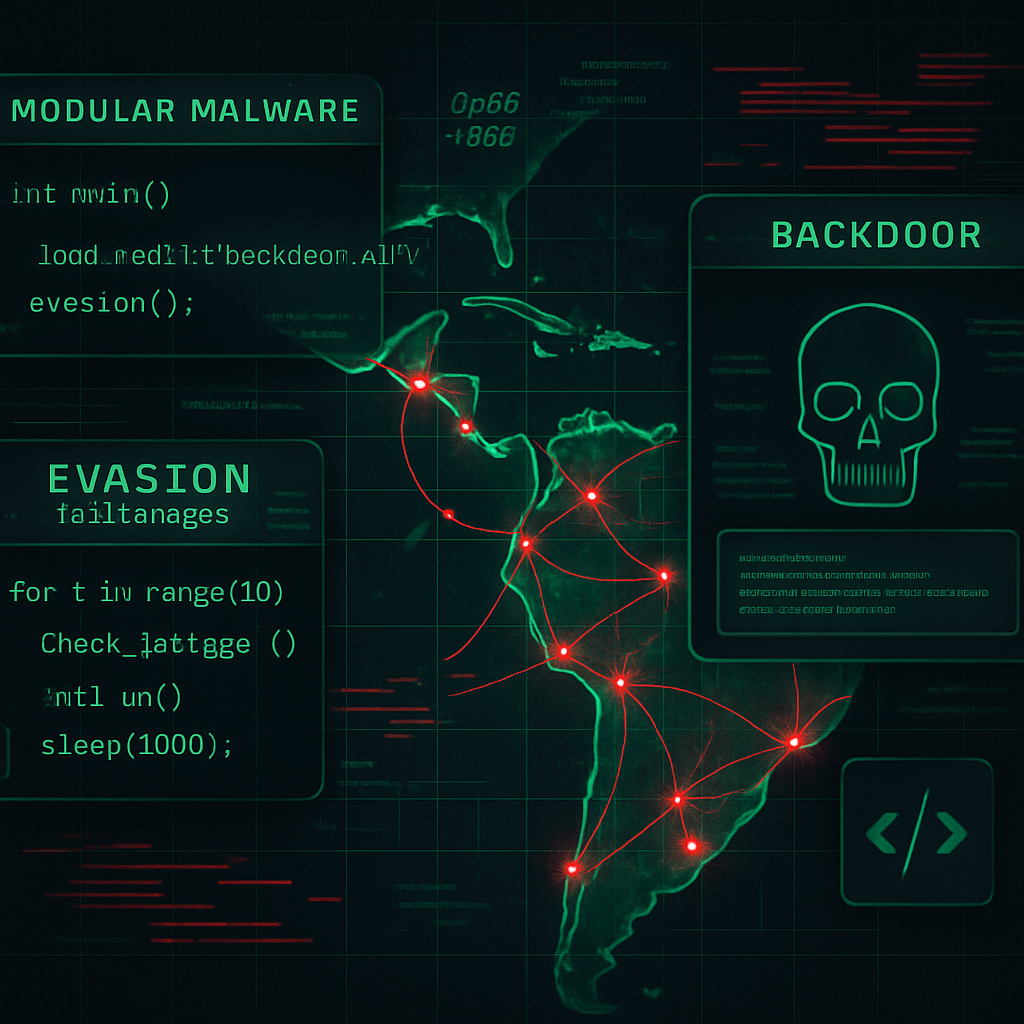
State-aligned cyber espionage group FamousSparrow, long suspected of operating with Chinese motives, has launched a previously unseen backdoor dubbed “SparroWocky” in Latin America. Security analysts traced its deployment as early as August 2025, targeting governments in economies ranging from Argentina to Venezuela. With this move, FamousSparrow appears to be replacing its older implant, SparrowDoor, with the more capable SparroWocky tool.
What SparroWocky Can Do
SparroWocky is built in C++ and includes modular architecture that supports operations such as executing arbitrary files, acting as a TCP proxy, and running shell commands. It gathers system data (including network interface IPs), captures files and screenshots, handles file operations, and provides a self-destruct mechanism. The backdoor’s makers adopted multiple open-source projects for stealth and communication: Mbed TLS for securing communication with its command-and-control server, MinHook to conceal thread launch addresses, a COFF loader for dynamic plugin loading, and StackMoonwalk (or a variant of SilentMoonwalk) to fake call stacks.
Modus Operandi & Targets
The infection chain hinges on DLL sideloading: a legitimate executable loads a loader DLL which decrypts and launches SparroWocky itself. Details on the initial compromise or delivery vector remain murky. Since July 2025, over 90% of this campaign’s known targets have been in Latin America. Governments in Argentina, Ecuador, Guatemala, Honduras, Panama, Peru, Puerto Rico, and Venezuela have been hit.
This campaign ties FamousSparrow to other known groups such as Earth Estries and Salt Typhoon, with similar footprints in malware techniques and infrastructure. FameousSparrow’s activity in espionage operations dates back to at least 2019, but SparroWocky marks a shift in its tooling and sophistication.
Despite the new backdoor, many tradecraft elements persist from SparrowDoor: evasion tactics, sideloading, dynamic payload deployment. It’s not yet clear whether the geographic focus on Latin America reflects organizational strategy or is situational. Analysts warn authorities there should be on guard for more aggressive, longer-term targeting.
SparroWocky also leverages encryption and evasion mechanisms more deeply than many typical state-sponsored tools. The use of legitimate executables to bootstrap malicious code, open-source tool integrations, and capacity to hide its operations signify a maturing phase in FamousSparrow’s campaign.
Why This Matters:The shift from SparrowDoor to SparroWocky indicates a leap in capabilities for this threat actor, with deeper commitments to evasion and modular malware design. For Latin American governments, this points to a growing cyber espionage threat with sustained risk. For international security, it underscores how nation-state aligned attackers continue to adapt more rapidly than much of the defensive ecosystem. Policymakers should watch whether this is a temporary surge or a long-term pivot, and security teams should reassess defenses around DLL loading, external library usage, and open-source project abuse.