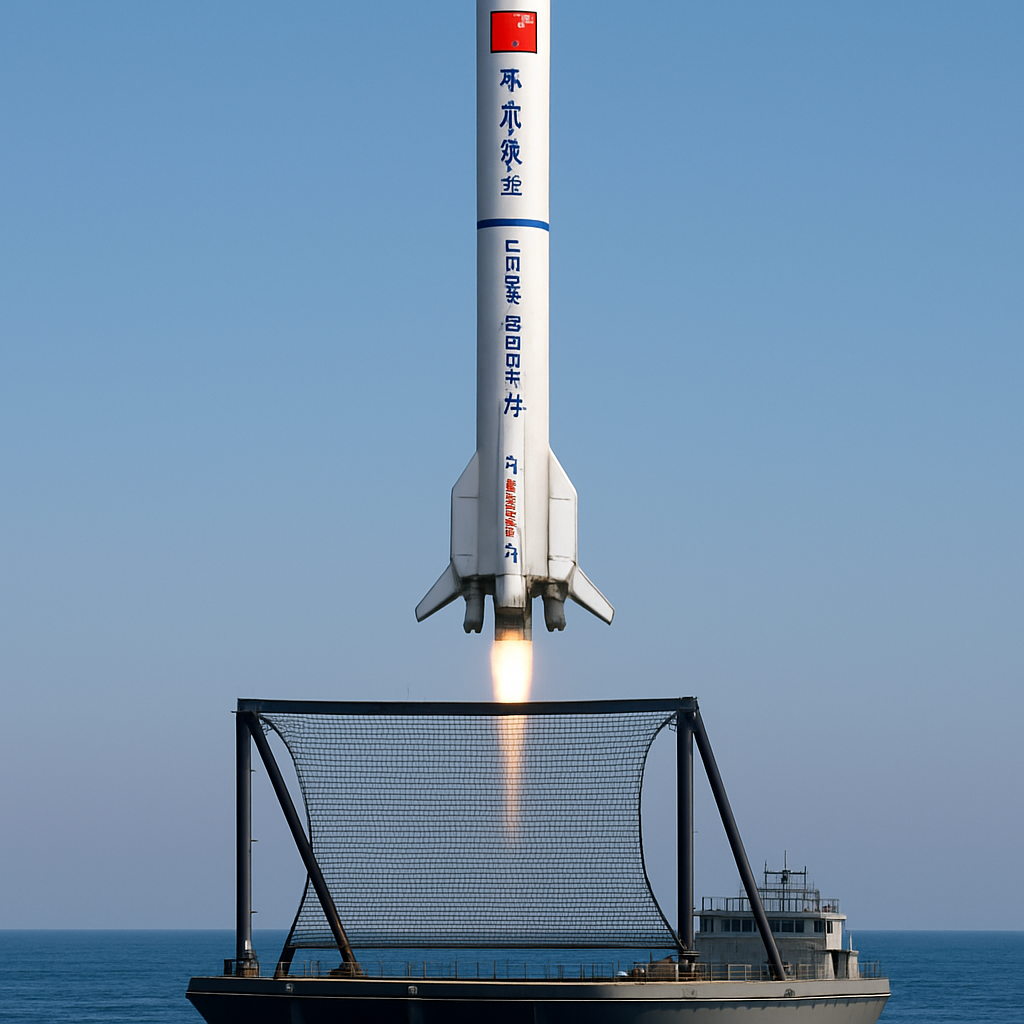
China has achieved a significant milestone in its space program by successfully launching and recovering the first stage of a Long March-10B rocket. This event marks China’s entry into the realm of reusable rocket technology, a domain previously dominated by the United States.
The Long March-10B, developed by the China Aerospace Science and Technology Corporation (CASC), was launched from Hainan Island. After completing its mission, the first stage booster executed a controlled descent and was recovered on a sea-based platform. This method of recovery mirrors techniques pioneered by U.S. companies like SpaceX and Blue Origin, which have been instrumental in reducing launch costs and increasing the frequency of space missions.
Unlike SpaceX’s Falcon 9, which utilizes landing legs to settle onto a floating platform, China’s approach involves capturing the descending rocket using netting strung across a large frame onboard a recovery ship. This method requires sophisticated guidance software and reliable engines capable of restarting and withstanding the descent through the atmosphere.
China’s foray into reusable rocketry is not limited to state-owned enterprises. Private companies are also making strides in this field. For instance, Beijing-based Space Pioneer recently completed a full-scale test of the first stage of its Tianlong-3 rocket from an offshore platform in Shandong province. This development is part of China’s broader strategy to build massive satellite internet constellations, addressing the shortage of rockets needed to launch these satellites.
To support these advancements, China has eased initial public offering (IPO) rules for firms developing reusable rockets. The Shanghai Stock Exchange announced that companies in this sector would have access to a fast lane for IPOs on the tech-heavy STAR market, exempting them from certain financial requirements. Instead, these firms are required to meet key technological milestones, such as a successful orbital launch using reusable rocket technology.
Furthermore, China has begun construction on its first “super plant” for reusable rockets capable of sea recovery. Located in Hangzhou, this facility aims to produce medium-to-large liquid-fueled rockets with high payload capacities and low costs. Once operational, the plant is expected to manufacture up to 25 rockets annually.
These developments signify China’s commitment to advancing its space capabilities and competing on a global scale. By investing in reusable rocket technology, China aims to reduce launch costs, increase the frequency of missions, and establish a robust commercial space industry. This progress not only enhances China’s position in the space race but also introduces new competition in the global market for satellite launches and space-based services.