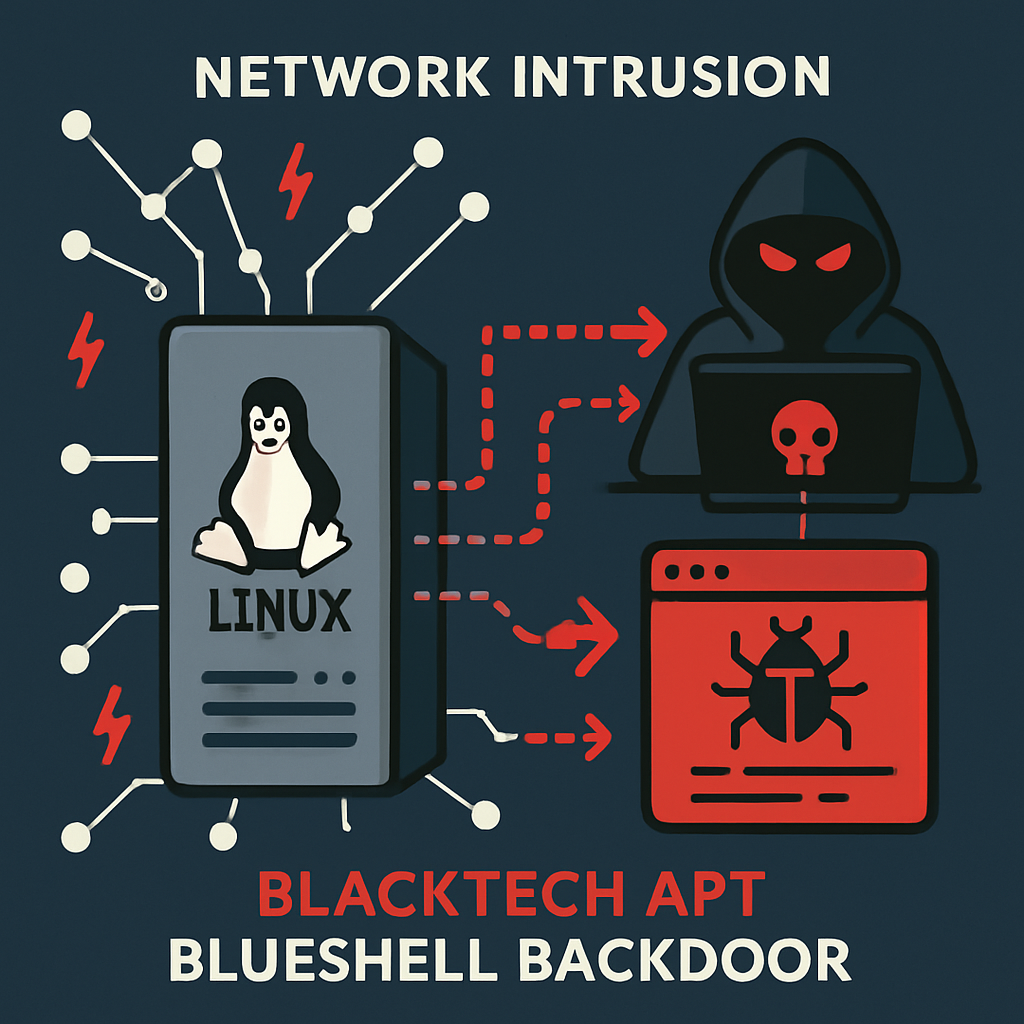
The advanced persistent threat (APT) group BlackTech has been identified deploying a Linux variant of the BlueShell backdoor against organizations in Japan, underscoring the group’s evolving cyberespionage tactics. This malware enables attackers to execute commands, transfer files, and route network traffic within compromised systems, significantly elevating the risk to internal infrastructures and sensitive data.
The attack sequence initiates with BlackTech gaining initial access to the target environment, followed by lateral movement through Secure Shell (SSH) protocols. Subsequently, the attackers deploy a loader designed to activate the BlueShell backdoor. This method aligns with BlackTech’s established pattern of seeking stealthy network access, as evidenced by previous intrusions targeting corporate routers.
Security analysts have observed multiple variants of this Linux-based BlueShell backdoor. Notably, these versions incorporate enhanced features aimed at complicating detection and analysis efforts. The malware is written in Go and originates from an openly available remote-access tool, but the modifications introduced by BlackTech demonstrate a deliberate effort to evade defensive measures.
Technical Analysis of BlueShell Deployment
Upon execution, the loader decodes embedded data, decompresses the backdoor, and initiates it with altered process information to mimic legitimate Linux kernel workers. To minimize forensic traces, the loader subsequently deletes the backdoor from the file system, complicating incident response efforts. This tactic necessitates rapid system preservation and may require advanced forensic techniques, such as memory analysis, to uncover the malware’s presence.
Once operational, BlueShell retrieves its configuration from environment variables and verifies its execution on the intended host. The backdoor’s capabilities include gathering system information, executing remote commands, facilitating file transfers, initiating shell sessions, and establishing a SOCKS5 proxy. The latter function is particularly concerning, as it allows attackers to pivot within the network, potentially accessing additional resources undetected.
Proxy-Based Command-and-Control Evasion
A significant evolution in this BlueShell variant is its ability to communicate with command-and-control (C2) servers through the victim organization’s internal proxy servers. This approach, absent in versions prior to 2023, has been increasingly adopted in samples identified from 2024 onward. By routing malicious traffic through trusted internal proxies, the malware effectively camouflages its communications, making detection more challenging.
Additionally, the backdoor performs checks on the C2 server’s digital certificate before establishing a connection, adding a layer of control over its communications. The use of obfuscated command names further complicates analysis, although researchers have been able to deduce their functions through examination of the Go binary.
Organizations are advised to monitor for unusual SSH activity, unexpected proxy usage, and anomalous encrypted sessions. Maintaining comprehensive logs of endpoint activities, authentication events, and proxy usage is crucial for reconstructing attacker movements and mitigating potential breaches.
The deployment of the BlueShell backdoor by BlackTech highlights the group’s ongoing adaptation of tools and techniques to evade detection and maintain persistent access within targeted networks. This development underscores the necessity for organizations to implement robust monitoring and incident response strategies to counter sophisticated cyber threats.