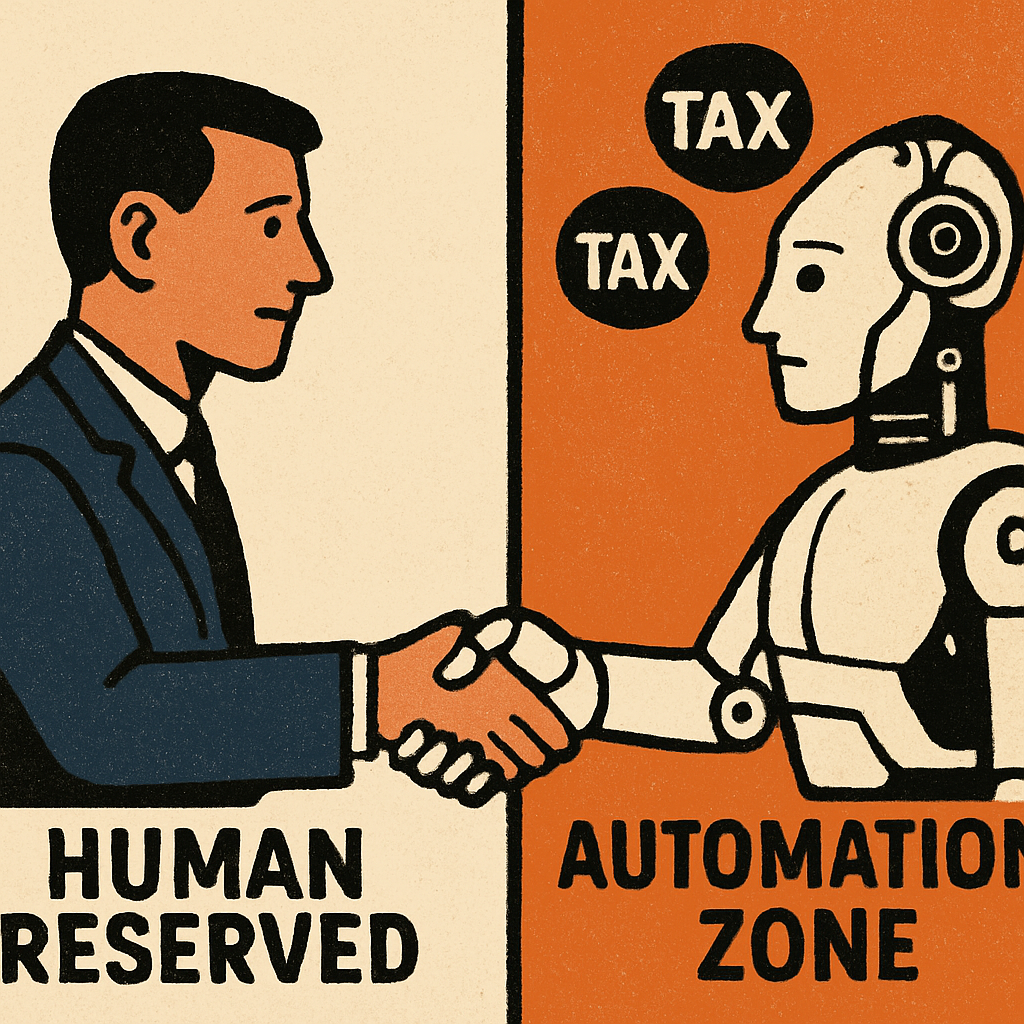
Bill Gates has laid out ambitious policy proposals aimed at countering sweeping workforce disruption from artificial intelligence. In a lengthy essay today, he suggests governments introduce a “robot tax” and designate certain occupations as “Human Reserved” — tasks reserved for humans even when AI could technically perform them. These ideas blend toward finding balance between innovation and protection for workers in the rapidly evolving AI economy.
What Gates Means by a Robot Tax and Human Reserved Jobs
The robot tax would change tax incentives that currently favor automation over human labor. Gates points out that employers pay payroll taxes when hiring people, which supports social safety nets and public revenue. But when they invest in machinery or automation — robots and AI systems — those are often fully expensed. That tax structure nudges businesses toward replacing human labor with machines. The proposed tax would slow that shift and raise funds for retraining displaced workers and bolstering safety nets. It should be designed to avoid dampening beneficial uses of AI in areas like medicine and education. (Ideas drawn from Gates’s recent essay.)
“Human Reserved” jobs are a second pillar in his vision. These are roles society decides should always involve humans, no matter how capable machines become. Examples might include caregiving, education, mental health, or giving sensitive medical diagnoses. Gates underscores both the emotional and ethical importance of human contact in such roles, and the societal harm in expecting older, specialized workers to abruptly shift industries. He argues some jobs need to be set aside now, with gradual implementation over years or decades.
Why These Ideas, and What They Signal
Gates believes this moment marks a different kind of technological transition. Rather than spanning generations, AI can replicate human cognition — seeing, speaking, reasoning — and is already moving into blue-collar work like construction, hospitality, and tasks long deemed safe from automation. Without structural changes, job loss and economic inequality could intensify sharply. Governments may see falling payroll tax revenue while demands for support and retraining soar.
In his essay, Gates also raises concerns about gaps in preparedness — noting that institutions and regulatory frameworks are not yet equipped to handle AI’s broad impacts on national security, education, public health, labor markets, and taxation. He urges policymakers to develop both domestic and international systems capable of overseeing AI across many domains.
Challenges and Open Questions
Implementing a robot tax or defining what constitutes a Human Reserved job brings thorny questions. Who decides which jobs are reserved? How are definitions enforced? How do such policies account for differences across countries? There’s risk of businesses attempting to skirt rules, and of policies lagging behind technologies. Moreover, critics warn that robot taxes could discourage investment, reduce growth, or lead to protectionist backlash.
Gates anticipates these concerns, saying inefficiencies are acceptable if they preserve dignity, employment, and social equity. He acknowledges this won’t solve every problem — but positions both ideas as parts of a broader “wise response” to seismic workforce changes.
He also emphasizes urgency: preparing retraining, adapting tax codes, setting up regulatory readiness — all should begin now, not after displacement has already hit.
What This Means and What to Watch
These proposals reflect a turning point in public discourse around AI. For decades, automation was welcomed as inevitable progress; now, high-profile tech leaders like Gates are calling for norms and guardrails. Policy experiments around robot taxes or “human-only” job protections may become test cases for how societies adapt to AI’s accelerating grip. Over the next year, watch for legislative proposals, academic studies quantifying the revenue effects of automation, and pilot programs in sectors like caregiving or education claiming “human-reserved” status. How political leaders respond — whether they see efficiency or equity as the priority — could shape the next era of work.