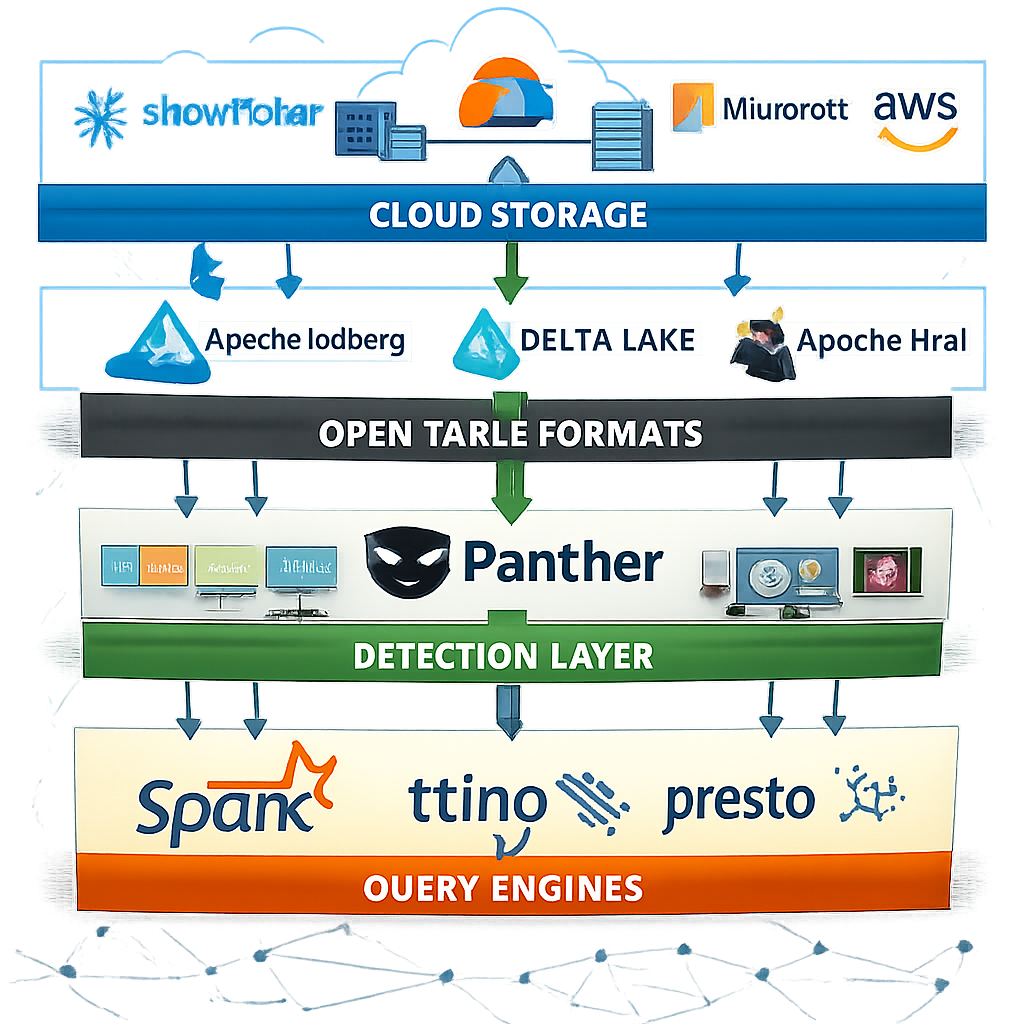
Security data lakes are reshaping how organizations collect, store, and analyze telemetry. Moving away from expensive SIEM storage, modern architectures leverage open formats and cheap object storage, while layering detection engines and query tools on top. In 2026, platforms compete across economics, architectural openness (think Iceberg, Delta, OCSF), detection capability, and ecosystem strength. Here’s how ten top contenders stack up.
The Top Platforms and What Makes Them Stand Out
Snowflake takes first place, offering strong separation of storage and compute, support for open table formats, and an ecosystem where security apps like Panther and Anvilogic run directly over your data. It delivers access via SQL and makes threat intelligence part of the platform experience. Biggest challenge: managing compute costs.
Google SecOps earns the second spot, offering packaged solutions that combine long hot-data retention with fast search and built-in retroactive hunting via acquired threat intel. Its model gives retention and performance “out of the box,” though it skews less open architecturally than build-your-own lake setups.
Microsoft’s Sentinel Data Lake / Azure Data Explorer (ADX) is third, offering a trajectory for organizations already in the Microsoft ecosystem. It provides lake-tier storage under the same query language (KQL) surface, with Azure Data Explorer giving power users control over custom modeling. Drawbacks include maturing pricing tiers and governance complexity.
Databricks earns praise for its lakehouse model, where open-format Delta tables, notebooks, and ML pipelines empower teams doing analytics, UEBA, fraud-graph detection, and ML workflows. Best fit: organizations with strong data-engineering skills. Quicker wins are harder to come by for those without them.
Amazon Security Lake is the pick for AWS-heavy environments. It normalizes telemetry into OCSF and stores data on S3 you control, allowing external engines for analytics and detection. It’s the “standards purist” path—clean architecture, but analytics are mostly on you.
Panther brings “detection-as-code” to large-scale lakes. Python-based rules over lake storage allow rigorous engineering practices and cost structures that beat ingest-priced SIEMs. But detection-as-code demands that you have, or build, engineering discipline.
Anvilogic shines when dealing with hybrid or multi-lake realities. It offers a unified detection layer across various backends (Snowflake, Databricks, Splunk), with AI-assisted rule building and a content library aligned to attacker techniques. There’s overhead in managing yet another layer in your stack.
Cribl isn’t a lake by itself but plays a critical role in migrating toward one. It filters, enriches, and routes telemetry—saving costs by keeping rarely used data cold and preserving full fidelity elsewhere. Detection lives outside, but it’s pragmatism in high-volume logging scenarios.
Elastic offers an integrated stack: snapshots on object storage, full search and detection rules built in. An open-core snapshot layer gives near lake economics without having to stitch together many vendors. But running and maintaining detection workflows is still on the user.
Hydrolix competes aggressively on cost per queryable terabyte. Using compression and hot‐queryable storage without needing to rehydrate data, it targets users drowning in volume who still need responsiveness. Ecosystem and content layer remain thin compared to leaders.
Choosing a Lake: What Matters and What Costs
The heart of a good security data lake setup is custody and anti-lock-in. Two levers matter most: open table formats (so your storage can be queried by any engine without migratory headaches) and OCSF normalization (for portable detections and tool compatibility). Build with exportability in mind—especially rules and schemas.
Cost comparisons must go beyond raw storage. Query compute, detection engine costs, retention behavior—especially where you search historic data—can dominate the bill. Real tests like replaying a 180-day incident to see where queries struggle or cost spikes are often more revealing than vendor claims or short trials.
If an organization lacks robust data engineering teams, the bundled paths—platforms that provide built-in retention, search, detection—will often hit the best balance. For those with strong in-house expertise, owning the tables, composing your detection layer, and picking tools gives more control and long-term savings.
Analytics Angle: The shift toward security data lakes in 2026 is no trend—it’s becoming the architecture of record for telemetry at scale. It’s not just cheaper storage: it’s about control, flexibility, and vendor neutrality. The winners now are those who can deliver both turnkey experiences and open rails—and the next phase will reward those who show that historic data still yields fast, precise detection without exploding costs. As you evaluate platforms, test operations at your scale—capture, search, detection—and make nothing proprietary unless it’s earned.