Automated Bots Overtake Human Activity in Global Web Traffic
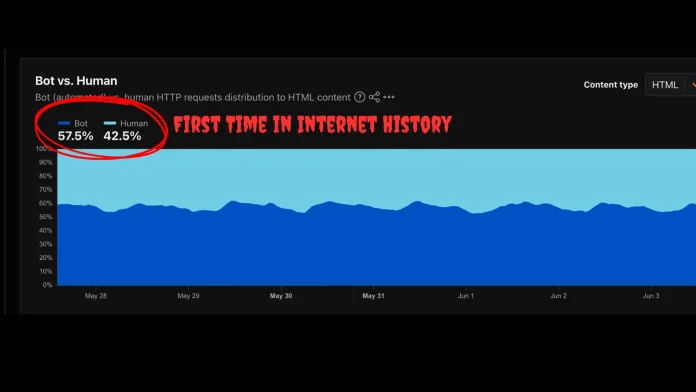
In a landmark development, automated bots have officially surpassed human users in global internet traffic, marking a significant shift in the digital landscape. Data from Cloudflare Radar reveals that bots now account for 57.5% of all HTTP requests to HTML pages worldwide, leaving human-generated traffic at 42.5%. This trend is even more pronounced in the United States, where bot traffic commands a staggering 71.5% share of domestic web requests, highlighting the deep penetration of AI-driven automation in highly connected markets.
This crossover is corroborated by multiple sources. The 2025 Imperva Bad Bot Report confirmed that automated traffic breached the 50% threshold for the first time in a decade, reaching 51% of all global web traffic in 2024. Cloudflare’s own network, which serves approximately one in five websites worldwide, reported a bot-to-human traffic ratio of about 53% to 47% on HTML requests by the end of 2025.
Cloudflare CEO Matthew Prince, speaking at SXSW earlier this year, had projected that bot traffic would surpass human traffic by 2027. However, this milestone has arrived ahead of schedule. Prince noted the scale difference between human and AI browsing behavior, explaining that while a human shopping for a product might visit five websites, an AI agent performing the same task could query 5,000 sites. This pattern is driven primarily by AI scrapers, large language model (LLM) training crawlers, and autonomous search agents built on models like OpenAI’s GPT, Anthropic’s Claude, and Google’s Gemini. AI-driven traffic specifically surged 187% in 2025, growing nearly eight times faster than human web activity during the same period.
The surge in bot traffic carries significant security implications. Of all automated traffic, 37% is classified as malicious bad bots, while only 14% are legitimate crawlers. This increase in malicious bot activity poses challenges for cybersecurity professionals, as these bots can be used for various nefarious purposes, including data scraping, credential stuffing, and distributed denial-of-service (DDoS) attacks.
Publishers and advertisers are also grappling with distorted analytics, as traffic dashboards now reflect machine behavior rather than genuine audience engagement. This shift complicates efforts to measure user engagement accurately and can impact advertising revenue and content strategy.
In response to the growing prevalence of AI-driven bots, emerging frameworks such as pay-to-crawl protocols are gaining traction. Cloudflare has already moved to block AI crawlers by default unless they compensate content creators. This approach aims to balance the benefits of AI-driven data collection with the rights and interests of content creators.
As autonomous agents, AI-powered search tools, and LLM pipelines continue to proliferate, the ratio of bot to human traffic is expected to tip further toward automation. The agent economy is no longer a future forecast; it is the present reality of the internet. Consequently, the web’s infrastructure, monetization models, and security architectures will need to adapt accordingly to address the challenges and opportunities presented by this new era of digital interaction.