ASML’s Unrivaled Position in Semiconductor Manufacturing: CEO Christophe Fouquet Speaks Out
In the rapidly evolving landscape of artificial intelligence (AI), a pivotal yet often overlooked player is ASML, a Dutch company with a 42-year legacy and a workforce of 44,000. Annually investing €4.5 billion in technological advancements, ASML stands as the sole manufacturer of machines capable of producing the intricate patterns on silicon wafers essential for the most advanced semiconductors—a process known as extreme ultraviolet lithography (EUV).
These EUV machines, comparable in size to a school bus, require months to assemble, involve collaboration with hundreds of suppliers, and are priced between $200 million and over $400 million each, depending on the model. This exclusivity has propelled ASML to become Europe’s most valuable company, boasting a valuation exceeding $530 billion.
The surge in AI infrastructure investments by tech giants such as Microsoft, Meta, Amazon, and Google—collectively committing over $600 billion this year—has intensified the demand for ASML’s machines. This unprecedented demand has led ASML to acknowledge potential global chip shortages in the coming years.
Despite its dominant market position, ASML faces emerging competition. San Francisco-based startup Substrate, founded by a protégé of Peter Thiel, has secured over $100 million in funding and achieved a valuation surpassing $1 billion, claiming the capability to develop a rival lithography machine. Additionally, reports have surfaced alleging that former ASML engineers in China have partially reverse-engineered the company’s technology, raising significant geopolitical concerns.
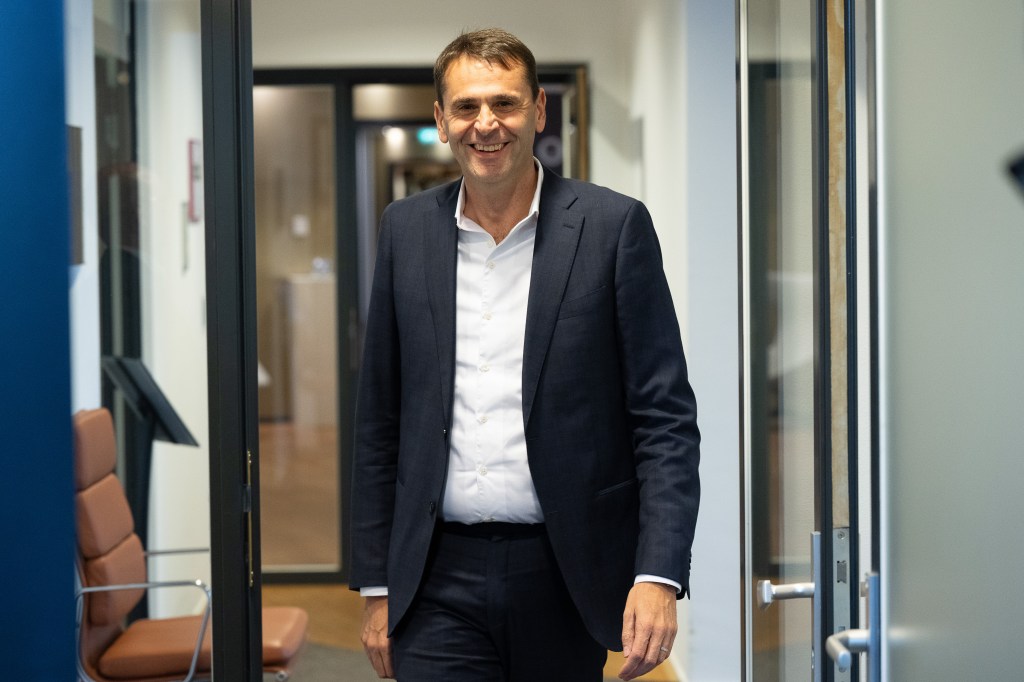
In a recent interview, ASML’s CEO Christophe Fouquet, who assumed leadership in 2024 after more than a decade with the company, addressed these developments. When asked about the unforeseen explosion of AI, Fouquet admitted, No, not at all. We worked very hard, but not with the idea that this would come. You went from a concept—something people thought would eventually arrive—to ChatGPT, which was really the first good example of what AI could do. And now I think we look at AI as the next revolution, not only industrial but societal.
Regarding the industry’s capacity to meet escalating demand, Fouquet acknowledged, The demand is such that the market overall will be supply-limited for quite a bit. Right now, the biggest bottleneck seems to be in chip manufacturing. We, as an equipment supplier, follow our customers, and so far we’ve followed them pretty well—but we know we have to step up our entire supply chain and capacity. If you talk to the hyperscalers, I think they will tell you that for the next two, three, even five years, they’re not going to get enough chips.
Addressing concerns from major clients like TSMC about the high costs of ASML’s latest machines, Fouquet explained, An EUV system, if you look at the price, is going to be more expensive than a low-NA system, but the cost of making a wafer with this tool on some advanced layers will be cheaper. We can get 20%, 30% cost reduction.
When questioned about potential competition from startups like Substrate, Fouquet expressed skepticism, stating, Wanting to have it and having it—that’s still a huge difference. The challenges of lithography are many. Being able to make an image is a starting point, but you need to make that image in very high quantity, at very low cost, at high speed, and with nanometer accuracy. I always say the only reason ASML could build an EUV machine is because 80% of it already existed, based on previous knowledge and products built over time. We had to solve one problem—getting EUV light—and that alone took 20 years. When you start from scratch, the challenge is enormous. I’ve seen a lot of claims. I’ve seen a few pictures. But we had our first EUV picture 30 years ago, and we still needed 20 more years of hard work to turn it into a manufacturing system.
Regarding reports of reverse-engineering by former ASML engineers in China, Fouquet clarified, To reverse-engineer anything, you first need to have the machine. And there is no EUV machine in China—we never shipped any tools there. All the tools we have shipped, we know where they are. They’re either in use with customers, and we track those, or they’ve been dismantled and came back to us. The idea that one of our systems is in China is simply wrong. And because our EUV technology has never been exported there, we also have no people in China trained on EUV.
On the topic of export controls and maintaining technological advantages, Fouquet concurred with Nvidia’s CEO Jensen Huang’s approach, stating, I think he’s totally right. What he adds—and I think this is what Nvidia has done—is that you can keep a technological advantage by maintaining a generation gap in what you sell. Nvidia sells a few generations back, and that lets them find the balance between still doing business and not handing a strong competitive advantage to countries where you won’t sell the latest. We believe the same approach should apply to our products. Today we ship tools to China—allowed by export controls—but it’s a tool we first shipped in 2015. If you apply Jensen’s philosophy to our situation, Nvidia is working with roughly an eight-generation gap. We’re looking at two or three. There’s room for rationalization—finding the right balance between not doing business at all, losing a major opportunity, and strongly inviting others to compete with you.
Fouquet emphasized the complexity and collaborative effort required to develop ASML’s technology, stating, People like to have the greatest technology, but they tend to forget what it took to build it. It’s been many years of work—not only at ASML but with our suppliers. Many different groups of people solving very difficult problems, and then one company bringing it all together using decades of lithography expertise to turn it into a manufacturing system. This is in no way easy. And I think that’s also our best protection. It’s simply what it took to put it together.
In summary, ASML’s unique position in the semiconductor manufacturing industry is the result of decades of dedicated research, development, and collaboration. While emerging competitors and geopolitical challenges present potential threats, the company’s deep-rooted expertise and substantial investments in innovation continue to solidify its dominance in the field.