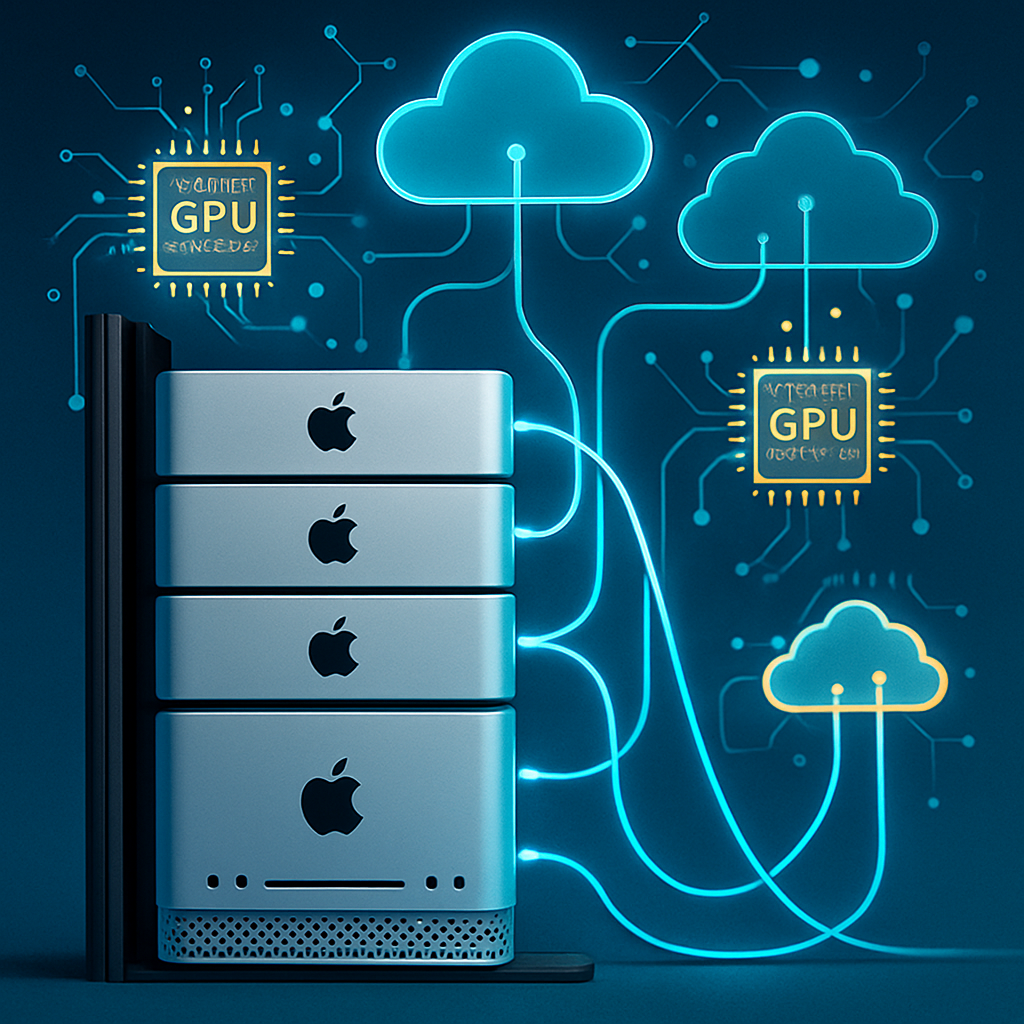
Apple today unveiled “Minions,” a research-backed system that harnesses dormant GPU capacity in Apple Silicon Macs to form a virtual GPU cloud. By pooling idle compute cycles across multiple machines, the platform promises to accelerate machine learning inference workloads by using hardware already present but often underused. Internal experiments have demonstrated its feasibility and performance advantages.
How Minions Works
The core idea behind Minions is simple yet powerful: Macs—especially models like the Mac Studio and Mac mini—frequently have GPU resources that go unused during daily tasks. With the right infrastructure in place, those spare cycles can be reallocated to perform heavy-duty AI inference. Minions orchestrates this redistribution via high-speed interconnects and software tools designed for coordination.
At its technical heart, Minions draws upon Remote Direct Memory Access (RDMA) over Thunderbolt 5, enabling high-bandwidth links between Macs. This lets multiple systems effectively combine compute and memory resources, executing tasks as though running on a single GPU-enabled cluster. Using RDMA means workloads can move across machines without traditional overhead or bottlenecks.
Architecture and Components
Minions is structured around four major components. The Minions Server serves as the control center—handling task submissions via web/API interfaces and managing metadata through a PostgreSQL store. The Minion Executors run on macOS devices equipped with underused Apple Silicon GPUs, executing subtasks locally and returning results to shared storage.
To ensure reliability, Minions includes a Watchdog module. It tracks failures—whether from power or connection loss—and reassigns failed tasks to other available machines. The system features a monitoring dashboard so administrators can observe job progress in real time, giving teams visibility into task status across the cluster.
Apple has already leveraged Minions internally, confirming that macOS devices can be transformed into a distributed inference platform when needed. The implications are especially strong for teams with multiple Macs that could otherwise sit idle.
Broader Significance
This research points to a shift in how we think about computational resources—less about buying ever more powerful standalone machines, more about smarter orchestration of what we already have. In environments where multiple Macs are clustered together, Minions suggests it may be possible to wring out significantly more performance without additional hardware.
Thunderbolt 5—able to carry large amounts of data between devices at high speed—is crucial to this model. Without such a low-latency, high-bandwidth conduit, aggregating GPU compute across machines becomes far less efficient.
For AI workloads that demand inference rather than training, this kind of approach could be particularly useful. Training tends to require massive, specialized infrastructure, but inference—especially for deployed models—might benefit more from distributed utility.
Things to Watch
This system still resides in the research phase, and several questions remain unanswered for wider deployment. Key among them are issues of task scheduling overhead, network reliability, power consumption, GPU memory consistency across disparate Macs, and how well this model scales beyond a few systems. Also open is whether Apple will turn Minions into a product or a public feature within macOS or Xcode.
Why this matters: Minions could unlock underutilized potential in the devices many professionals already own, reducing the gap between budget and high-end AI inference infrastructure. If it becomes accessible beyond Apple’s internal teams, developers, studios, and research labs may find more efficient and cost-effective paths for running AI applications. The architecture also signals a broader trend toward distributed compute using edge or local devices rather than relying entirely on cloud service providers.