In a milestone of robotics and AI integration, Apple has demonstrated a robot powered solely by an M4 Pro-equipped Mac mini that can navigate unfamiliar rooms, follow instructions, and perform tasks like sitting on chairs—all without any human-guided training. Dubbed HALO (Humanoid Autonomy, Learned in Simulation, running Onboard), the system runs entirely on the robot without cloud dependency. What’s more, the models are trained purely in simulation.
Simulated Learning, Real-World Success
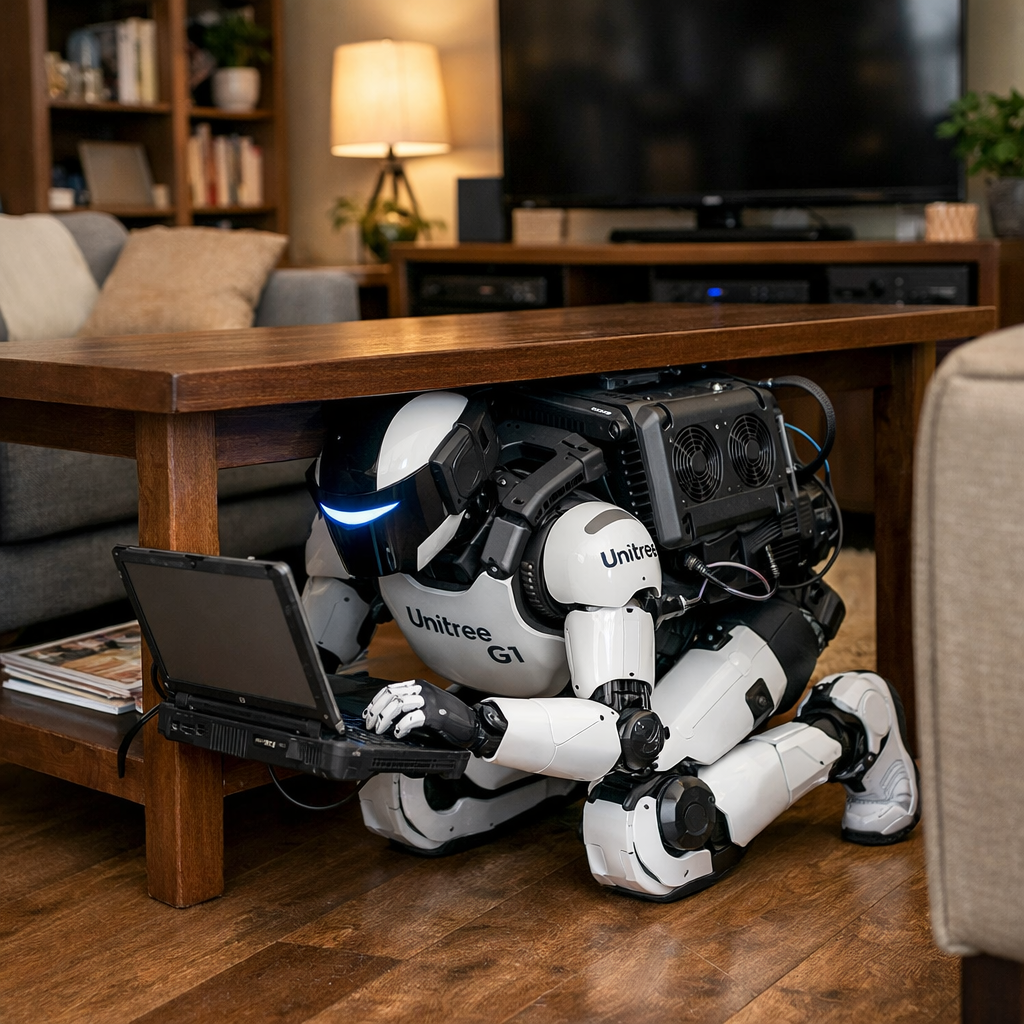
The project paired a Unitree G1 humanoid with a Mac mini carrying Apple’s M4 Pro chip and 64GB of RAM. Visually guided by onboard cameras, the robot leverages data processed against what it ‘learned’ during synthetic training. Much of that training involved 300 hours of simulated movement spread across about 1,000 virtual environments—living rooms, offices, bedrooms—created in Nvidia’s Isaac Sim. The robot never experienced real-world movement guided by a human during that phase.
When put through its paces in six real settings and tested on tasks like stepping through half-open doors, crouching under tables, or sitting on chairs, the robot achieved a ~91% success rate over 360 trials. In stepping through doors, it scored up to 93% in real space; in the sitting test, it was lowest at around 85%. These trials also included 100 virtual rooms for comparison, and tasks were carried out in six distinct physical environments. The system consistently operated without any external control or cloud processing.
Limits and Potential
While the results are impressive, there are clear limitations. The robot needs a human to craft prompts—what task to do and when. Chaining multiple tasks together caused performance to drop. Also, manipulation tasks—grasping or manipulating objects—were excluded from testing. So while HALO is strong in navigation, perception, and motion planning, it isn’t yet doing fine-manipulation or task sequencing well.
All code underpinning HALO is now publicly available on GitHub. Apple emphasizes that its approach—generating vision-language-motion datasets in simulation rather than collecting data via human teleoperation—offers scalability. Tasks that would traditionally demand months or years of human labor can now be produced much faster and in parallel, bounded mainly by compute resources.
This work isn’t likely to appear in any consumer product in the near term. The research paper doesn’t outline specific productization plans, but the architecture suggests a future where robots could operate entirely on device, interpreting and acting in the physical world more autonomously than ever.
Why this matters: HALO represents a leap in robot autonomy, showing it’s possible to train complex behaviors off-device and deploy them on hardware as modest yet efficient as a Mac mini. It bridges simulation and physical reality with promising success. Going forward, breakthroughs in handling objects, refining chained behaviors, and reducing the need for human instruction will be pivotal. If achieved, HALO’s approach could reshape expectations for household, industrial, or service robots in the next few years.