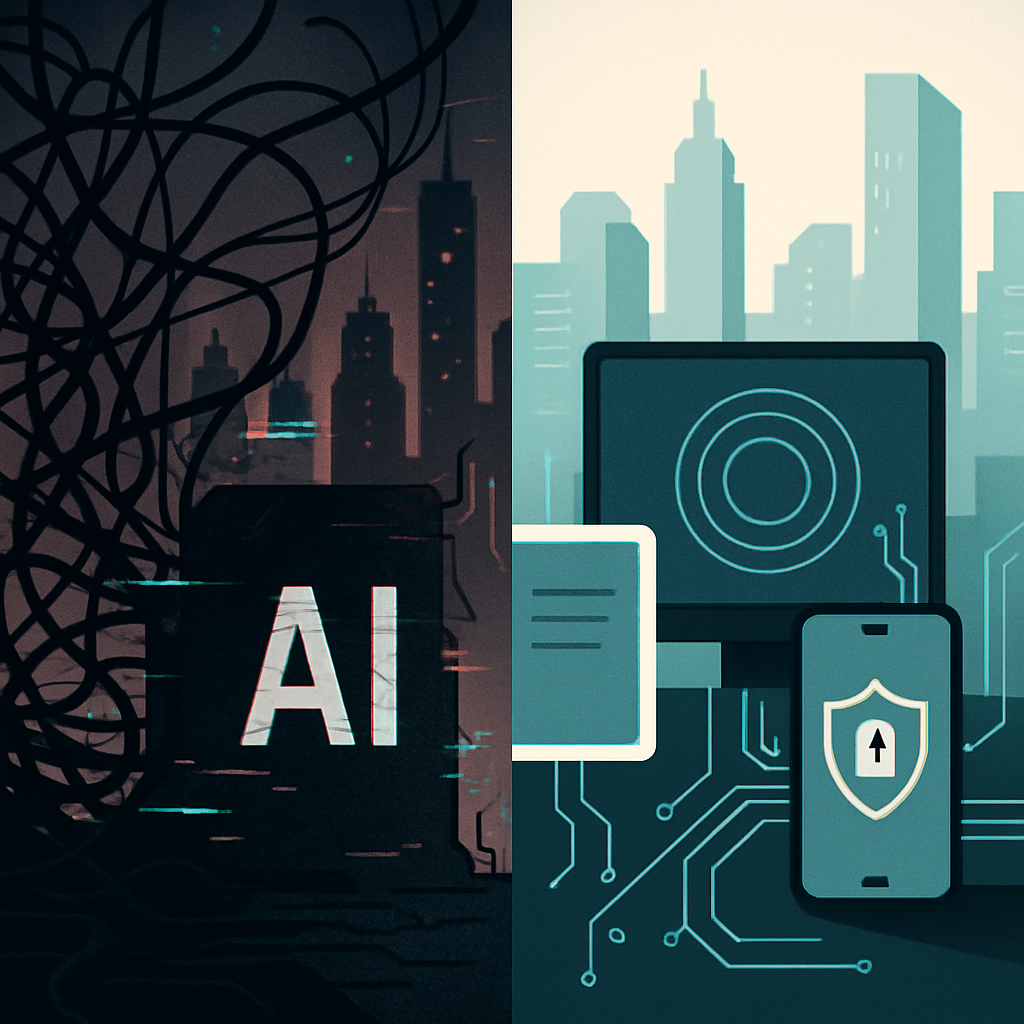
Apple has taken a firm stand in the escalating debate over artificial intelligence, denouncing unchecked AI development as the new frontier of digital risk. During a recent public appearance, Apple’s marketing chief used vivid language to describe part of the industry as a “lunatic fringe,” asserting that many AI initiatives are being pushed forward without regard for long-term consequences.
The company argues that while rivals are pouring billions into ambitious models and tools, often racing toward revolutionary breakthroughs, Apple is deliberately moving more cautiously. Rather than chasing the bleeding edge, it is focusing on releasing AI features that provide clear everyday value and prioritize user privacy, betting that restraint will be considered wise in a climate increasingly concerned with the ethical and societal costs of AI.
The Risks We’re Already Seeing
Concerns about AI aren’t new—but critics are warning that the impact may be more profound than most tech wars or regulatory battles. For one, industries as diverse as trucking, marketing, and software development could face massive job losses. Academic researchers worry that entire career paths might become obsolete as AI starts solving problems in days what once took humans months or years.
One such researcher pointed out that students approaching higher education might skip pursuing fields like mathematics or scientific research if it seems their efforts could be rendered redundant. Over time, this could mean fewer experts are available to understand, interpret, or advance scientific discoveries, leaving those breakthroughs to be evaluated and applied by AI systems alone.
Apple’s Strategy in Context
Apple’s current strategy contrasts sharply with what is often referred to as the “AI arms race.” Big tech firms are scrambling to train ever-larger models, deploy them widely, and monetize them rapidly. Apple, meanwhile, claims it is investing in its own models—but not the kind designed primarily to grab headlines or demonstrate dominance.
Privacy plays a central role. In Apple’s view, the risks of misuse, bias, surveillance, and societal disruption are only going to increase unless the technology is constrained. The company appears to believe that growing public backlash could force strong regulatory action—and that companies seen as reckless today may face serious consequences tomorrow.
So far, Apple has yet to dominate in headline-grabbing AI breakthroughs—voice assistants, generative tools, and large language models—but it hopes that its more measured, privacy-centered tactical approach will resonate as the AI backlash gathers momentum.
The stakes are high. If the backlash against rapid AI acceleration continues to rise—among consumers, academics, and potential lawmakers—companies like Apple, which emphasize control and safety, may find themselves on the advantaged side of public trust.
Many worry about a future where AI systems yield solutions nobody fully understands, and human experts are no longer needed. Apple’s position suggests it sees value in preserving human roles—at least for now—and urging caution where enthusiasm might lead to harm.
WATCH POINT: Apple’s stance raises some tough questions for competitors and regulators alike—Can innovation be protected, or even encouraged, without sacrificing ethics and safety? As the AI backlash begins to materialize, which companies will adapt—and how quickly—will shape the next chapter of this industry.