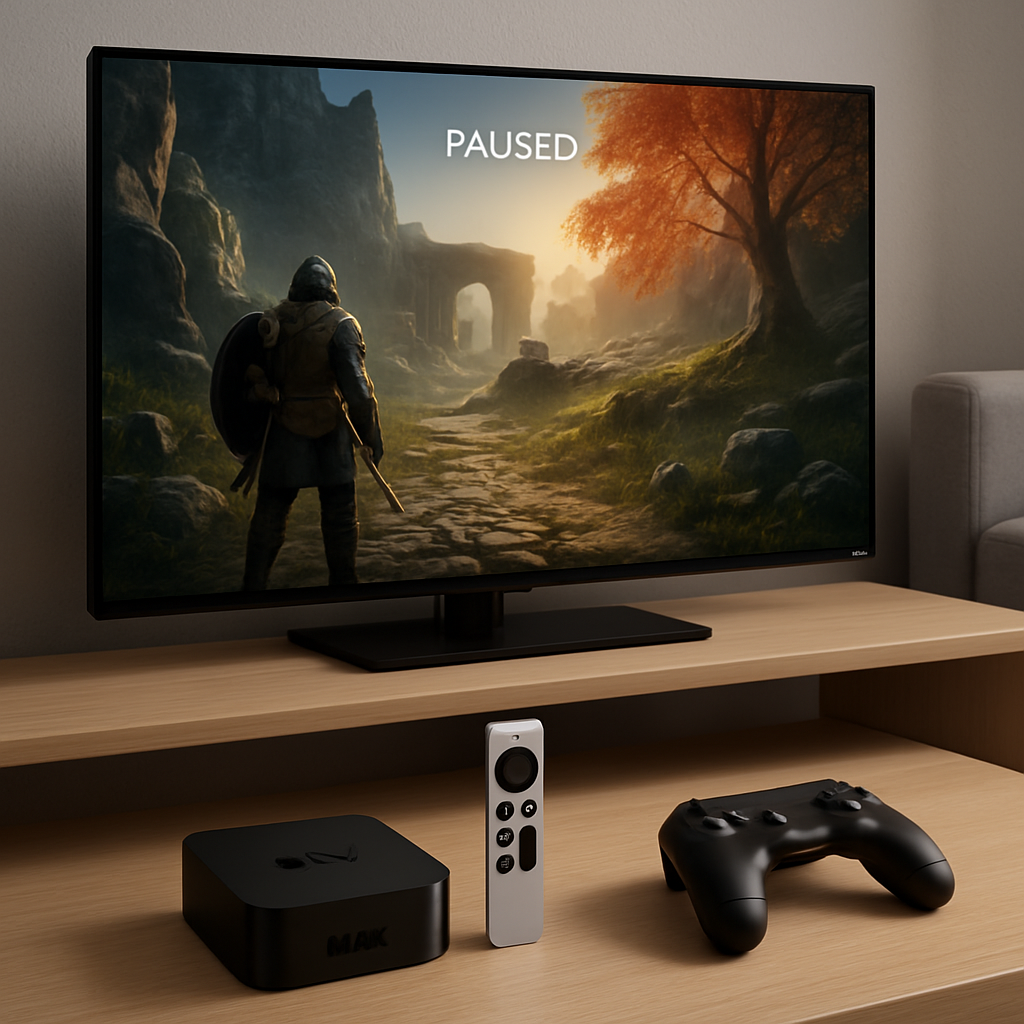
The latest Apple TV 4K offers upgraded hardware—introducing the A19 chip and a base 128GB model—but despite those boosts, it still falls short of becoming a solid choice for gamers beyond casual play. Without key features, modern gaming aspirations remain out of reach.
What’s New—and What Still Missing
The 4th-generation Apple TV 4K raises expectations with its faster A19 chip, delivering better performance than earlier models and making games run more smoothly than before. It also ditches the 64GB base option—now every model comes with 128GB of storage—giving users more room for installing apps and titles. Controller support remains strong, including support for popular models like the DualSense. On paper, these feel like the moves expected of a device aiming to close the gap with consoles.
But specs alone don’t make a platform. The device remains capped at 4K resolution and 60 frames per second, even when many modern TVs and competitors support 120Hz or variable refresh rates. That limitation undermines the visuals and fluidity gamers demand. Meanwhile, while 128GB is an improvement, game sizes have ballooned—some AAA titles can occupy significant space, leaving less headroom for installations plus the overhead tvOS needs to manage storage.
Structural Limitations & Price Concerns
Another major roadblock is tvOS’s lack of Just-In-Time (JIT) compilation. Without JIT, emulators—and games that rely on dynamic code execution—aren’t going to perform well, effectively putting a ceiling on what’s possible for retro gamers or developers needing dynamic runtime performance. This reflects deeper design choices that suggest gaming isn’t a primary priority.
Then there’s the price. At $299, the new Apple TV 4K undercuts some full game consoles but still feels expensive for a device that prioritizes streaming. Users are paying a premium for upgraded chipsets and storage, but the trade‐offs—no 120Hz video, limited framerate, constrained game selection—make the value proposition weaker for those aiming to use it for serious gaming.
Why This Feels Like Half-Commitment
Apple markets its Arcade service and showcases new games across its platforms, yet promotional materials rarely depict the Apple TV running these games on big‐screen displays—an omission that signals something. Meanwhile, other devices in the Apple ecosystem—iPhones with high refresh rate, Macs with M-series chips—are increasingly effective gaming rigs. Even non-gaming Macs are picking up more intense titles thanks to the Game Porting Toolkit and native game support.
So, what the Apple TV 4K delivers is certainly better than previous versions, and for streaming and general media consumption it is among the best. But as a gaming platform, it still struggles with key omissions in performance, design, and price. For core gamers, those shortcomings weigh heavy.
What this means: If you’re after a streaming box with some casual gaming—Arcade titles, indie platformers, or retro games—the new Apple TV 4K could satisfy. But for those who want high‐framerate console games or full emulator performance, it’s not yet the device. Apple may need to decide whether it wants Apple TV to be a platform that compromises, or one that leads—and so far, it looks like it’s only decided to sit somewhere in between.