Apple has published a technical white paper this week giving one of the clearest explanations yet of how its Secure Exclaves work — the isolated hardware zones that power audio and video intelligence features like Siri Recaps and Live Rewind. The key claim: they enable speech and sound analysis without ever creating a retrievable recording accessible to apps, people, or even Apple itself. — everything happens in protected, encrypted, and ephemeral buffers.
From Contagious Chatter to Secure Silence
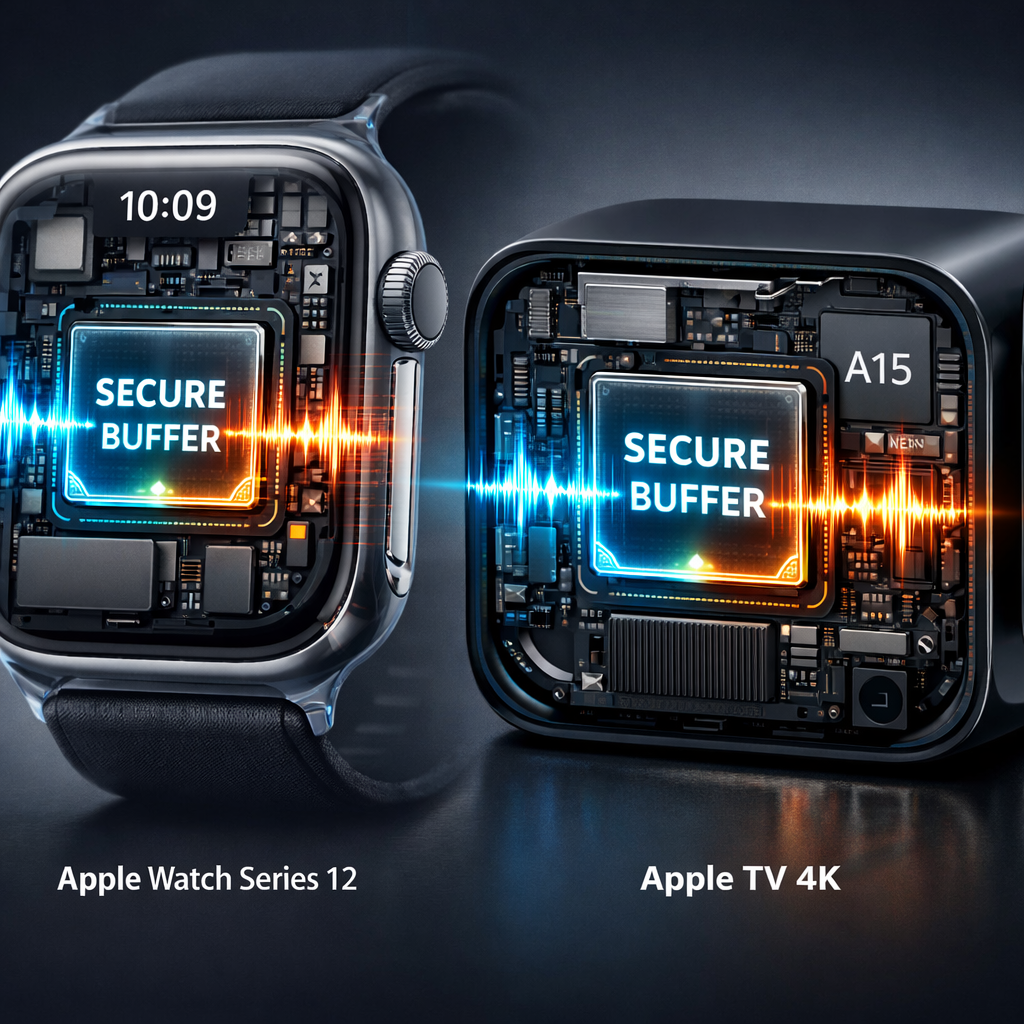
On the Apple Watch Series 12 and Ultra 4, all ambient audio passes into a continuously overwritten buffer inside the S11 chip’s Secure Exclave. That means it never accumulates as a file, but is analyzed in real time for voice detection, sound alerts, or music signatures. Once processed, the data is purged — the old segments are overwritten.
For Siri Recap, when conversation is detected, encrypted audio moves from the watch’s Secure Exclave to the paired iPhone’s Secure Exclave. There, the raw audio is decrypted, transcribed into text, then condensed into a summary shorter than half its original length. Raw audio is immediately deleted afterward. The final summary can go to Apple’s Private Cloud Compute for further processing — again under encryption — with Apple asserting that neither raw audio nor the full transcript is accessible to anyone outside the end-device environment.
Live Rewind, another feature in the new watches, gives users access to the last 15 seconds of speech via a text snippet. That snippet disappears around 30 seconds after the display dims unless the user saves it. Like Siri Recap, users must activate these features and opt in.
‘Isolated Hardware’ Everywhere: Cortex on Apple TV & Broader Secure Architecture
The concept extends beyond wearables. The newest Apple TV 4K (4th generation) with its A19 chip also includes Secure Exclaves for microphone data. That means the audio is processed separately from tvOS, apps, the user, or even Apple. Both hardware isolation and runtime compartmentalization are cited in protecting data handled inside an Exclave from other system components.
Underpinning Secure Exclaves is Apple’s evolving security architecture — new kernel-level changes like the Secure Kernel (SK), exclusion of sensitive resources from the main XNU kernel, and secure world execution. Modern chips (A18, M4, etc.) support hardware features such as the Secure Page Table Monitor (SPTM), Trusted Execution Monitor (TXM), and dedicated isolation boundaries that ensure even if the primary kernel were compromised, Exclave-protected data remains out of reach.
Apple stresses that summaries stored by users across devices are synced via iCloud only when two-factor authentication and a passcode are enabled, and with end-to-end encryption — meaning only the user has access to anything saved.
The company also clearly draws the line between temporary processing and recording — emphasizing that no way exists to “play back” raw audio or transcript once it has been deleted. Through selective transmission (only when needed), encryption, and hardware isolation, Apple claims multiple layers of protection.
So what are people still debating? Even with Secure Exclaves, there’s scrutiny over how summaries are generated, what context is included (e.g. time, place, music playing), and whether implications for privacy and consent — especially involving bystanders — are fully addressed. The architecture promises strong containment, but its effectiveness depends on implementation integrity and transparency.
Why it matters: with AI assistants and ambient awareness features gaining traction, users and regulators are wary of “always-listening” tech. Secure Exclaves represent Apple’s most ambitious effort yet at giving people control — ensuring privacy by hardware design, not just policy. What to watch: bug hunters validating claims in Apple’s Platform Security Guide, real-world use-cases where context leaks may happen, and whether upcoming features expand these protections beyond watchOS and Apple TV into macOS, Vision, and more.