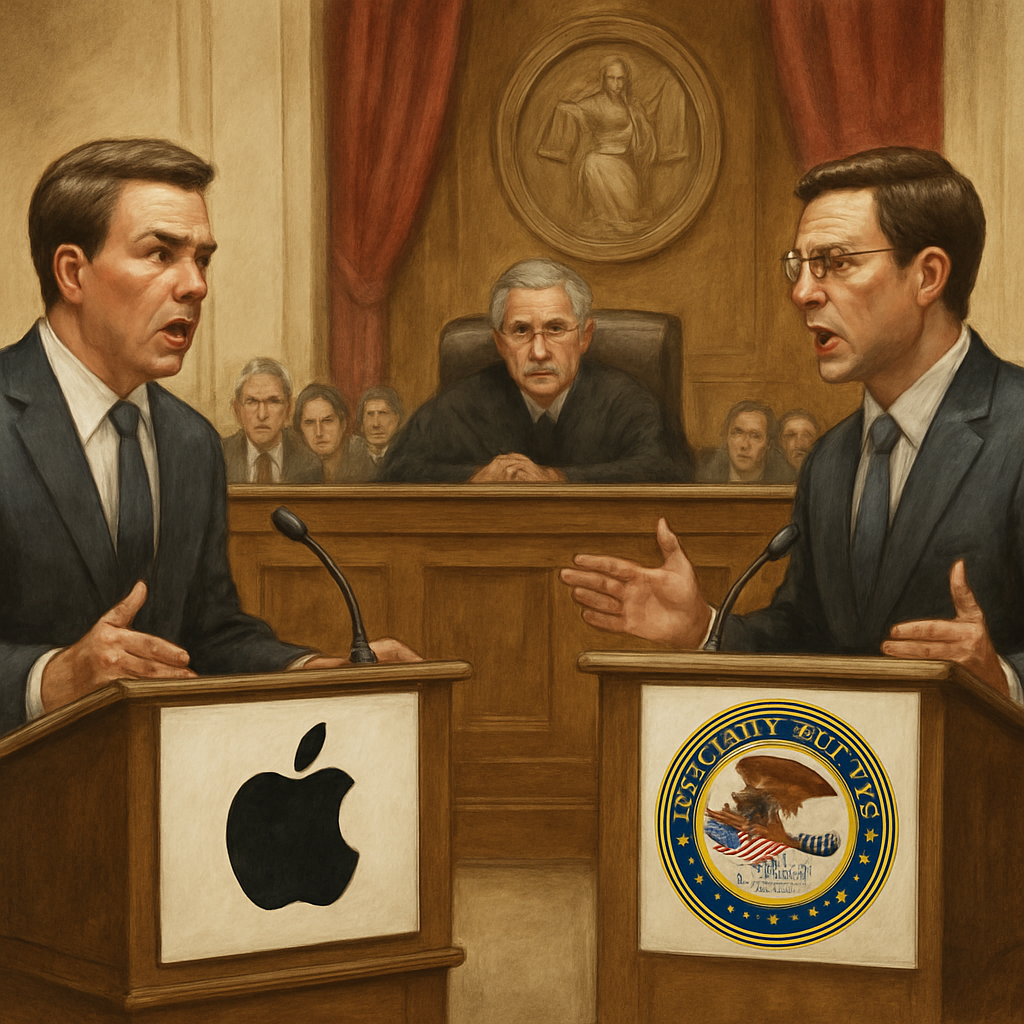
Apple is contesting the Department of Justice’s (DOJ) recent effort to overturn a court decision that permits the company to obtain documents from 14 federal agencies. This development is part of Apple’s defense strategy in the ongoing antitrust lawsuit initiated by the DOJ in March 2024.
In July 2026, a special master appointed to oversee discovery disputes granted Apple the right to request documents from agencies including the Central Intelligence Agency (CIA), Department of Commerce, Department of Homeland Security, Department of Defense, Federal Bureau of Investigation (FBI), Federal Trade Commission (FTC), General Services Administration, Department of Labor, National Aeronautics and Space Administration (NASA), National Security Agency (NSA), Office of the Director of National Intelligence, Office of Management and Budget, Office of Personnel Management, and Department of State. Apple argues that these documents could demonstrate that federal agencies selected its products for their privacy and security features, thereby supporting its claim that the contested practices are legitimate and not anticompetitive.
Following this decision, the DOJ filed a motion requesting the special master, retired federal judge Jose Linares, to reconsider his ruling. The DOJ contends that Judge Linares applied an incorrect legal standard by treating the agencies as parties to the case, rather than as non-parties who are entitled to greater protection from discovery. Additionally, the DOJ argues that complying with Apple’s requests would impose an undue burden on these agencies and that the documents sought have limited relevance, as federal agencies do not represent typical consumers.
In response, Apple has submitted a detailed rebuttal, asserting that the DOJ’s motion is an improper attempt to re-litigate the issue. Apple maintains that the special master correctly applied the legal standard for party discovery from federal agencies and that the DOJ’s claims of undue burden are unsubstantiated. The company emphasizes that the DOJ’s new evidence was always available and should not be considered at this stage. Apple concludes by requesting that the motion be denied, stating that it fails on all counts.
Judge Linares has set a timeline that prohibits further briefing on this matter. The decision now rests with him to either uphold his original discovery order or grant the DOJ’s request for reconsideration.
This legal maneuvering underscores the complexities inherent in antitrust litigation involving major technology companies. The outcome of this dispute could significantly influence the scope of discovery in such cases, potentially affecting how companies can defend themselves against antitrust allegations. Observers should monitor Judge Linares’s forthcoming decision, as it may set a precedent for the treatment of federal agencies in similar legal contexts.