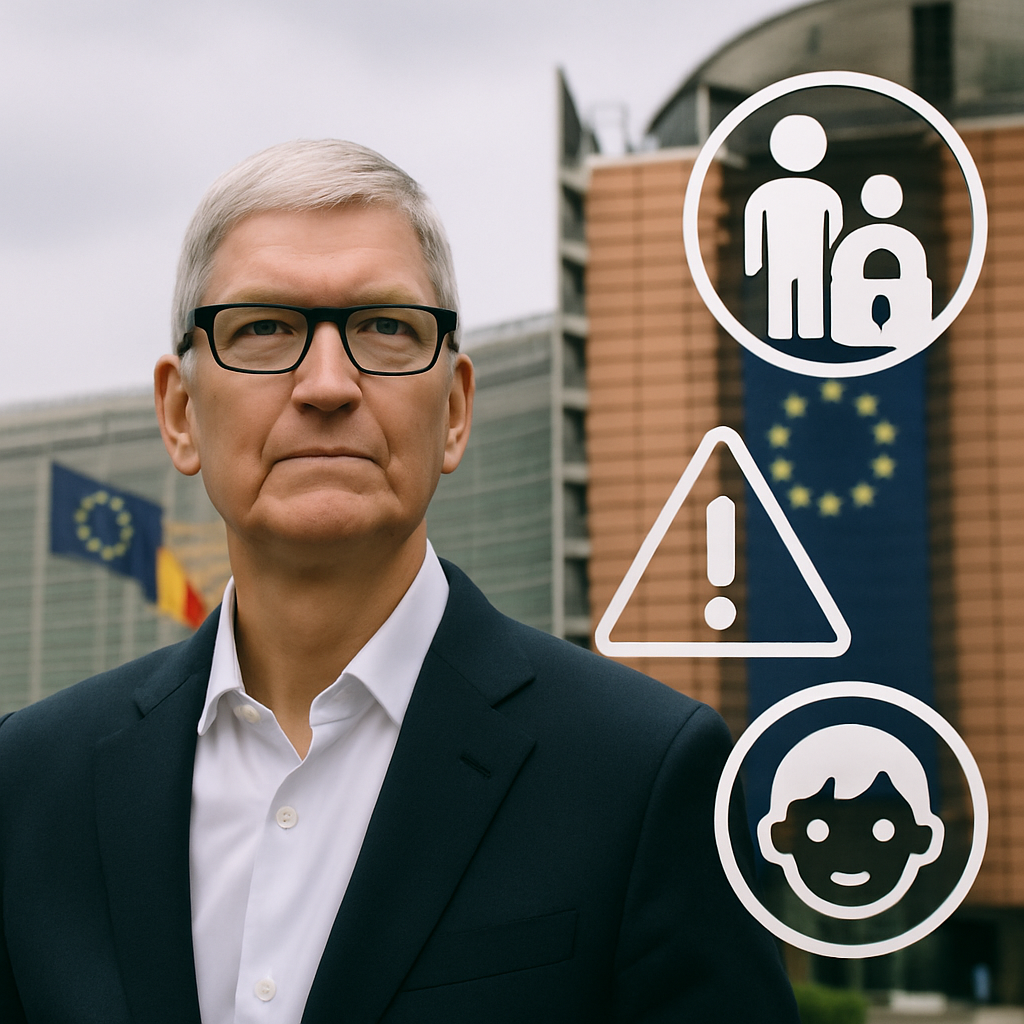
Apple’s leadership has voiced strong support for the European Union’s draft child-safety legislation, marking one of its rare moments of agreement with EU regulators. During a visit to Strasbourg, Apple Executive Chairman Tim Cook commended the European Parliament’s effort to establish a harmonized, EU-wide framework to protect children online—a move aligning closely with the company’s own existing tools.
What the EU’s KIDS Act proposes
The KIDS Act, unveiled by the European Commission on September 17, seeks to put in place sweeping rules around social media, video-sharing platforms, online games, AI companions, and chatbots. Under the proposal, children under 13 would be barred from social platforms entirely. Those aged 13 to 14 may gain access through “mini accounts” controlled by parents, with limited features and a daily one-hour usage cap. Full access would be permitted beginning at age 15.
The act would also mandate that app stores rate content by age, prevent minors from accessing inappropriate content or making unsuitable purchases, and employ privacy-preserving age verification systems. These safety requirements would extend beyond simple age limits, encompassing broader protections for young users across online services.
Where Apple already meets the KIDS Act standards
Many of the KIDS Act’s priorities echo tools already woven into Apple’s ecosystem. Parents have access to Child Accounts, which grant tight control over access for younger users, and Screen Time, which allows web and app restrictions as well as usage limits. With iOS 27, Apple has expanded parental controls and made it easier to set up Child Accounts across iPhone, iPad, and Mac.
Additionally, Apple offers privacy-focused methods for age assurance. Its Declared Age Range API lets developers request a general age category rather than a precise birthday. The company has also been updating this system in 2026 to comply with evolving legal requirements for age checks.
Why this is distinct from Apple’s disputes with the EU
The company has clashed frequently with EU regulation over competition-focused policies like the Digital Markets Act (DMA), which demand Apple open up its tightly controlled ecosystem—for example, to allow alternative app marketplaces or interoperability options. Apple has argued these rules may compromise security and privacy, and has cited them as reasons for delays to features such as Siri AI.
By contrast, the KIDS Act places demands in areas where Apple already invests heavily: privacy-aware age verification, safe default settings, stronger parental oversight, and age-rated content. These align far more closely with Apple’s existing product philosophy than the DMA’s requirements.
Cook’s strategic role in shaping policy
Tim Cook became Apple’s Executive Chairman on September 1, handing over the CEO role to John Ternus. One of Cook’s ongoing priorities is engaging with policymakers around the world—a task especially well-suited to discussions like those around the KIDS Act.
Cook has already spoken with EU leaders, including Ursula von der Leyen, emphasizing the need for child protections online. His Strasbourg meeting with the European Parliament comes as the proposed law works its way through the legislative process—and as Apple seeks areas of convergence with regulators.
Unlike its long-running opposition to parts of EU legislation like the DMA, Apple now finds itself in rare agreement with Brussels. The company’s existing tools give it a strong head start toward compliance with the KIDS Act, but many details still need negotiation.
Analysis: Why this matter of alignment is important
This convergence over child-safety law is significant in several ways. First, it demonstrates that while Apple may resist regulation that requires opening its systems, it’s more receptive when rules match existing architecture—especially where user safety and privacy are concerned. Second, it could signal a shift in how Apple approaches regulation: over opposition toward engagement when goals align. As the KIDS Act advances, watch for the exact definitions of “mini accounts,” usage limits, and how age verification technologies are regulated. Any mismatches between the Act’s requirements and Apple’s current systems could still spark tension or require redesigns.