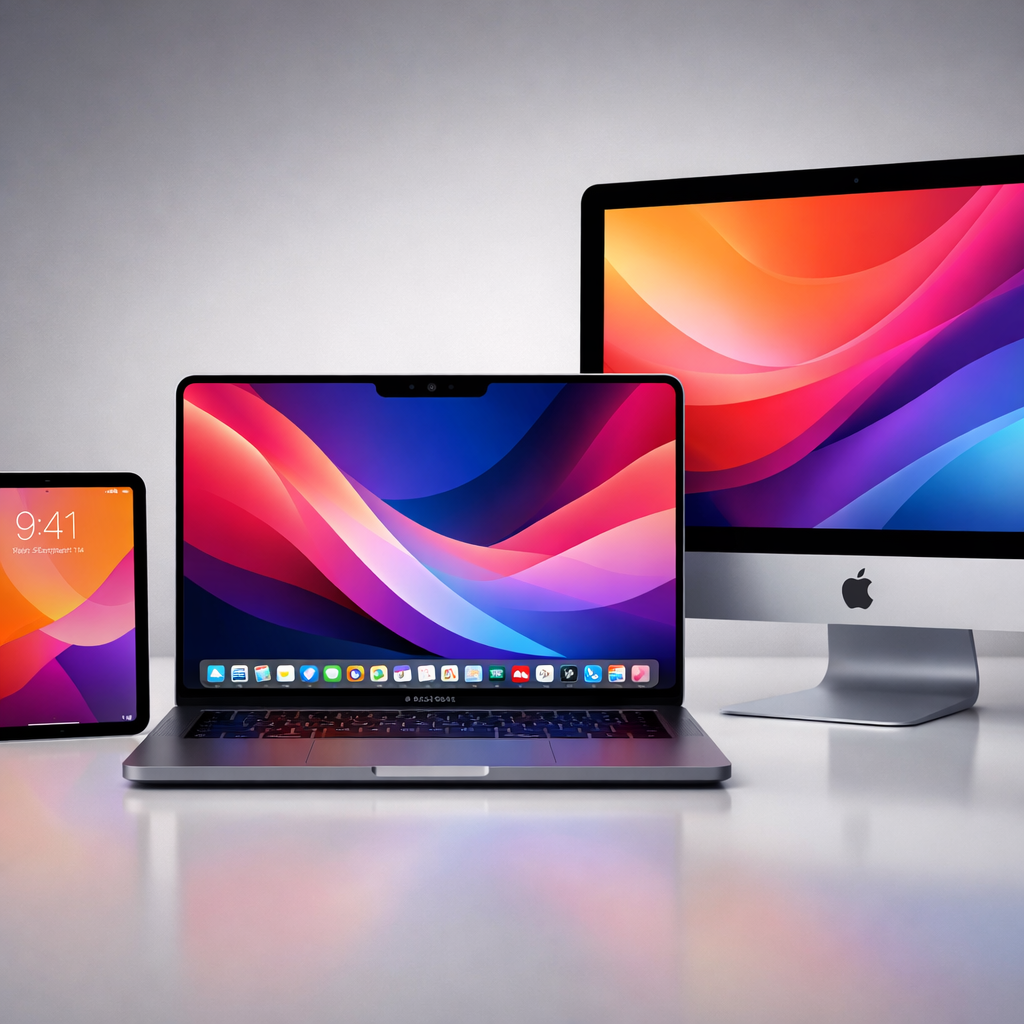
Apple has revealed sweeping updates across its MacBook Pro, iPad mini, iMac, and the entry-level 14-inch MacBook Pro lineup, all arriving November 6. The marquee change: the MacBook Pro now features a touchscreen OLED panel, dubbed the “PROLED XDR display,” available in 14- and 16-inch sizes. Also new are beefed-up performance, upgraded connectivity, and enhanced design refinements. Prices start at $1,999 for the entry model and go up to $2,899 and $3,399 for the premium touchscreen variants.
MacBook Pro Gets OLED Touchscreen, Dynamic Island & Design Tweaks
For the first time, Apple has introduced a touch-enabled OLED screen in its MacBook Pro line. This display supports gestures like pinch-to-zoom and dragging, and includes a reinforced hinge and camera stabilization to facilitate direct screen interaction. The PROLED XDR display boasts up to 2,000 nits of peak brightness in both HDR and SDR modes, an impressive 10,000,000:1 contrast ratio, and supports Adobe RGB in addition to P3.
The 16-inch model grows slightly to 16.3 inches and brings back the illuminated Apple logo. Both sizes are slimmer and lighter overall, with the 14-inch version weighing around 3 pounds and the 16-inch version around 4 pounds. Apple also replaces the notch with a Dynamic Island that enables Live Activities, Siri AI, and more. Powering these models are the M5 Pro and M5 Max chips introduced earlier this year, now coupled with upgraded thermal architecture to better manage performance. Speakers have been overhauled to deliver 50% deeper bass, and storage now tops out at 16TB—a $400 premium over their mini-LED predecessors.
Other Devices Also See Major Upgrades
The iPad mini receives its biggest refresh yet. Moving from an 8.3-inch LCD to an 8.5-inch OLED display with narrower bezels, it gains optional nano-texture glass for 256GB and 512GB versions, IP67 water and dust resistance, and drops to just 5.4mm in thickness. The display caps at 1,200 nits in HDR, but Apple stops short of adding ProMotion; refresh remains at 60Hz. The A20 Pro chip brings GPU neural accelerators and upgraded memory bandwidth, with claims of up to 60% faster CPU performance, 2.7× graphics, and 4.5× AI performance over the prior model. A new Acoustic Display system removes speaker holes, the front camera moves to a landscape edge and the rear camera gets Adaptive True Tone flash. Also included: fast charging, Wi-Fi 7, Bluetooth 6, Thread support, Apple’s C2 modem for cellular versions, and support for external displays under iPadOS 27.2. Pricing starts at $699 in Midnight and Starlight finishes.
The iMac gets moved up to the M6 chip, gaining extra CPU and GPU cores in both two-port and four-port configurations. It also adds GPU Neural Accelerators, dual 16-core Neural Engines, faster SSD speed, Wi-Fi 7, Bluetooth 6, Thread, and 2.5 Gigabit Ethernet. Base pricing begins at $1,499 for the two-port model and $1,699 for the higher-end four-port version.
The more affordable 14-inch MacBook Pro receives an M6 upgrade—shifting from the prior M5—along with a 12-core CPU, 12-core GPU, dual 16-core Neural Engines, and higher memory bandwidth on 24GB/32GB configurations. The 16GB model keeps prior bandwidth. Despite the bump, price remains at $1,999 with battery life up to 24 hours.
Pre-orders for all four revamped devices are open now, with official launch set for November 6.
This wave of hardware highlights Apple’s shifting priorities: embracing touch for MacBooks, pushing OLED deeper into its product stack, and sharpening AI and GPU performance across its devices. What to watch next is how these changes affect Apple’s ecosystem in real world: will the MacBook Pro’s Touch OLED truly change how people use macOS, and can the performance gains in the A20 Pro and M6 chips meet expectations? Apple’s move sets a strong foundation for 2027 developments.