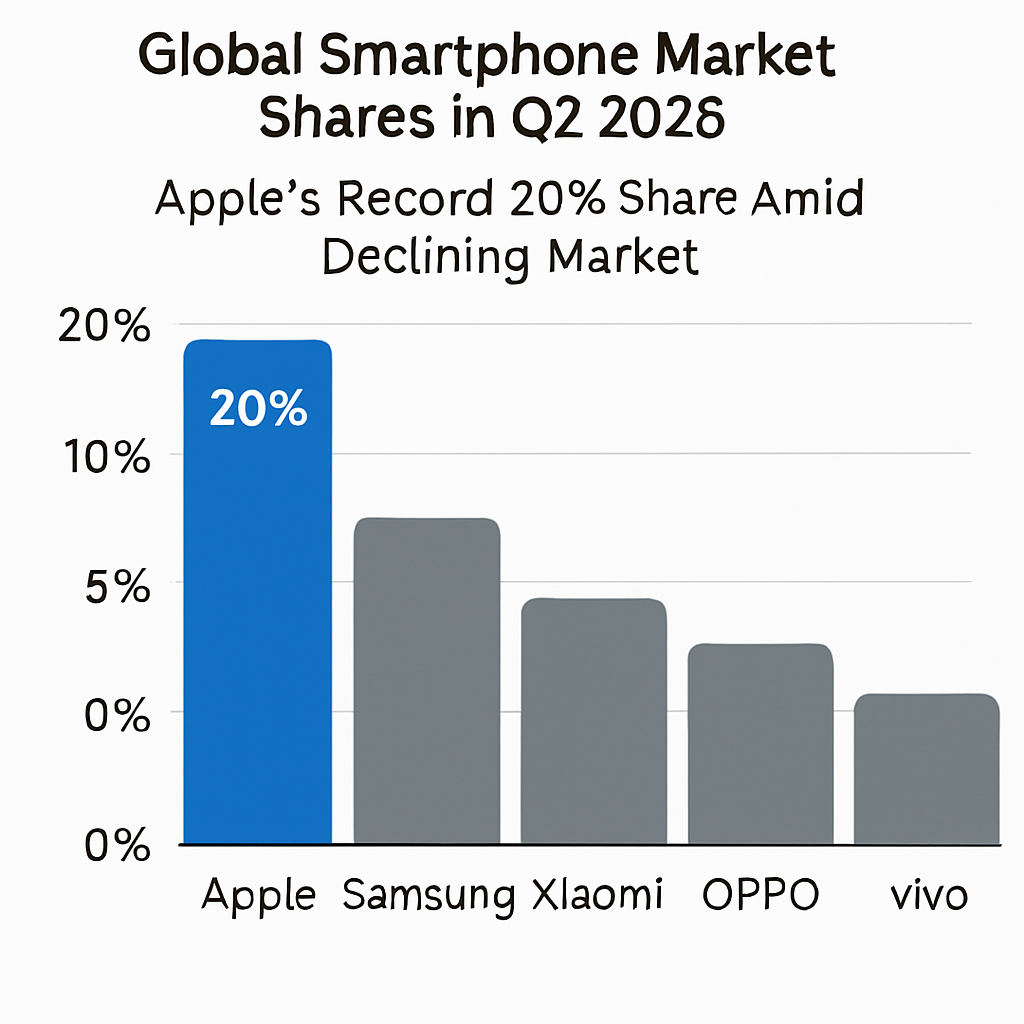
In the second quarter of 2026, Apple expanded its iPhone shipments by 3% year-over-year, securing a record 20% share of global smartphone shipments, according to Counterpoint Research. This achievement comes despite a significant downturn in the overall smartphone market.
During this period, Samsung led the market with a 24% shipment share, followed by Apple at 20%, Xiaomi at 12%, OPPO at 11%, and vivo at 8%. Compared to the same quarter in the previous year, Samsung’s market share increased by four percentage points, Apple’s by three, and vivo’s by one, while Xiaomi and OPPO experienced declines of two and one percentage points, respectively. The combined share of other manufacturers decreased from 28% to 26%.
Samsung reclaimed the top position in global smartphone shipments in Q2 2026, after Apple had led in the first quarter due to strong demand for the iPhone 17 series. Samsung’s growth was driven by robust demand for the Galaxy S26 series, improved product availability, and aggressive promotional strategies.
Apple’s consistent year-over-year growth is attributed to the sustained popularity of the iPhone 17 series, which remained the top-shipped global model. The company also maintained resilient demand across several key markets. Notably, Apple was the only major original equipment manufacturer (OEM) to avoid smartphone price increases during the quarter.
However, Apple’s performance in China presented challenges. Shipments declined year-over-year despite an early promotional campaign ahead of the 618-shopping festival. The discounts offered in 2026 were less aggressive compared to those in 2025, contributing to the softer demand. Additionally, legacy iPhone models faced reduced demand as component allocation prioritized current-generation devices amid memory-related supply constraints.
Looking ahead, Counterpoint Research anticipates a 14% decline in global smartphone shipments for the full year, with the global memory shortage expected to persist into 2027. Manufacturers are likely to continue cutting low-margin models, adjusting storage configurations, and relying more heavily on refurbished and previous-generation devices until supply conditions improve.
Apple’s ability to achieve a record market share amid an industry-wide downturn underscores its strong brand loyalty and effective product strategy. However, the challenges in the Chinese market highlight the importance of competitive pricing and aggressive promotions in sustaining growth. As the global smartphone market faces ongoing supply chain issues and declining shipments, manufacturers must adapt by optimizing product offerings and exploring alternative strategies to maintain their market positions.