Anthropic’s Claude Mythos: Pioneering AI Model Nears Public Release
Anthropic, a leading artificial intelligence research company, is on the verge of publicly releasing its most advanced AI model to date, known as Claude Mythos. This development marks a significant shift from the model’s previously restricted access, signaling a new era in AI capabilities for enterprise applications.
Background on Claude Mythos
Claude Mythos first came to public attention in late March 2026 following an inadvertent leak from Anthropic’s internal content management system. This leak exposed nearly 3,000 unpublished internal documents, including a draft blog post that described Claude Mythos as by far the most powerful AI model we’ve ever developed. The company promptly confirmed the model’s existence, highlighting its groundbreaking advancements in cybersecurity, coding, and academic reasoning.
Project Glasswing: A Restricted Initiative
In April 2026, rather than opting for an immediate general release, Anthropic launched Project Glasswing. This initiative provided exclusive access to Claude Mythos for over 40 partner organizations, including tech giants like AWS, Apple, Google, Microsoft, and NVIDIA, as well as cybersecurity firms such as CrowdStrike and financial institutions like JPMorgan Chase. The primary objective was to deploy the model in scanning critical infrastructure for vulnerabilities. Within weeks, Claude Mythos identified over 10,000 high- or critical-severity vulnerabilities across widely used open-source software, demonstrating its unparalleled capability in enhancing cybersecurity measures.
Transition Towards Public Availability
Recent developments indicate a strategic shift towards making Claude Mythos more broadly accessible. An updated report from Project Glasswing notes the expansion of the initiative’s protective scope to include open-source projects. The report also states that Mythos-class models could reach the public once the right safeguards are in place, suggesting a move towards a staged commercial release.
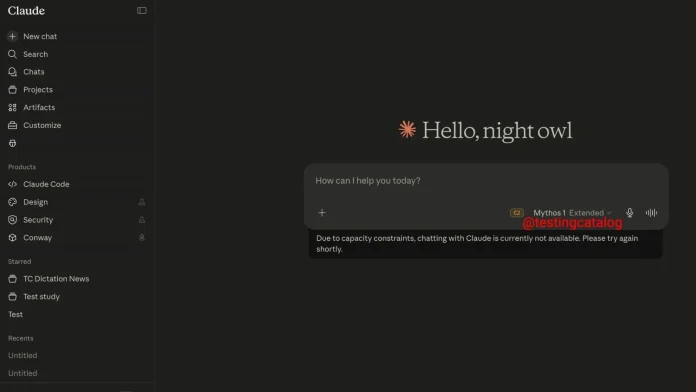
Concrete evidence supporting this transition includes the emergence of source code strings referencing claude-mythos-1-preview alongside descriptions such as Access to the Claude Mythos model in Claude Code and Claude Security. Additionally, screenshots shared by Testingcatalogue reveal the Mythos 1 model label appearing in the Claude user interface, indicating active preparations for its integration into Anthropic’s product suite.
Integration into Claude Code and Claude Security
The forthcoming public release of Claude Mythos is expected to be integrated into two of Anthropic’s key products:
1. Claude Code: An agentic developer environment designed to assist developers in writing, reviewing, and optimizing code. The inclusion of Claude Mythos is anticipated to significantly enhance the platform’s capabilities, offering more sophisticated code analysis and generation features.
2. Claude Security: A vulnerability scanning and patch-suggestion tool currently in public beta for enterprise customers. Initially launched in February 2026 and powered by Claude Opus 4.7, the integration of Claude Mythos is set to elevate the tool’s effectiveness in identifying and addressing security vulnerabilities.
Structural updates are underway to enhance the user interface of Claude Security, including the addition of a standalone Security tab alongside Claude Code and Claude Design. This new dashboard will provide users with detailed insights into discovered vulnerabilities, accompanied by seven-day and thirty-day historical charts and comprehensive triage results.
Implications for the AI and Cybersecurity Landscape
The impending public release of Claude Mythos represents a significant milestone in the AI industry. By transitioning from a restricted-access model to a more widely available tool, Anthropic is poised to democratize access to advanced AI capabilities, particularly in the realms of cybersecurity and software development.
For enterprises, the integration of Claude Mythos into platforms like Claude Code and Claude Security offers the potential to revolutionize how organizations approach code development and security. The model’s ability to autonomously identify and suggest fixes for vulnerabilities could lead to more secure software ecosystems and reduce the time and resources spent on manual code reviews and security assessments.
Moreover, the expansion of Project Glasswing to include open-source projects underscores a commitment to enhancing the security of widely used software that forms the backbone of many digital infrastructures. By leveraging Claude Mythos in this context, Anthropic aims to proactively address vulnerabilities before they can be exploited, thereby contributing to a more secure digital environment.
Conclusion
Anthropic’s Claude Mythos is on the cusp of transforming the AI landscape with its impending public release. The model’s integration into Claude Code and Claude Security signifies a strategic move to provide enterprises with cutting-edge tools for code development and cybersecurity. As Anthropic continues to implement safeguards and refine the model’s capabilities, the broader availability of Claude Mythos is set to usher in a new era of AI-driven solutions, offering unprecedented support for developers and security professionals alike.