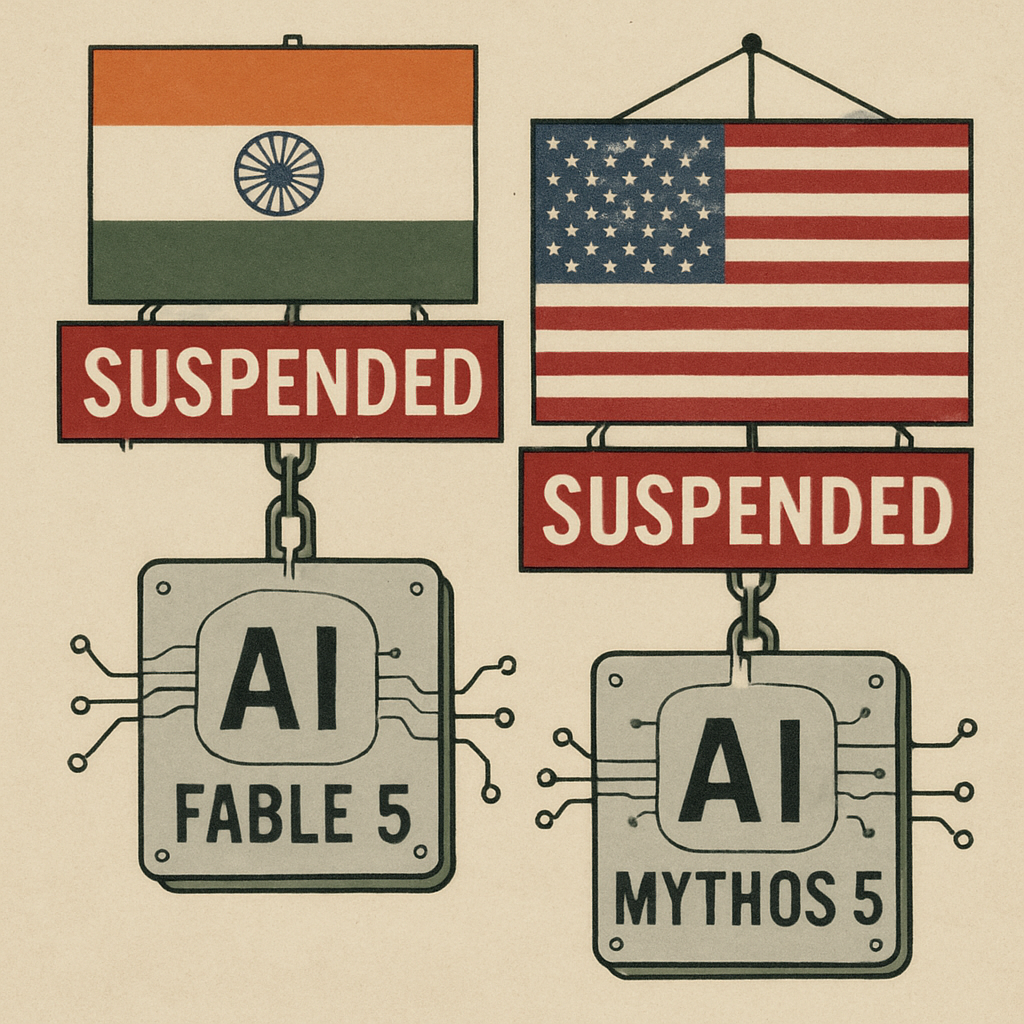
Anthropic, a leading artificial intelligence company, has suspended access to its advanced AI models, Fable 5 and Mythos 5, following a directive from the U.S. government citing national security concerns. This decision has ignited a significant debate in India regarding the nation’s reliance on foreign-developed AI technologies and the need to bolster domestic capabilities.
The U.S. government’s directive mandates that Anthropic restrict access to these models for all foreign nationals, including its own employees who are not U.S. citizens. Consequently, Anthropic has disabled Fable 5 and Mythos 5 for all users to ensure compliance. This move comes shortly after Anthropic announced a partnership with Tata Consultancy Services (TCS) to enhance enterprise AI adoption in India, highlighting the country’s deep integration with U.S.-developed AI technologies.
India has emerged as a crucial market for frontier AI companies. Both Anthropic and OpenAI have identified India as their second-largest market after the United States. These companies have established offices, expanded local hiring, and formed partnerships with Indian firms to accelerate the adoption of their technologies. For instance, Anthropic’s collaboration with TCS aimed to equip 50,000 employees with its AI models, underscoring the strategic importance of the Indian market.
The suspension has prompted Indian tech leaders to reassess the nation’s AI strategy. Aakrit Vaish, founder of the AI venture platform Activate, expressed that this development fundamentally alters the approach to sovereign AI in India. He anticipates a shift towards open-source models and plans to advise companies in his portfolio to reduce dependence on a limited number of foreign AI providers.
Concerns have also been raised about the competitive disadvantages faced by startups with international teams. Vijay Rayapati, co-founder and CEO of Atomicwork, highlighted the risks for companies with teams spanning multiple countries if access to advanced AI systems becomes subject to geopolitical restrictions. Atomicwork, with a significant portion of its engineering team based in Bengaluru, India, exemplifies this challenge.
Beyond individual companies, the suspension has sparked a broader discussion about India’s dependence on foreign AI infrastructure. Sridhar Vembu, founder of Zoho, emphasized the need for Indian organizations to embrace smaller, open-source models to mitigate reliance on foreign technologies. Investor and former Infosys executive Mohandas Pai called for a substantial increase in government investment in AI and deep technology, proposing a national mission with significant funding to develop domestic capabilities.
Despite growing interest and government initiatives like the IndiaAI Mission, which allocated approximately $1.2 billion over five years to develop indigenous AI capabilities, India remains a relatively small player in frontier model development. Only a few startups are pursuing foundational AI models, with much of the ecosystem focusing on applications built atop existing models.
Policy experts suggest that the suspension may reinforce concerns within the Indian government about strategic autonomy. The incident serves as a reminder that access to critical AI systems can be influenced by geopolitical decisions beyond India’s control, underscoring the importance of developing domestic AI capabilities to ensure technological sovereignty.
This development highlights the delicate balance between leveraging global AI advancements and fostering indigenous innovation. As AI becomes increasingly integral to various sectors, India’s approach to building and maintaining control over its AI infrastructure will be crucial in determining its position in the global technology landscape.