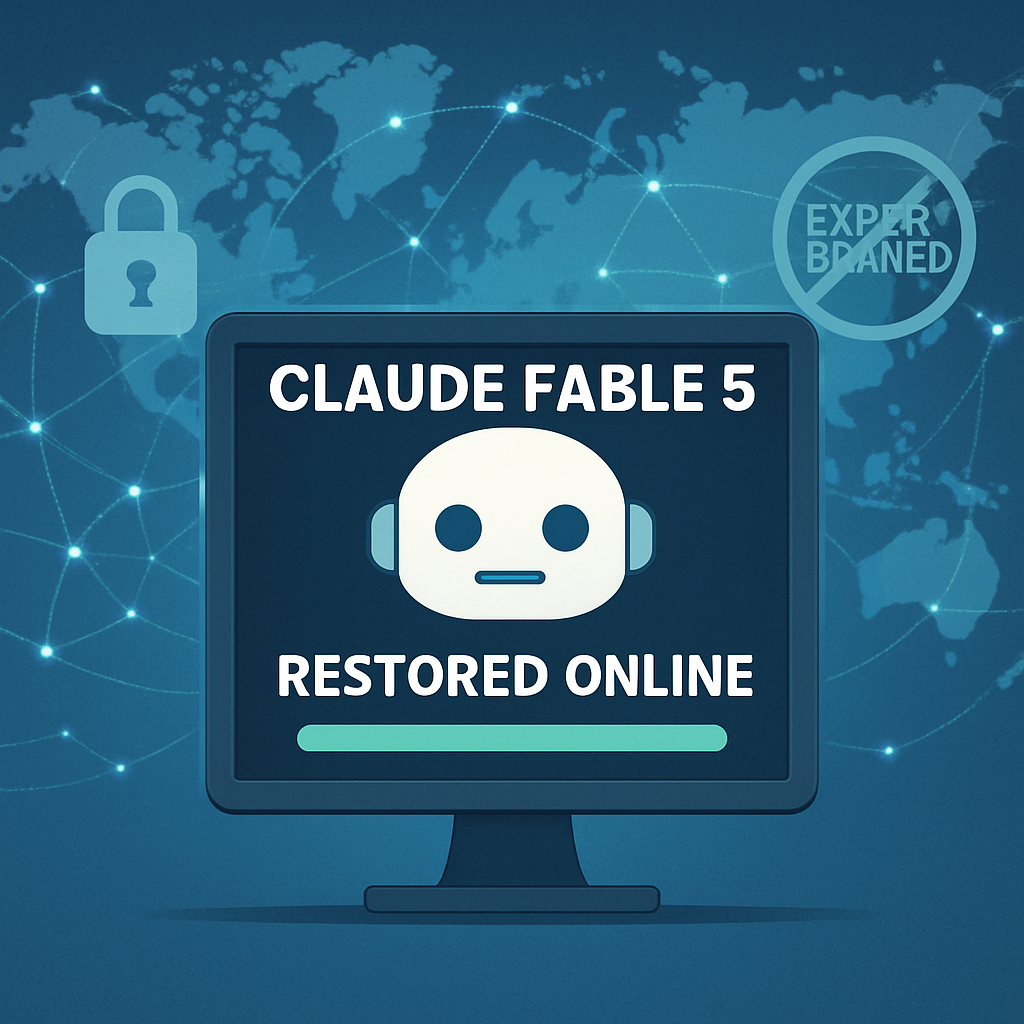
Anthropic has reinstated global access to its advanced AI model, Claude Fable 5, following the U.S. Commerce Department’s decision to lift export controls imposed earlier this month. As of July 1, users can access Fable 5 across platforms such as Claude.ai, the Claude Platform, Claude Code, and Claude Cowork.
The export controls, enacted on June 12, mandated that Anthropic restrict access to both Fable 5 and its counterpart, Mythos 5, for all foreign nationals, including non-U.S. citizens within the United States. Due to the immediate enforcement and the challenge of verifying users’ nationalities in real-time, Anthropic opted to suspend both models for all users temporarily.
The catalyst for these restrictions was a security vulnerability known as a “jailbreak,” which allows a model to bypass its safety protocols. Researchers identified such a vulnerability in Fable 5, enabling the model to identify software flaws and, in some instances, generate code that could exploit these vulnerabilities. Anthropic noted that similar prompts could elicit comparable responses from other models, including its own Claude Opus 4.8, OpenAI’s GPT-5.5, and China’s Kimi K2.7, suggesting that the behavior was not unique to Fable 5.
In response to the identified security concerns, Anthropic developed a new safety filter, termed a classifier, designed to detect and block the specific technique used in the reported jailbreak. The company reports that this classifier now successfully intercepts the technique in over 99% of attempts. When a request is blocked, users are redirected to the less advanced Opus 4.8 model and informed of the redirection. However, this solution may lead to an increase in false positives during standard coding and debugging tasks.
Regarding Mythos 5, which shares the same underlying model as Fable 5 but with fewer safety restrictions, access remains limited. As of June 26, approximately 100 U.S. companies and federal agencies involved in critical infrastructure defense have regained access. Anthropic continues to collaborate with the government to broaden access to this model.
Commerce Secretary Howard Lutnick, who authorized the reversal of the export controls, stated that his department conducted a two-week review of the models in partnership with Anthropic. The company has committed to proactively identifying security issues, coordinating on future model releases, and reporting any detected malicious use.
The initial implementation of export controls was influenced by research from Amazon and concerns raised by CEO Andy Jassy. Former AI czar David Sacks criticized Anthropic for allegedly prioritizing the availability of the consumer model over safety considerations. Conversely, some viewed the government’s actions as an overreach, with University of Sydney AI governance researcher Francesco Bailo suggesting that the reversal indicated a recognition of this overstep. Additionally, a group of security leaders had previously signed an open letter advocating for the lifting of the controls.
The timing of the suspension coincided with the rise of capable Chinese open-source models, leading to concerns that halting U.S. models could provide competitors with an opportunity to catch up. In response, Anthropic is advocating for a standardized method to assess the severity of jailbreaks. Collaborating with partners such as Amazon, Microsoft, and Google, the company proposes evaluating each jailbreak based on factors like capability gain, breadth, ease of weaponization, and discoverability.
For the most severe cases, such as those enabling attacks on critical infrastructure, Anthropic plans to implement immediate fixes upon confirmation of severity. The company is also establishing a dedicated team to monitor jailbreak reports continuously. Furthermore, Anthropic has launched a HackerOne program to encourage researchers to report new Fable 5 jailbreaks and has committed to providing the U.S. government with earlier access to test future models before their public release.
Other AI labs are facing similar challenges. Recently, OpenAI previewed GPT-5.6 to a select, government-approved group rather than the general public, citing concerns that models capable of assisting defenders in patching vulnerabilities could also aid attackers in identifying them. This underscores the dual-use nature of advanced AI models and the necessity for robust safety measures.
While the immediate crisis has been addressed, the broader issue of regulating frontier AI models remains unresolved. A recent executive order established a voluntary review process for such models before their release, along with a classified benchmark to determine which models are covered. However, there is currently no mandatory licensing requirement for deploying these models. The government’s reliance on export controls in this instance highlights the need for a more structured and binding regulatory framework for advanced AI technologies.
The restoration of Claude Fable 5’s availability marks a significant step in balancing innovation with security. However, it also emphasizes the ongoing challenges in regulating powerful AI models. As the AI landscape continues to evolve, it is imperative for both industry leaders and policymakers to collaborate in developing comprehensive frameworks that ensure the safe and ethical deployment of these technologies.