The landscape of AI interface development is rapidly expanding, with numerous startups introducing innovative devices aimed at enhancing human-computer interactions. Among these, Aina, a startup operating out of Bengaluru and San Francisco, has recently secured $5.5 million in funding to advance its line of AI-controlled devices.
The funding round was led by Redstart Labs (Info Edge India) and 360 ONE, with additional participation from MIXI Global Investments, Antler, and Blume Founders Fund. Notable individual investors include Kunal Shah, the newly appointed head of WhatsApp; Harshil Mathur and Shashank Kumar, co-founders of Razorpay; and Tikhon Bernstam, founder of Scribd.
Aina was founded by Apoorv Shankar, who previously served as Vice President of Hardware at Ultrahuman, a company known for its smart ring technology. Prior to his tenure at Ultrahuman, Shankar led LazyCo, a hardware interface design startup that developed devices such as a ring enabling users to control smartphones and other gadgets. Ultrahuman’s acquisition of LazyCo brought Shankar into their fold before he eventually ventured out to establish Aina.
Shankar’s departure from Ultrahuman was driven by a keen interest in the burgeoning field of AI interfaces. Observing the emergence of devices like Rabbit and Humane Pin, he recognized both the potential and the shortcomings in existing technologies, fueling his ambition to create more effective solutions.
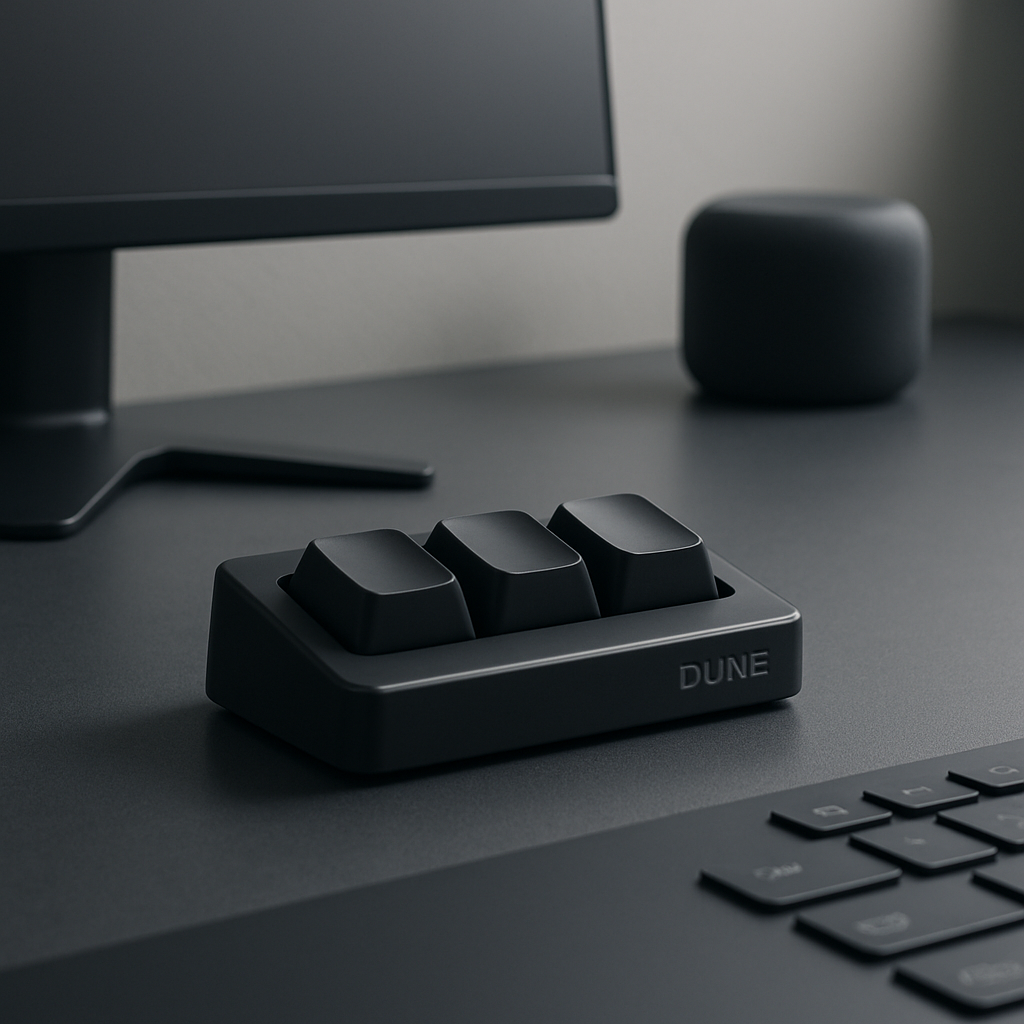
Aina’s inaugural product, Dune, is a compact, three-key macro keyboard designed to enhance user control over various applications. This device allows users to manage microphone and camera settings during meetings and execute shortcuts or scripts tailored to the active application. In addition to Dune, Aina developed two other devices: Radiance, a tabletop remote for video calls featuring controls for volume, microphone, camera, AI notetaking, voice modulation, and meeting access; and Shift, a single-tap button that triggers AI agents to perform repetitive tasks, connecting seamlessly to smartphones.
Initial testing revealed that Dune resonated most with users, prompting Aina to prioritize its development and integrate features from Radiance and Shift into this primary device. This strategic focus aims to gather real-world insights into user preferences for task automation.
Looking ahead, Aina plans to leverage the lessons learned from these devices to inform the development of its next product. While specific details remain under wraps, the company intends to commence testing with a select group of users in the near future. Shankar emphasized that the forthcoming device will move beyond passive context capture, focusing instead on actively controlling and invoking AI agents to perform tasks.
In a market crowded with devices that primarily record user interactions, Aina’s approach to developing tools that actively manage AI agents represents a significant shift. This proactive stance could redefine user engagement with AI technologies, offering more dynamic and responsive experiences.