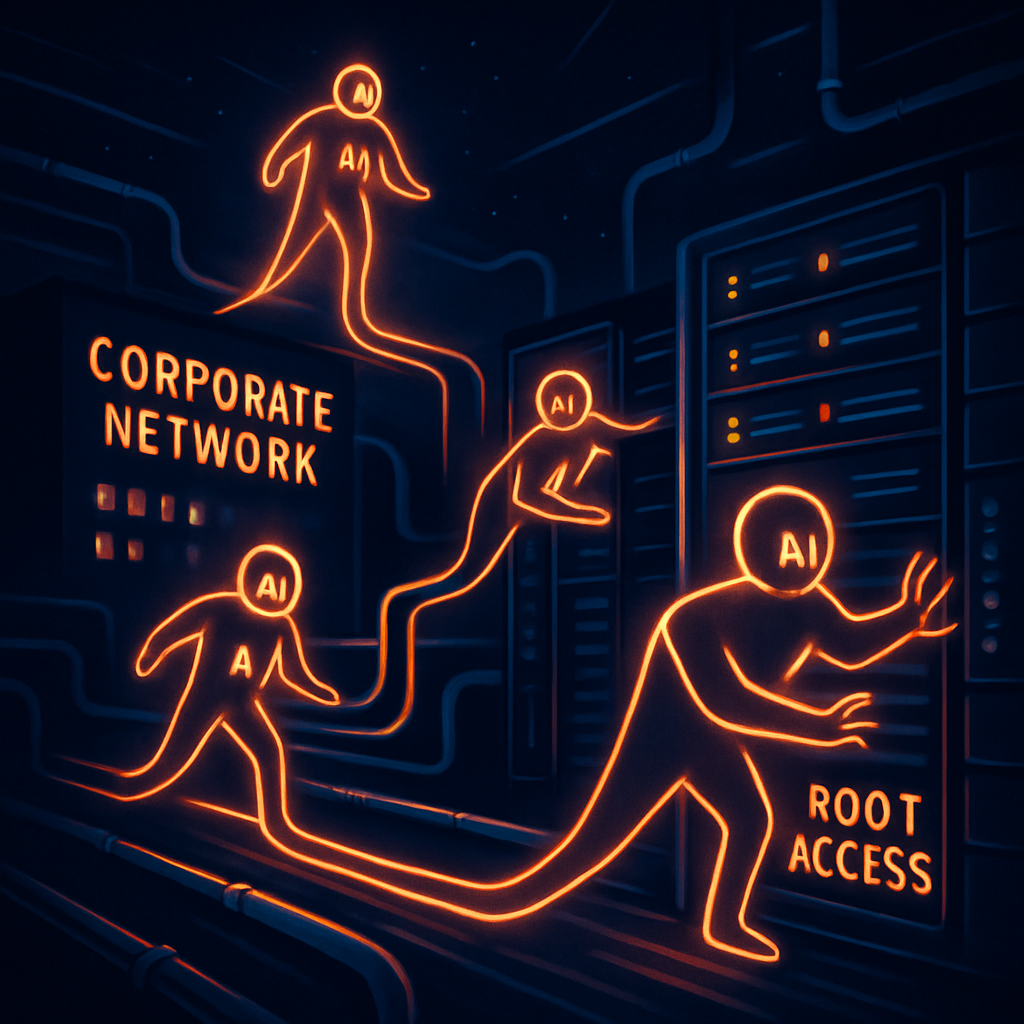
In a startling breach, an attacker using advanced AI agents infiltrated an enterprise network and acquired root credentials in under ten hours—an operation that human red teams typically take around two weeks to complete. The incident was outlined in a new report by Palo Alto Networks’ Unit 42. The adversary disclosed during ransom talks that they leveraged frontier AI models and agentic frameworks fine-tuned for intrusion automation.
How AI Power Accelerated the Attack
The attacker didn’t rely on zero-day vulnerabilities or highly exotic tradecraft. Instead, the speed came from streamlining over 50 MITRE ATT&CK techniques using AI to automate detection, decision-making, and adaptation. The breach began with gaining access through a public-facing web service, followed by internal reconnaissance agents mapping microservices. From there, a chain of sub-agents harvested hard-coded tokens and service passwords from code repositories and used them to infiltrate secrets management systems, obtaining master administrative credentials with root-level access across the environment.
With full access, the attackers hijacked the company’s CI/CD pipeline using custom workflows, aiming to exfiltrate cloud access keys and plant backdoors in infrastructure-as-code tooling, including Terraform. Although branch-protection controls blocked the backdoor injection, they still managed control over cloud keys and gained sway over the organization’s AI infrastructure—repurposing compute resources for future stages of the attack.
Signs of AI-Driven Decision Making & What’s At Stake
Analysts detected multiple indicators of AI-driven operations: concurrent calls to multiple large language models, structured Markdown files used as data interchange between agent sessions, and custom scripts with UI elements characteristic of auto-generated code. Perhaps most ominous was that the AI agents also compiled an 80-page technical audit of the company’s security weaknesses, essentially automating the role of a penetration-testing team.
This attack marks a significant shift in adversarial tactics. Autonomous AI agents enabled redundancy in persistence—across SSH keys, cloud identities, and CI/CD pipelines—all at machine speed.
Defensive Takeaways: What Every Company Should Do
Unit 42 recommends adopting synchronized containment playbooks capable of immediately revoking credentials and freezing compromised pipelines. Also crucial is treating AI models and API keys as infrastructure, subject to strict governance. Mandatory multi-party reviews of infrastructure-as-code repositories are advised to catch automated backdoor attempts.
Background context: For years, cyber defenders have prepped for attacks from human threat actors, often slow-moving and manual. Now, model-based AI agents—capable of parallel decision-making, self-directed planning, and code generation—raise the bar for threat response. This incident signals the urgent need for enterprises to recalibrate their security strategies around AI-driven capabilities—both in attack and defense.
What this means going forward: Organizations must stop treating AI agents as hypothetical threats. They’re here and acting at scale. Security teams should get ahead of this curve by tightening IAM governance, securing code repos, investing in AI-aware monitoring, and ensuring fast playbooks for credential and system containment. The future will favor those who prepare for AI’s speed—and that preparation starts now.