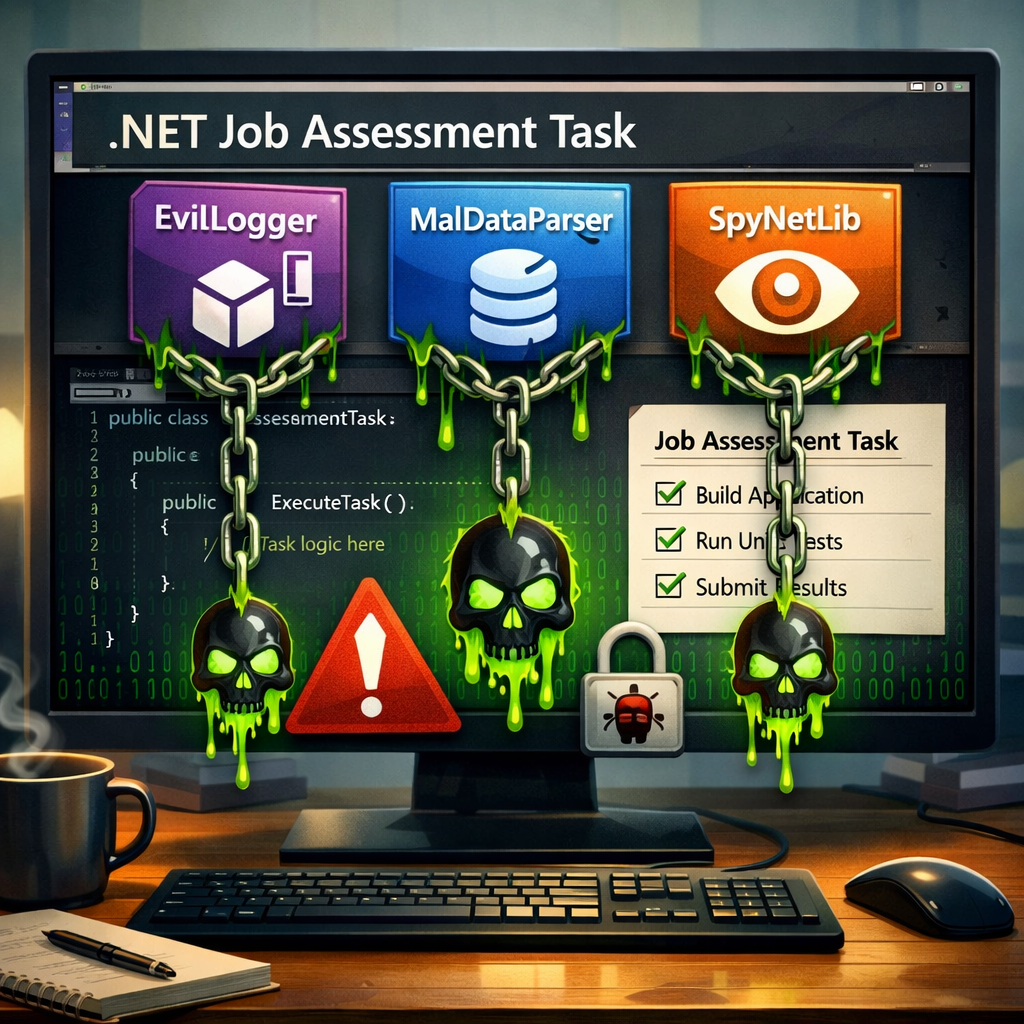
Security analysts have uncovered a sophisticated malicious campaign that exploited fake .NET job assessments to distribute malware via NuGet packages targeting Windows developers. The strategy involved luring prospective hires into downloading and integrating seemingly innocuous WinUI and WPF control libraries, which in turn embedded malware through DLL side-loading and remote code execution. All 13 malicious packages have since been removed from NuGet.
How the Lure Worked
The attackers posed as clients offering technical assessments for job applicants. Assessments were hosted in a GitHub repository under the guise of tasks like enhancing a FileButton control and implementing exception handling within a 3–4 hour window. Candidates were allowed to use AI coding tools but discouraged from simply pasting solutions without understanding them. Reference to malicious packages was woven into the assessment’s project file, steering candidates to include names like VS_Builder.WinUI3Controls and WinUI3IconButton as dependencies. These packages came with hidden payloads.
Malicious Capabilities Uncovered
The malicious packages performed a variety of harmful actions once a project was built or launched. Some would fetch files from GitHub, then plant a DLL next to the legitimate Microsoft On-Screen Keyboard executable (osk.exe), leveraging DLL side-loading for stealthy execution. One package downloaded a file named avast.exe via GitHub APIs, placed it in the %TEMP%\Launcher.exe path, and executed it. Another package included an MSBuild target file that triggered a DLL download and side-loaded it through osk.exe.
Additionally, the threat actors created deceptive repositories mimicking the popular Axios JavaScript library. These included names like axios-test-one, telemetry-metrics, and fs-extra-core. Although they appeared legitimate, they incorporated backdoor executables, Chrome profile stealers, data exfiltration mechanisms, and persistent loaders reporting system info to attackers via Telegram bots.
The campaign extended into job marketplace sphere: the fake client posted a C# WPF developer position on a Web3 freelancing platform, offering compensation between $8,500 and $10,000. The job description claimed the project would involve creating .NET desktop applications to enumerate installed crypto wallet extensions. The persona portrayed a “blockchain and DeFi specialist” based in Miami—though records show the account is linked to Korea and was only created in July 2026.
Unraveling the Timeline & Investigation
The first malicious package was uploaded back on July 23, 2026; the most recent known uploads came in early November of the same year. The assessment repository was established on November 3. The fraudulent freelancing listing appeared on November 7. NuGet removed many of the packages on November 2 after detection. Researchers uncovered links across the fake assessment, malicious NuGet libraries, and phishing-style activities including fake reCAPTCHA prompts.
No concrete attribution has been made yet. Analysts noted similarities in methods with campaigns tied to nation-state groups from North Korea and Iran, though the code and infrastructure diverge from known public malware families.
Key malicious NuGet package names identified include: WinUI.Button, VS_Builder.MSBuildAnalyzer, HappyOne.WinUI3Controls, Web3TotalButton, RevertButtonIcon, WinUI3IconButton, WindowsAccentColorName, SetButtonColor, InitializeCustomButton, StyledAppButton, and StyledComponent.
What .NET Developers Should Do
- Verify package origin: Review publisher details or external documentation when adding unfamiliar NuGet packages.
- Audit third-party dependencies, especially for control libraries or UI kits, for suspicious behavior like file downloads, embedded executables, or side-loading usage.
- Monitor for unexpected build steps or MSBuild targets that run hidden DLLs post-build.
- Avoid job assessments requiring external packages unless provided or verified by the hosting organization.
This discovery underscores how supply chain attacks are evolving: fake job assessments are becoming a vector to distribute malware. It highlights a dangerous intersection of social engineering, open-source dependency misuse, and recruitment tactics. As organizations and developers rely on outsourced assessments and public package ecosystems, verifying trust becomes harder but more essential. Watch for increased scrutiny on dependency publishers, more stringent vetting of assessment workflows, and expanded oversight from platforms to shut down malicious packages quickly. The lasting take-away: for developers, every dependency is a door—stay alert before letting any in.