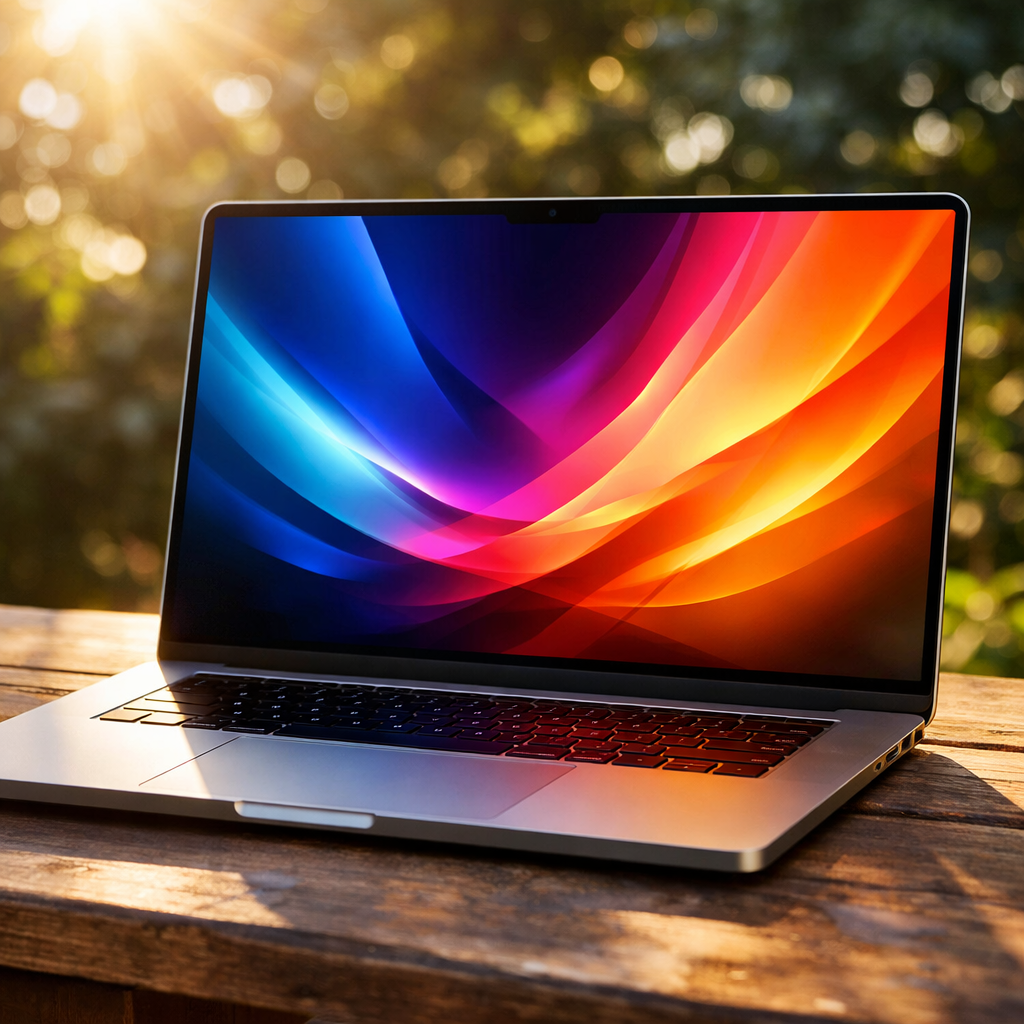
Apple’s new 16-inch MacBook Pro ushers in its first OLED display under the name PROLED XDR, adds touch support, Dynamic Island, and a redesigned cooling system. It’s a bold move, but the heart of this generation—the M5 chip—is unchanged. If you don’t need cutting-edge yet, the next big leap may arrive with the anticipated M7 version, likely in November 2027. The question is: buy now for the visual and feature upgrades, or wait for refined performance?
First OLED, First Touch, First Dynamic Island
The hallmark of this model is its PROLED XDR display. OLED layers are stacked in tandem to deliver a 16.3-inch panel with a 3472×2266 resolution, yielding vibrant color, deep blacks, and exceptional contrast: up to 2,000 nits peak brightness both in HDR and SDR, and a contrast ratio of 10,000,000:1. It adds Adobe RGB to its color gamut alongside P3. ProMotion remains, now spanning 10 to 120Hz, and a nano-texture glass option cuts glare for demanding visual work. The impact is immediate—whether editing or watching media, this display overshadows Apple’s prior mini-LED screens.
Tactile control has come to the MacBook Pro in the form of true touch support—swiping, pinching, and dragging are now part of the laptop experience. While most core workflows remain built for the trackpad or mouse, touch adds intuitive shortcuts, like contextual menus and window controls. Dynamic Island replaces the former wide notch with a smaller hole-punch camera, freeing up the menu bar and housing Live Activities. It’s a redesign that improves visibility and utility for many users.
Build, Internals, and Battery
Apple has shaved about 0.7 pounds off the 16-inch model, bringing it down to 4.0 lb—with slimmer borders and a thinner profile throughout. New recessed feet reduce lift on desks, which helps reduce bounce when using the touch screen. The chassis still feels premium despite the lighter form.
Under the hood, the Silicon remains the same: your options are the M5 Pro or M5 Max, both with an 18-core CPU (6 efficiency cores, 12 performance cores). GPU ranges from 20 cores in M5 Pro, up to 32 or 40 cores in Max configurations, with memory up to 128GB and bandwidth peaking at 614GB/s. Apple cites up to 10.9× improvements over M1 Pro with the M5 Pro, and up to 12× over M1 Max for the M5 Max—but in real-world uses, performance holds steady, with no major gains over the prior generation.
Battery life impresses: the 100Wh pack delivers up to 24 hours of video playback on the M5 Pro, and up to 22 hours on the M5 Max—matching Apple’s projections. Port selection is familiar: three Thunderbolt 5 with 120Gb/s speed, HDMI, SDXC card slot, MagSafe 3, headphone jack. Wireless has also been updated: there’s a new N1 chip, plus Wi-Fi 7 and Bluetooth 6. Camera and audio see boosts too, with a 12MP Center Stage camera with Desk View and a six-speaker speaker system with force-cancelling woofers and a three-mic array.
Trade-Offs and Why You Might Wait for M7
Even with its impressive display and design refresh, there are compromises. The screen’s touch layer still has some give, and its use case is limited in macOS. More importantly, OLED’s pulse-width modulation introduces a flicker—running at 240Hz with roughly 56% amplitude. For sensitive users, that could mean discomfort over extended sessions. Also, while Apple dropped in a new cooling layout, sustained load performance remains similar to last year’s models. Tasks that push the hardware don’t run cooler, or finish substantially faster.
Price is another hurdle. With PROLED as the premium tier, this model commands a higher cost—on top of already elevated pricing for MacBook Pros. If your current machine still does what you need, holding out for the M7 generation makes sense. That version should keep the visual wins while refining thermal behavior, reducing temperatures, and eliminating early quirks.
Verdict. For those who want the best display Apple has ever built into a laptop, combined with a lighter body, speakers, and new features like touch and Dynamic Island, the PROLED MacBook Pro is a compelling upgrade. But it’s first-generation tech. If performance trumps visuals in your work, or if you’re sensitive to screen flicker, waiting for the M7 might reward you more.
What this means. Apple has taken a big step toward merging display and interface innovation with its laptop line. The PROLED model signals that OLED touchscreens are coming to the core MacBook experience. The company is clearly balancing flashy upgrades with incremental architectural changes. As users, the trade-offs will revolve around price, first-gen cost and polish, and whether performance gains are worth waiting for. The real test for Apple will be how well the next iteration delivers polish, reliability, and thermal improvements—especially for creators loyal to the MacBook Pro.