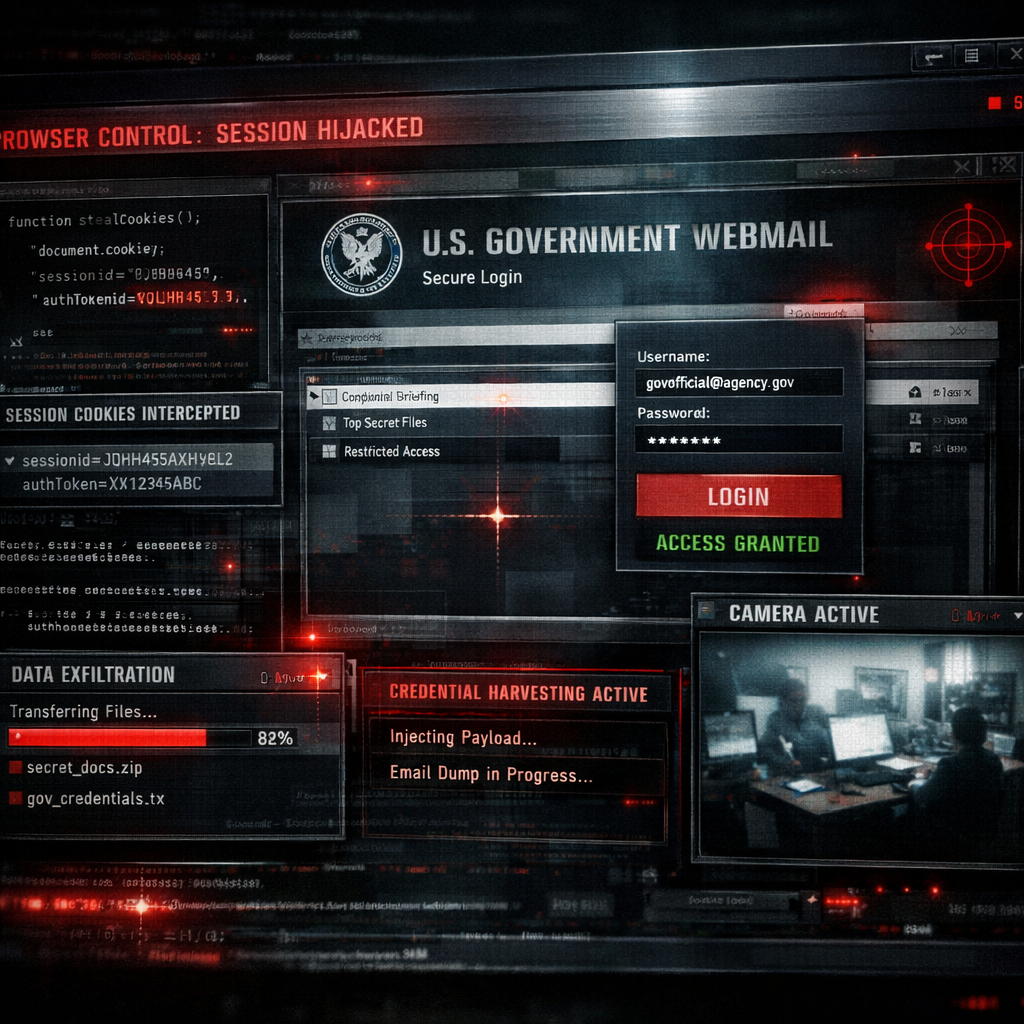
Hackers are exploiting a browser-based command-and-control framework dubbed Falcon C2 (also known as XG or Xiàng Gē) to breach government webmail portals and internal applications. The group behind Falcon C2 has stolen passwords, session cookies, emails, and internal communications by injecting malicious JavaScript into trusted websites. Targets include foreign affairs, defense, and interior ministries, as well as law enforcement agencies. The affected countries span one in the Middle East and four in Southeast Asia, in attacks that occurred between March and May 2026.
How Falcon C2 Works and Its Toolset
Falcon begins its attack chain when a user opens a compromised site, which then contacts an attacker-controlled server. That server delivers an obfuscated JavaScript implant uniquely modified per browser session, using numeric encoding and a decoder to mask its code before execution. Once loaded, the implant creates a persistent WebSocket connection over TLS, and may encrypt messages using AES-256-CBC following a key exchange via RSA. This gives operators full visibility into sessions, including labeling victims, monitoring active browsing contexts, and deploying commands that exfiltrate browser data. The implant is limited to the browser at first, until further escalation.
Complementing the script-based implant are browser extensions—disguised as PDF viewers—that work in Chrome and Firefox. These extensions request up to 40 permissions, enabling access to credentials, cookies, browsing history, clipboard contents, downloads, and network traffic. They can even turn a compromised browser into a proxy so the attacker can act as the user, harvesting Gmail messages, Discord data, Zalo messages, and even visible Direct Messages from X (formerly Twitter).
Notable Intrusions & Antino Deployment
In April 2026, a Roundcube webmail portal belonging to a foreign ministry in the Middle East was found compromised: at least 39 instances of Roundcube in that country had been hit. The attackers were able to steal credentials and access inboxes in authenticated webmail sessions. At another target in Southeast Asia—law enforcement—attackers first harvested usernames from an internal portal, then deployed a fake Adobe Flash Player update to deliver a Rust-based Windows backdoor named Antino. That tool is separate from Falcon, using Microsoft OneDrive as a command and control channel to issue commands, collect data, and transfer files.
Another case involved an extension sideloaded onto Chrome in developer mode at a justice-related institution. The extension operated for over three weeks, capturing plaintext login credentials, taking screenshots of internal documents, and collecting other sensitive data. Although defenders saw references to automated tools for silently installing such extensions, those utilities were not recovered in the samples analyzed.
Indicators & Defensive Measures
Indicators of compromise (IoCs) tied to Falcon’s infrastructure include domains such as fonts.tarotfree101[.]top, fonts.chrorne[.]com, robot.avbliud[.]com, plus payload delivery domains like microsoft-flash[.]com and wps-cn[.]com. Specific artifacts include the Chrome extension with ID mbidcmlcbgbphpoacojjbmfpohcimjji, payload URLs such as a fake Flash installer, cookie patterns, storage fields, OneDrive paths for command requests and file uploads, and the Antino executable’s install path on Windows systems.
Mitigation strategies include auditing for unauthorized browser extensions (especially in dev mode), inspecting internal portals for embedded external scripts, monitoring outgoing WebSocket connections from browsers, and watching for abnormal OneDrive usage tied to unknown tenants. Blocking untrusted extensions and ensuring portal integrity are critical first steps for defenders.
Falcon C2’s campaign demonstrates a growing trend in which attackers use browser-resident malware and cloud-based channels for espionage-style operations. Rather than going after mass financial gain, this campaign appears focused on intelligence gathering via targeted webmail systems and internal government applications. It joins a larger ecosystem of threats that persistently exploit browsers, often using compromised or trusted infrastructure to mask their activity.
What this means: For government agencies and high-value organizations, browser security has become as important as traditional network defenses. Falcon’s techniques show how ordinary internal webmail portals and browser extensions are increasingly being weaponized. Going forward, watchdogs must strengthen telemetry around browser extensions and privilege creep, and maintain up-to-date threat intelligence around tools like Falcon and Antino. The ability to detect subtle anomalies—like a WebSocket using TLS or odd OneDrive file transfers—may make the difference between compromise and containment.