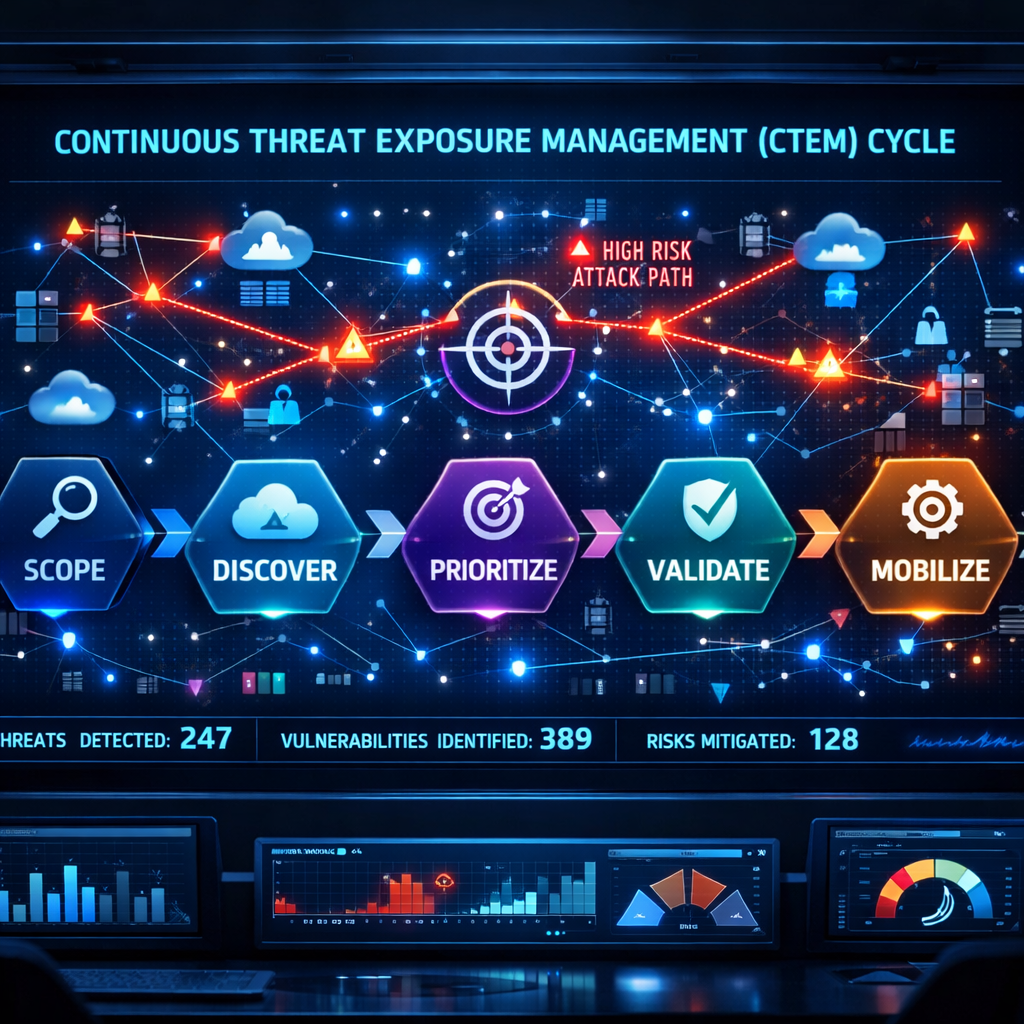
Continuous Threat Exposure Management (CTEM) is becoming essential in cybersecurity—a structured, five-stage cycle spanning scope, discover, prioritize, validate, and mobilize. Most platforms don’t fully cover all these stages, even if sales sheets claim otherwise. Validation—the step where exposures are proven exploitable along real attacker paths—is the hardest and most skipped stage. Others often omit it entirely. Among the top contenders this year, XM Cyber, Cymulate, and Tenable rise to the top.
Leading Platforms by Strengths
XM Cybertakes first place with a score of 8.8. It excels by offering continuous path computation to critical assets (crown jewels), enabling defenders to prioritize choke-points whose fixes sever the most attack routes. Its validation capability is robust—ongoing, not periodic. Discovery and mobilization aren’t its strongest suit, however; they often need help from other tools.
Cymulatecomes in a close second with an 8.7. What sets it apart is the convergence of its validation and exposure layers. It extends control testing across email, web, endpoint, and lateral movement, then feeds those findings into an exposure-scoring layer that powers mobilization workflows. This makes it more accessible to smaller or resource-constrained security teams.
Tenablesits in third, at a score of 8.5. It packs the broadest discovery footprint—cloud, identity, external assets, infrastructure—all feeding into a unified prioritization engine. It’s the go-to for organizations focused on mapping their full attack surface and weighing risks holistically. But its validation realism still has room to grow.
Other platforms scoring high include:
- Palo Alto’s Cortex Xpanse— exceptional external discovery by mapping internet-facing assets, including forgotten or orphaned ones. Score: 8.3.
- Microsoft— strong for organizations already using its Defender/E5 suite. It bundles discovery, scope, and prioritization across identity, endpoint, and cloud, with attack-path features starting to mature. Score: 8.2.
- CrowdStrike— prioritization informed by adversarial telemetry; marrying agent-based internal data with surface-wide discovery. Score: 8.1.
- Picus Security— control-validation-led work, turning test failures into vendor-specific remediation items, feeding exposure scoring. Score: 8.0.
- Rapid7— balanced discovery, prioritization, and mobilization geared toward mid-market users. Score: 7.8.
- IONIX— sharp external and supply-chain mapping with exploitability validation; focused on what’s real, not hypothetical. Score: 7.7.
- Skybox Security— its depth in network-model path analysis is notable, but corporate restructuring in 2024 means companies must now verify its corporate status before contract. Score: 7.2.
How CTEM Works & What to Look For
CTEM is different from traditional vulnerability management because it treats exposure without validation as just prettied-up scanner results. To do CTEM well, you need buy-in and ownership for all five stages—scope, discovery, prioritization, validation, and mobilization. Throwing money at tools won’t help if validation isn’t real and fixes aren’t tracked.
A reliable program should strive for metrics that mean something: how many validated attack paths are severed per quarter, and how long it takes to move from a prioritized finding to a fixed exposure. Skip these at your risk.
For many organizations, a combination of tools yields the best coverage: pick one anchor for discovery & prioritization (platforms like Tenable, Microsoft, or CrowdStrike), one that excels at validation (like XM Cyber or Picus), and something external (such as Xpanse or IONIX) if you’re exposed on the public internet. Always be honest about which CTEM stages your tools cover—and demand real validation or accept that you’re really doing VM.
Whether you’re investing in CTEM for front-line security teams or to satisfy board-level risk mandates, the platforms you pick determine what you can actually prove—not just what you can scan. Prioritize paths over checkboxes. Watch for validation, exposure reduction, and actionable mobilization. CTEM isn’t marketing—it’s measurement.