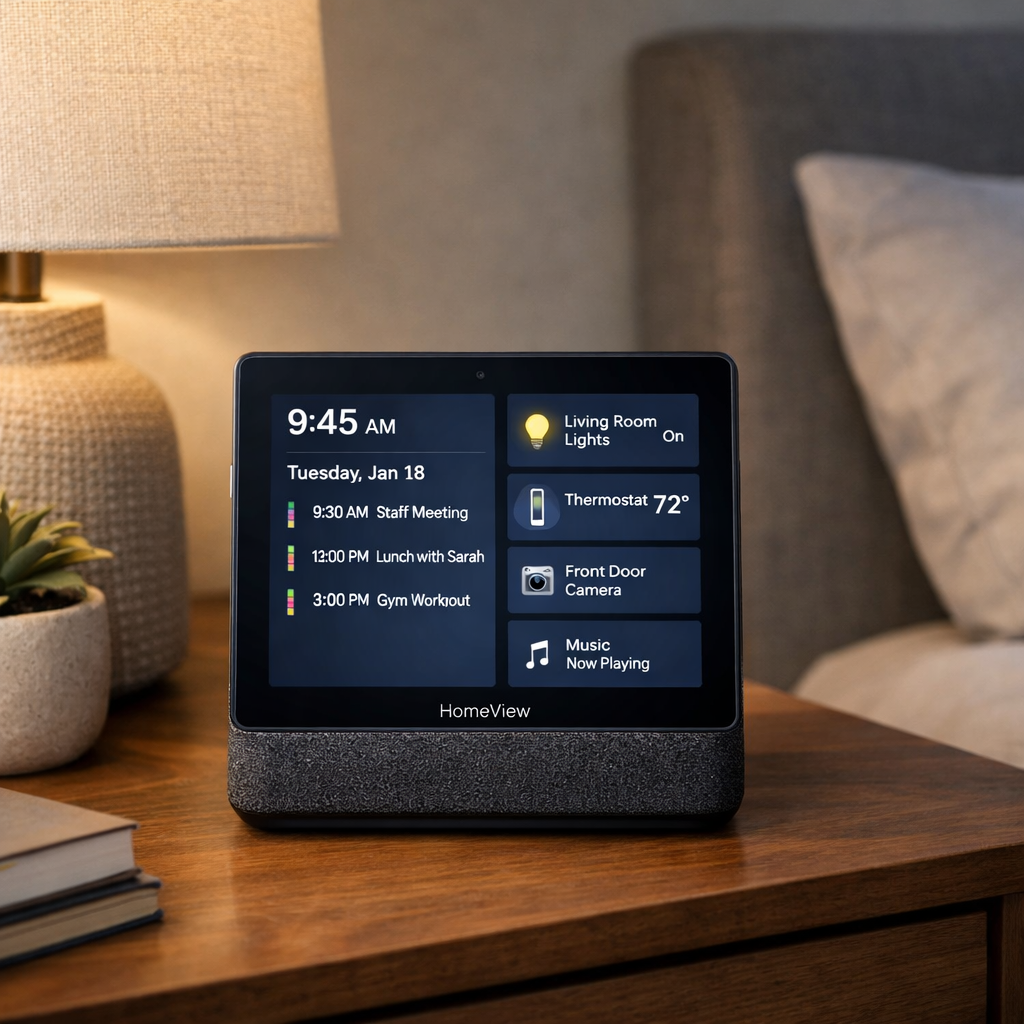
Apple’s HomeView smart home hub, announced just a month ago, is now arriving at the doorsteps of pre-order customers. In several markets—Australia, New Zealand, the UK, Canada, India, Singapore, South Africa, and the U.S.—people are beginning to receive the device ahead of the official launch date set for November 13. In Australia and New Zealand, that date falls today (November 13 local time), while Apple doesn’t expect any stock shortages. HomeView is designed to blend the functions of a compact iPad and a HomePod.
What HomeView Offers
The device features a 7-inch square display available in two versions: a tabletop model with a speaker base, and a wall-mount model (mounting hardware sold separately). It includes a camera and facial and voice recognition capabilities, enabling it to distinguish up to six people in a home. Each user gets customized content—thumbnails, data, and widgets drawn from their iPhone. Apps are built in; there’s no App Store, but native Apple apps and widgets deliver weather, calendar, music, video, smart home control, and video calls.
Under the hood, HomeView runs on Apple’s Siri AI, the upgraded voice assistant introduced in iOS 27. The device is priced at $299, with the wall-mount version requiring a separate purchase for the mounting hardware.
Where and When
HomeView is launching in eight countries and regions: Australia, New Zealand, the United States, Canada, the UK, India, Singapore, and South Africa. Notably, it won’t be available in the European Union initially, because Apple’s Siri AI isn’t yet cleared to operate in the EU markets. Apple TV 4K (fourth generation) is also launching on November 13 in many of the same countries; this model offers options like an A19 chip, 128 GB storage, Wi-Fi-7 support, and an optional surround sound setup with four HomePods.
In countries where physical Apple Stores exist, such as Australia, customers will be able to visit in person to pick up HomeView. In New Zealand—where there are no Apple Stores—customers must go through online or authorized channels.
This marks the beginning of a broader rollout that aims to place HomeView as the central hub in Apple’s vision of a smart home. Its timing aligns with Apple’s recent push into integrating AI across its ecosystem and extending its influence in home automation.
Why This Matters
HomeView isn’t just another smart display—it represents a convergence of personal AI, privacy, and everyday smart home utilities. By offering facial and voice customizations tied to individual users, running local Siri AI, and integrating with iPhone widgets and apps, Apple is staking a claim in a space increasingly defined by privacy concerns and personalization.
As HomeView starts reaching hands outside of tightly controlled review units, what to watch for are real-world reliability of the voice and face recognition, how well the device handles cross-user experience, and how the absence of third-party app support affects its value. Also telling will be how quickly Apple can expand into the EU and/or adapt Siri AI to meet regulatory requirements there.