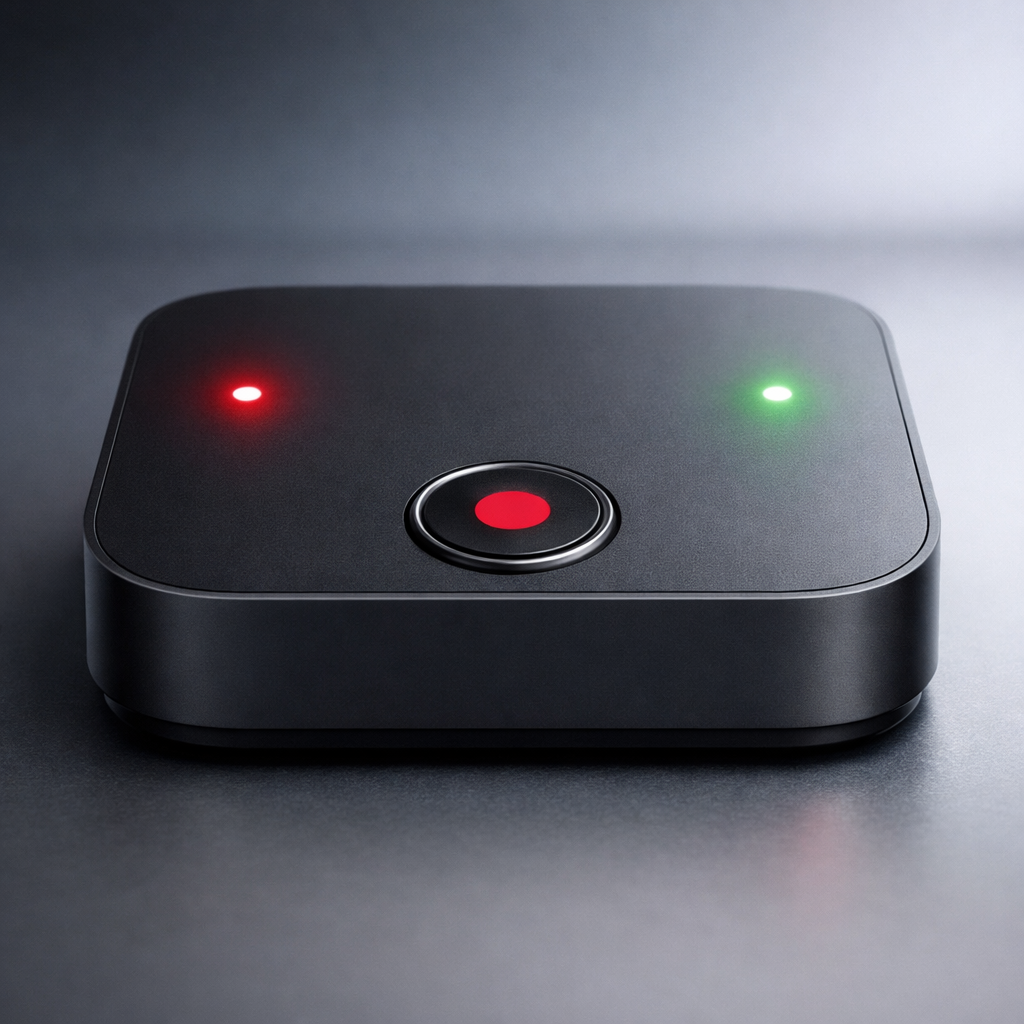
Nothing, the company helmed by Carl Pei, is gearing up to launch its first “AI-native” hardware—one explicitly described as screenless and more substantial than just an app. Teased last week, the device remains under wraps. But recent glimpses suggest it’s shaping up to be, quite literally, an AI recorder.
Teasers hint at recorder design and intent
Pei’s recent public comments described a product that “couldn’t have been an app,” signaling the need for dedicated physical form. Paired with a follow-up teaser featuring a slogan about context “not living in a chat box,” these remarks suggest that this device captures raw, spontaneous moments—possibly voice-based—that are often lost when relying on smartphones. Add to that visible green and red lights next to what looks like a record button, and the picture becomes clearer.
While Nothing hasn’t confirmed its exact form or functionality, the green and red indicators—common UI elements for recording—and the device’s lack of screen strongly support the idea of an audio-focused recorder. The visuals and positioning of buttons make it seem more than a digital toy; this may be intended for serious audio capture, perhaps even one-touch recording of thoughts, conversations, or ideas.
Existing market & potential pitfalls
AI recorders exist already, with varying degrees of quality in terms of recording fidelity, transcription accuracy, and features like noise cancellation or privacy safeguards. Nothing will need to differentiate itself in all of those areas. So far, there’s no indication of how the company plans to tackle legal concerns—such as consent and data protection—around a device whose core function implies passive listening or continuous recording.
Equally important will be how the device sources context and metadata. Is it always listening, or only when prompted? Does it associate recordings with timestamped data or location? All that matters when aiming to stitch together fragmented moments into coherent memories—and that seems to be the goal hinted at by Nothing’s teasers.
Why screenless AI recorders keep drawing interest
Recent years have seen a surge in demand for devices that let users capture thoughts and interactions without interrupting their flow—traditional gadgets like smartphones with screens often get in the way. People want tools that are lightweight, always-ready, embedded in daily life, and less obtrusive. Nothing seems to be targeting that niche.
Another driving force is the rising importance of context-aware AI. A constant challenge for AI tools is missing data: the small, fleeting moments that don’t make it into text messages or social media posts, but shape how we think, communicate, and decide. Capturing that context outside a chat interface can be profound if done with sensitivity to privacy.
What to look for next: Nothing will need to provide clarity on battery life, storage, user interface (if any), privacy and security measures, and how it sets itself apart against incumbents. A unique angle—whether it’s seamless transcription, edge processing for privacy, or integration with AI assistants—could be the deciding factor in whether this device becomes a novelty or a tool that people actually want everyday.
This signals more than another gadget: it reflects a shift toward ambient tech, tools that assume the role of silent companions helping us remember, think, and act—without always demanding our full attention. If Nothing pulls this off, it could mark a turning point in how we capture and interact with our lived experience.