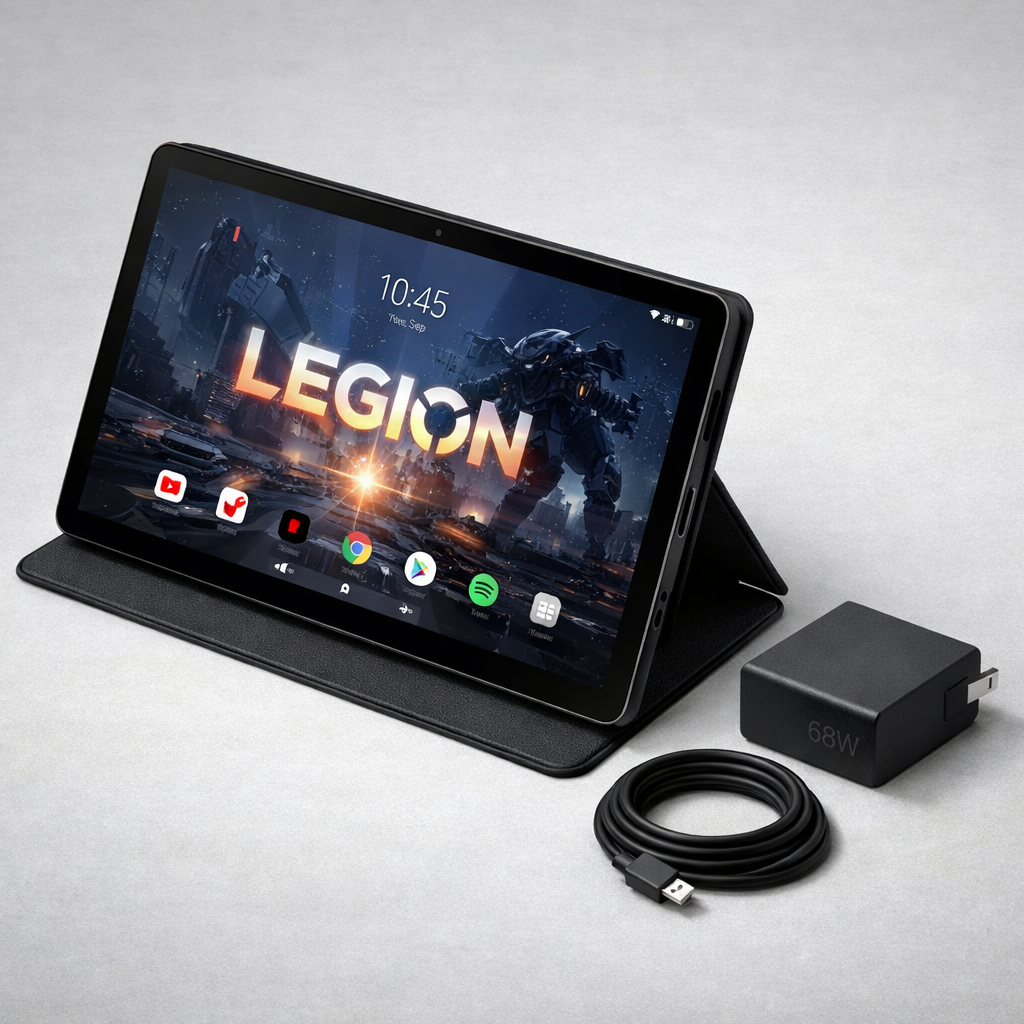
Lenovo’s Legion Tab Gen 5 lands as a rare miniature Android gaming tablet promising serious performance — but at nearly $900, it comes with some serious compromises. A decade on from devices like Nvidia’s Shield Tablet, it recaptures that small, gaming-first form factor but struggles with display and software shortcomings.
Design & Display: Compact, classic style with modern quirks
The Legion Tab Gen 5 features an 8.8-inch 16:10 LCD screen housed in a boxy matte-black shell, recalling older gaming tablets. It’s sizable enough to feel immersive, yet still manageable in a backpack. Lenovo’s design choices include stereo speakers placed along the device’s right side, bottom, and top edges — clever positioning that avoids covering them in landscape mode. But battery weight (360 g) and a camera bump that prevents it from lying flat hurt its usability. Also, its matte back attracts fingerprints. Notably missing is a stylus and an OLED panel; contrast suffers, with deep blacks appearing more like dark grays. The screen can reach 600 nits normally, 800 nits in HBM, but occasional lock-ups at 60 Hz regardless of refresh rate setting are a frustrating bug.
Performance, hardware & accessories: Power-packed but pricey
Under the hood, the Tab Gen 5 uses a Snapdragon 8 Elite Gen 5 chip that’s powerful enough for high-intensity games, with titles like Persona 3 Reload managing to run with reduced graphics settings. Steam emulation via apps like DroidDeck comes alive, delivering features such as Big Picture mode. For many games, performance is impressive — but pushing graphical limits or emulation brings framerate dips. Battery life impressed during content-heavy usage and is supported by a 68 W fast charger in the box, alongside dual USB-C ports that cater to both portrait and landscape orientations.
Accessories are less inspiring. The included folio case feels flimsy — its triangular stand poorly grips and one corner flexes noticeably. The tablet comes with a screen protector, but no headphone jack — a miss for a device clearly aimed at gamers. As for biometrics, there’s only face unlock (camera-based), no fingerprint sensor, which proves unreliable in low light and often demands a PIN instead.
Software & daily usability: Rough edges undermine potential
The software experience is mixed. While Android still offers flexibility, Lenovo’s implementation on the Legion Tab feels rough around the edges — scrolling, rotation, and wake-from-sleep features are inconsistent. Severe bugs plague basic functions: switching refresh rates, auto-rotate toggles that don’t behave, YouTube videos stutter even when resolution is lowered, and the slate sometimes fails to wake reliably. There’s also considerable bloat: preloaded apps include social media tools, match-three games, and multiple solitaire or mahjong clones, many unwanted by users.
Lenovo hasn’t published a clear update roadmap. Based on its past footprint, expectations hover around two major OS upgrades and roughly four years of security patches — modest for a premium price tag. Many of the frustrations stem from what feels like on-device glitches rather than hardware limitations, leaving hopes that firmware updates could unlock better stability over time.
Verdict: Unique, but not ready — unless you wait
For gamers craving a small, powerful Android tablet, the Legion Tab Gen 5 has moments of brilliance. Steam-based emulation runs surprisingly well, and its form factor is deeply appealing. But at its launch price of ~$900, the device’s display, software, and value pale compared to competitors like the iPad Mini or OLED gaming slates.
Unless you can snag it for ~$700—not fully expecting miracles—or you’re okay with rough software but want muscle under the hood now, it might be better to hold off. The real upgrade worth waiting for could be the LEGION Tab Gen 6, rumored to bring OLED and hopefully fix many of these issues.
Ultimately, the Legion Tab Gen 5 shows what gaming tablets should try to be in 2026, but the polish just isn’t there yet. Buyers paying full price are banking heavily on future updates — and hoping Lenovo can charge less for long-term shortcomings.