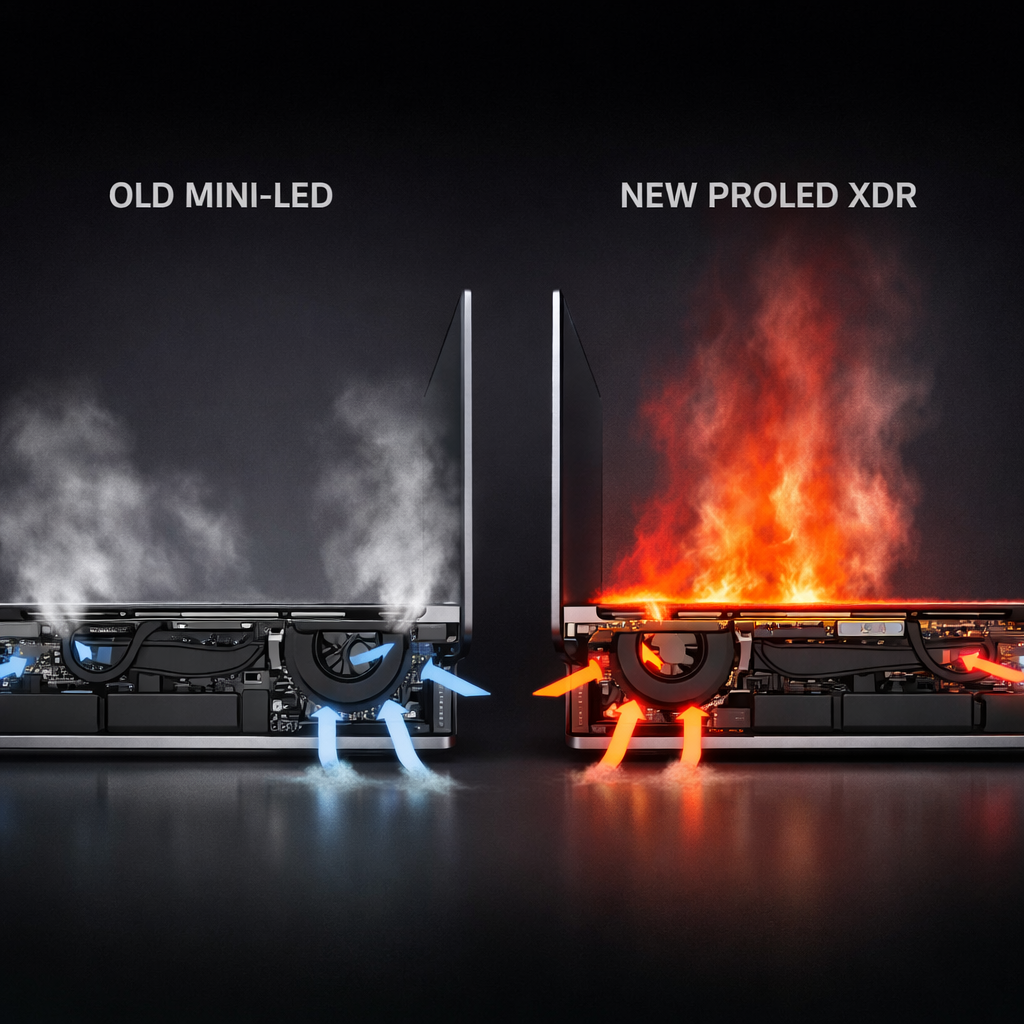
Apple’s latest MacBook Pro with PROLED XDR display has finally had its upgraded cooling system put on display in a real-world test — and it appears to deliver on the company’s claims for “incredible sustained performance.” As promised, the thermal architecture has been completely redesigned to push warm air away from the screen hinge, delivering better airflow especially when the laptop is closed or under heavy load.
Fog Machine Test Shows Airflow Shift
A YouTuber rolled out a fog machine comparison between the previous mini-LED MacBook Pro and the new PROLED XDR model. With both devices running and fans active, the cloud of fog visualized the airflow paths: the legacy model expelled hot air up toward the display, while the latest version routes it backward, through the hinge. That subtle difference in ventilation might seem small on paper, but its effects become obvious when the laptop is closed and heat buildup threatens performance.
This change matters because traditional laptops often have to throttle processing power when they overheat — especially compact models or those docked to external monitors. Apple’s reworked enclosure aims to avoid that by moving the heat exhaust away from sensitive components in the display, allowing the system to maintain peak power longer.
Why This Redesign Counts
Apple’s official description of the upgrade states that the new cooling architecture enables exceptional sustained performance from the M5 Pro and M5 Max chips, while also reclaiming a lighter chassis. A key piece of that redesign is the hinge-ward airflow: venting hot air toward the back instead of up toward the lid. Along with the updated internal layout, it all signals a shift toward more efficient thermal management without compromising on weight or form factor.
Users who push their machines with video rendering, code compilation, or running external displays alongside full loads will likely notice the difference. Heat leakage into the display not only makes a laptop uncomfortable to use, it can throttle GPU or CPU power under stress. With the redesign, performance throttling should be reduced.
This demonstration isn’t just marketing: seeing airflow in motion confirms that the new MacBook Pro can more directly address the common thermal pain points. For those who demand sustained performance — creatives, developers, pros — this could represent a meaningful upgrade.
What to watch for: real-world benchmarks under continuous load, long video exports, and the laptop’s behavior when it’s closed but still working hard. How much quieter will it stay? Will surface temperatures near the hinge stay manageable? That will determine whether this new design doesn’t just look good, but delivers where it counts.
As Apple rolls out this new thermal design, it may set a higher bar for laptop cooling — pushing other makers to move beyond simply shrinking fans or tweaking vents. The next horizon may be sustained performance without compromise. That’s the change to monitor.