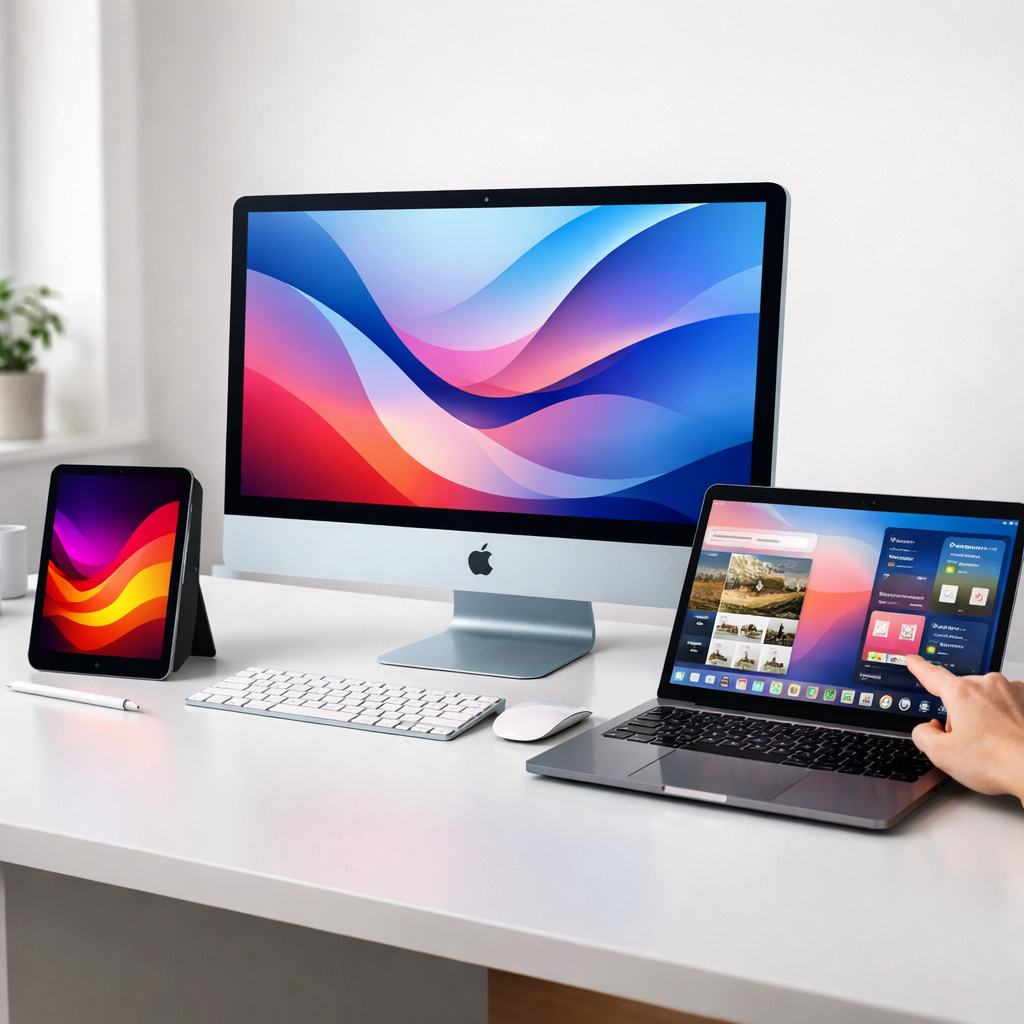
Today marks the official launch of several major new Apple products: the OLED iPad mini (8th generation), the iMac with the M6 chip, and revamped MacBook Pro models—all available to order online or in-store, with first deliveries arriving immediately. Below is a breakdown of what’s new, how they differ from predecessors, and what to expect in price and availability.
OLED iPad mini
The new iPad mini arrives with its first-ever OLED display: an 8.5-inch Super Retina XDR panel that peaks at 1,200 nits of brightness and offers a contrast ratio of 2,000,000:1. For those wanting reduced glare, a nano-texture glass option is now available—but only on the 256 GB and 512 GB models.
Under the hood sits Apple’s A20 Pro chip, paired with the N1 wireless chip, bringing support for Wi-Fi 7 and Bluetooth 6. At just 5.4 mm thin and 255 g light, it’s the slimmest, lightest iPad yet. Water and dust resistance reach IP67, and a novel acoustic display replaces speaker holes entirely by producing sound through the screen. Other updates include a 12 MP front camera optimized for landscape positioning and compatibility with both Apple Pencil Pro and standard Apple Pencil via USB-C. However, unlike some higher-end iPads, it lacks a ProMotion display—sticking with 60 Hz refresh rate—which reviewers point out as its main downside.
Pricing starts at $699 for the base 128 GB Wi-Fi version. Stepping up to 256 GB or 512 GB raises the price to $799 and $999 respectively; adding the nano-texture glass to those models costs an extra $100. Cellular variants are priced from $849. For students, education discounts bring the 128 GB model down to $649.
M6 iMac
The refreshed iMac is the first full-size all-in-one in Apple’s lineup to be updated since its M4 series. It features the new M6 chip with options for 10 or 12 cores in both CPU and GPU, delivering up to double the graphics performance of the previous generation. It also includes upgraded wireless connectivity—Wi-Fi 7 and Bluetooth 6—and an optional 2.5 Gbps Ethernet port built into the power adapter.
The entry iMac with 10-core CPU and GPU starts at $1,499, while the higher-spec 12-core/12-core variant begins at $1,699. Education pricing brings the base model down to $1,449.
MacBook Pro Lineup: Touchscreens & Pro Power
Today’s release also adds new MacBook Pro options. The 14-inch model with the M6 chip starts at $1,999, carrying a 12-core CPU and GPU inside along with Wi-Fi 7 and Bluetooth 6 via Apple’s N1 wireless chip.
On the premium side, Apple now offers 14- and 16-inch MacBook Pros with touchscreen PROLED XDR displays. Both sizes are powered by M5 Pro or M5 Max chips, and feature a Dynamic Island instead of the notch. Both SDR and HDR content can now reach 2,000 nits of peak brightness. These high-end variants are priced at $2,899 for the 14-inch and $3,399 for the 16-inch. Online orders suggest ship times in 2-3 weeks for many configurations; those wanting quicker delivery might find base models in stock at physical Apple Stores.
Availability Snapshot
All these devices are live on Apple’s website and via the Apple Store app as of today. First pre-orders are hitting customers today, and stock is rolling into Apple Stores and authorized resellers. If timing matters, it may be worthwhile to visit a local store for earlier availability.
What this means: Apple has expanded its display and performance milestones across the product line. The OLED iPad mini brings top-tier panel quality to its smallest size yet, while the M6 introduces meaningful CPU/GPU gains in both desktop and portable Macs. The move to touchscreen for MacBook Pros is especially significant—it pushes Apple further into convergence territory, raising questions about future gestures, touch input, and display tech.