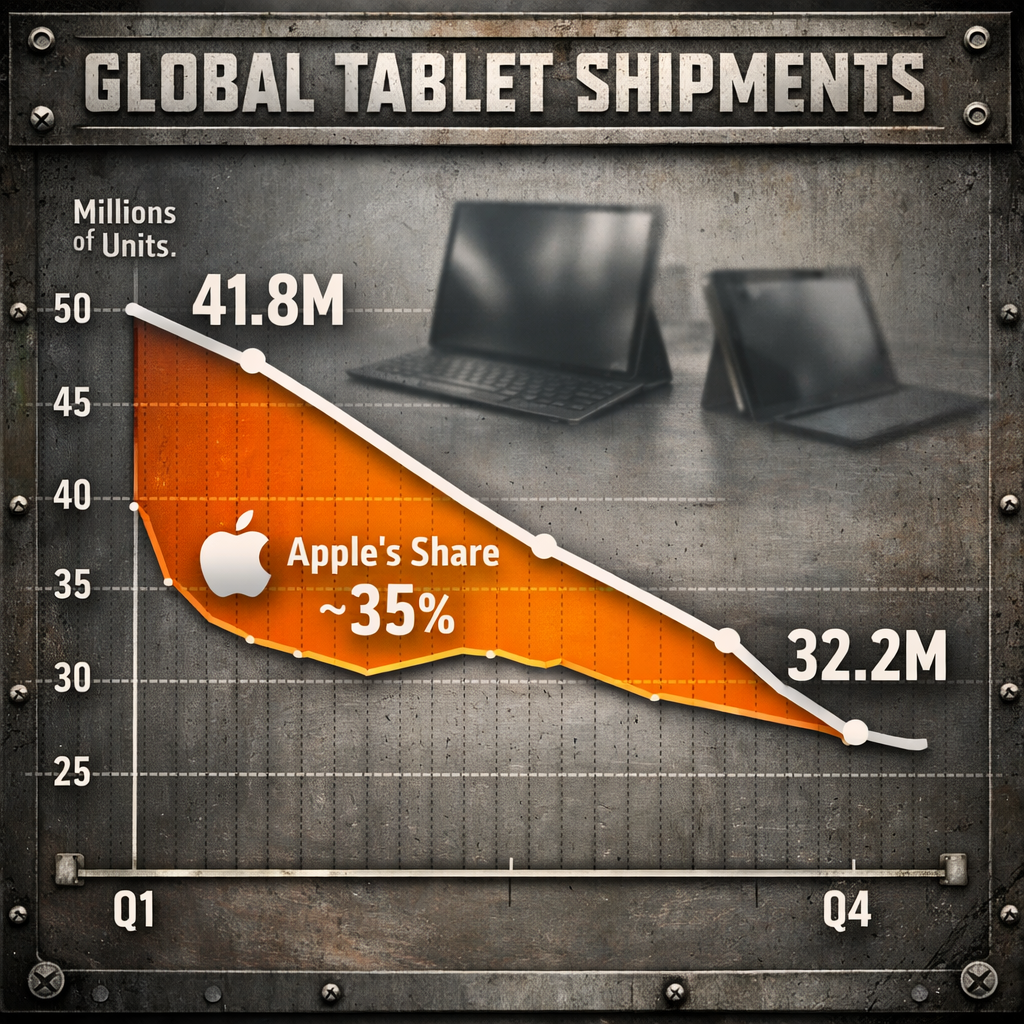
Apple’s iPad shipments fell dramatically in the third quarter of 2026, down 27.5% year over year to 11.5 million units. Despite the drop, Apple held onto its position as the leading tablet maker, capturing 36% of global tablet shipments—albeit with a small loss in market share. The decline was revealed in a report published by Omdia.
The wider tablet market tumbled nearly across the board. Total global shipments sank from 41.8 million in Q3 2025 to 32.2 million in Q3 2026, a roughly 23% year-over-year drop. That makes this past quarter the weakest in shipment volume in almost three years.
How the Competition Fared
In second place after Apple came Samsung, with 16.9% of the market, followed by Lenovo at 12.7%, Xiaomi at 7.3%, and Huawei at 5.7%. Only Lenovo managed to post shipment growth among the top five, climbing 11.9% year over year.
The steepest drop came from Huawei, which saw tablet shipments collapse by 43%. Apple’s decline was 27.5%, while Samsung dropped by 21.7% and Xiaomi by 10.6%. The report suggests that lackluster improvements and limited supply are causing consumers to postpone upgrading their tablets.
What’s Behind the Downturn?
Omdia analysts believe supply constraints are restricting vendors from delivering major upgrades, which in turn is reducing the appeal of new tablets versus older models. Because buyers are waiting for more meaningful improvements in features and specs, demand has far outpaced what new product launches are offering.
Added to that, many consumers are holding onto their existing tablets longer, deferring purchases until hardware takes a bigger leap forward.
This falloff comes even as Apple continues to lead the global market. But its loss of share—albeit modest—combined with broader market weakness—even for second-place vendors like Samsung—underscores just how rough the tablet landscape has become in this cycle.
Analysis:The tablet space appears to be in a pause mode. With Omdia attributing the drop in shipments to weak upgrades and supply bottlenecks, vendors may need to rethink how frequently they release new models—and what truly differentiates them. Apple’s challenge is to justify why its next iPads should matter; for competitors, the task is to capitalize when newer innovations emerge. For consumers, it means we might see stronger hardware leaps, higher performance, or entirely new form factors before many feel it’s time to upgrade again.