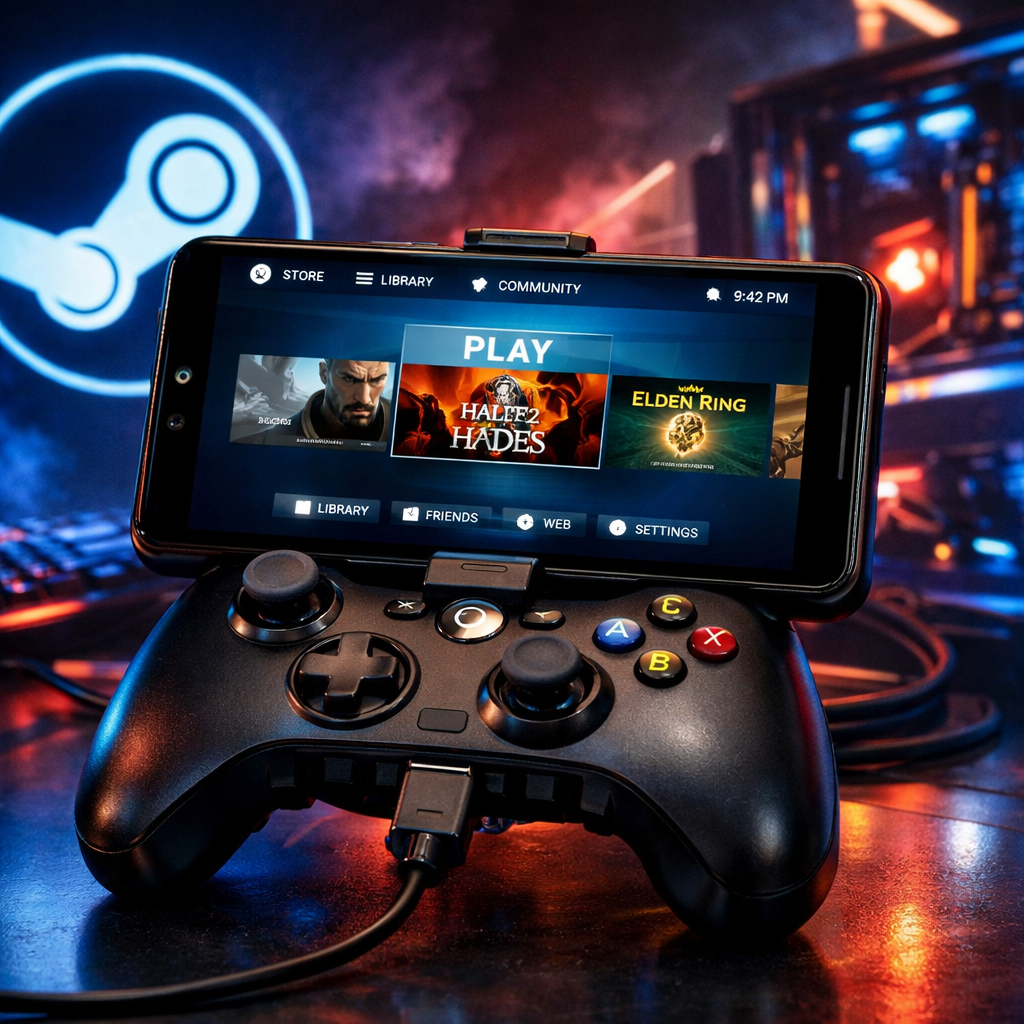
DroidDeck is a new project that lets you run Valve’s Steam Big Picture interface directly on Snapdragon-powered Android phones, bringing native PC gaming—complete with Proton translation and custom graphics drivers—to your pocket. No rooting or streaming required, and games are installed locally just like on a Steam Deck.
How it Works
To get started, you install the DroidDeck APK from the official GitHub page, sign into your Steam account, select the correct Proton compatibility layer, and enable the Mesa Turnip graphics driver. These settings allow your phone’s Adreno GPU to deliver real 3D gaming performance. From there, you can download games, access cloud-saves, and use the full Steam Workshop library—all without needing an internet connection once games are installed.
What Phones Can Do It—and How Well
The minimum hardware requirement is a Snapdragon chip with Adreno 730 or newer—equivalent to a Snapdragon 8 Gen 1 or newer. While older flagships meet that baseline, Pixels are excluded from official support. For smoother gameplay, smartphones with faster CPUs, 12–16GB RAM, and UFS 4.0 storage are recommended.
Tests with titles like Portal 2 and Burnout Paradise Remastered suggest that 60fps at 1080p is possible for older or less demanding games. Heavier games struggle—resolution drops (down to 720p) are often necessary, and frame rates can range widely. Storage is a major concern: unless you have a high-capacity phone, storing multiple large PC games alongside daily apps may be unrealistic. Heat build-up and battery drain are also significant challenges, making external controllers practically essential.
Where DroidDeck Fits in the Big Picture
DroidDeck delivers an experience very different from other tools like GameNative, which act more like traditional launchers and use separate containers for each game. DroidDeck provides a unified environment in which the entire Steam Deck UI—store, interface, workshop—is directly accessible. For many users, it feels more streamlined and Deck-like.
While it’s still early and performance varies depending on game, hardware, and settings, DroidDeck makes a strong case for the future of mobile gaming. As translation layers and drivers continue to improve, phones may become viable platforms for much of your Steam library—saving the cost of a dedicated handheld. If you have a powerful phone and are curious, it’s worth trying out—just know you’ll need enough storage, a cool setup, and realistic expectations.
What this means: DroidDeck represents one of the strongest pushes yet toward bringing PC gaming powerfully into mobile devices. It shifts the ambition from streaming to running locally, and while limitations remain, the potential for standard phones to double as portable PCs is now very real. The big questions now are stability, compatibility across phones, and whether pressure from hardware makers will push for components built for this purpose.