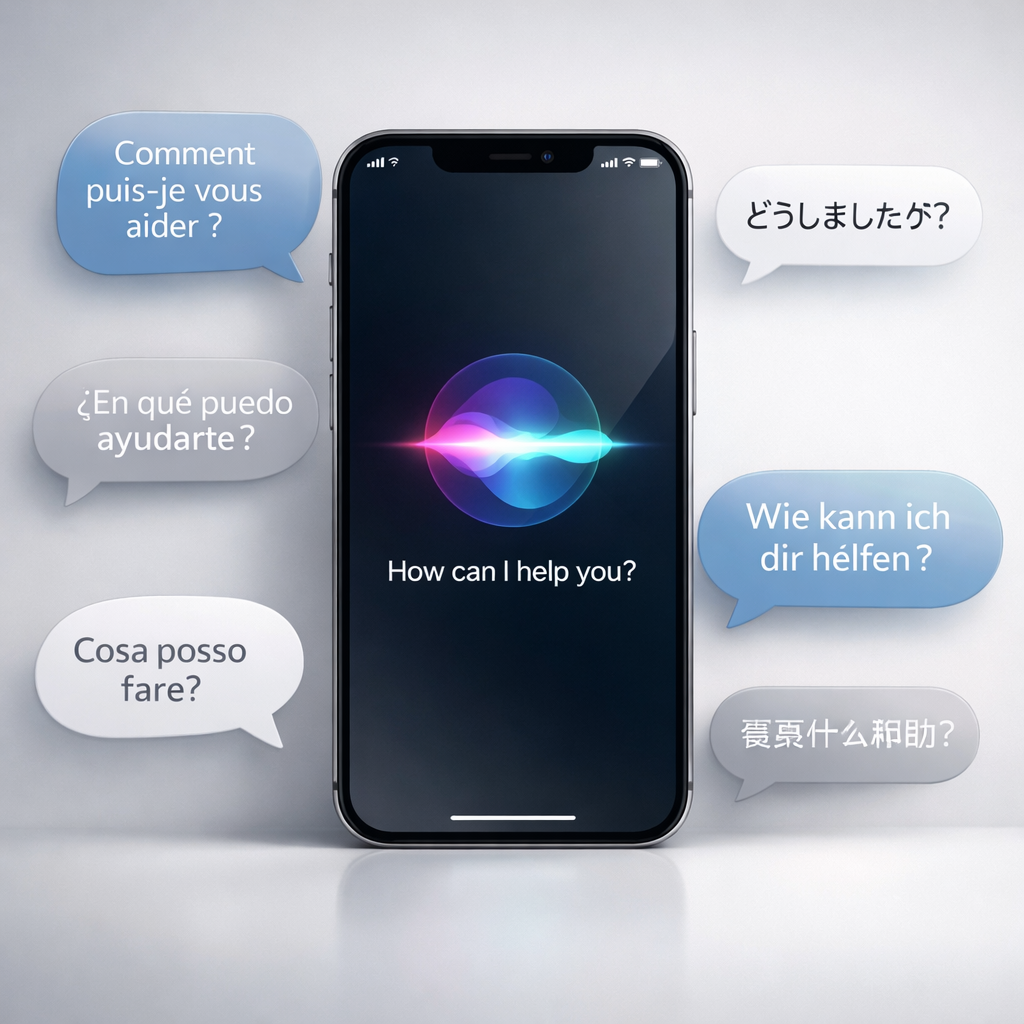
Apple continues expanding the reach of its latest Siri AI, revealing today that support for four additional languages—Chinese (Traditional), Norwegian, Turkish, and Vietnamese—will roll out before the close of 2026. The announcement comes alongside the public release of iOS, iPadOS, macOS, watchOS, and visionOS 27.2, which ushers in support for five new languages immediately. The assistant already supports English, which has been active since the Siri AI launch in September. New languages added now include French, Japanese, Korean, Portuguese, and Spanish.
What Siri AI Now Offers
With the 27.2 update live today, users who speak French, Japanese, Korean, Portuguese, or Spanish can access Siri AI’s full capabilities across Apple’s operating systems. These features include generating responses based on personal context drawn from messages, photos, emails, and more. Siri AI also adds “onscreen awareness,” meaning it can interact with and respond to content visible on the device’s screen. Additionally, it leverages what Apple calls “world knowledge” to provide current information on diverse topics.
What’s Coming Next
Later this year, the four languages announced—Traditional Chinese, Norwegian, Turkish, and Vietnamese—will join the supported list. This expansion rounds out language support in a growing list that already includes English, Chinese (simplified), Danish, Dutch, German, Italian, Swedish, and others under the Apple Intelligence umbrella.
Some limitations linger. Siri AI remains unavailable in the European Union for iOS, iPadOS, and watchOS versions of the software. It also isn’t offered to users under age 13. Moreover, certain features powered by server-side models—such as Image Playground, advanced photo editing, and some Apple Intelligence tools—are subject to daily usage limits that vary based on request complexity and regional demand.
The rollout also depends on having a compatible device and setting both device and Siri language to one the system supports. This requirement applies across iOS 27.2 and corresponding updates.
Earlier this cycle, Siri AI was introduced in September as part of Apple’s broader Apple Intelligence initiative—designed to make Siri more conversational, context-aware, capable of handling complex and multi-step tasks, and more integrated with daily workflows. The move to rapidly increase language support reflects Apple’s focus on broadening accessibility globally.
This update matters because language support is one of the most critical barriers in deploying AI-powered assistants worldwide. Apple’s aggressive roadmap for Siri AI’s linguistics suggests the company understands that to compete in global markets, its AI assistant needs to speak—and understand—more than a handful of languages. Watch for how quickly the promised languages appear and whether Apple shrinks the delay for regions like the EU, often delayed by regulatory, technical, or localization hurdles.