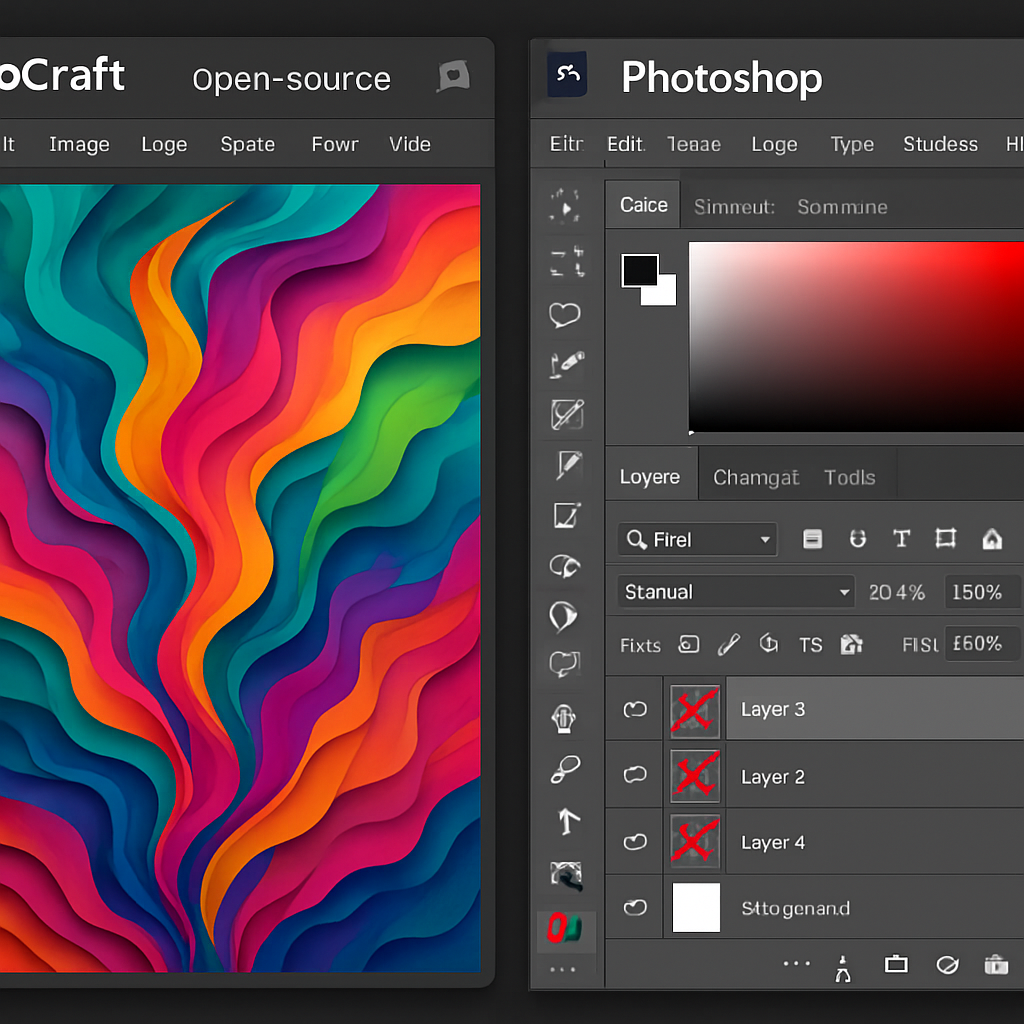
Imagine running a suite of software that mirrors Adobe Creative Cloud apps—but for free and open-source. That’s what ArtCraft, a new project, has launched: “clean-room” alternatives to flagship design tools like Photoshop, Lightroom, Premiere Pro and more. These apps preserve the look and feel of the originals, sparking discussions on legality, ethics, and what it means to clone a user experience.
What is ArtCraft and what’s included
ArtCraft is a group of developers aiming to rebuild major design, video, and productivity apps using AI and fresh code instead of copying existing source. They’re building them in Rust, powered by prompt-based workflows—primarily using tools like Claude Opus. The current lineup includes PhotoCraft (Photoshop clone), LightCraft, FilmCraft, VectorCraft, PDFCraft, EffectCraft, and more. In addition to the Adobe analogs, the collection extends to WordCraft, DeckCraft, GridCraft, CADCraft, and SoundCraft—clearly targeting comprehensive suites rather than niche utilities.
All ArtCraft tools are totally free, open-source, and released on GitHub. They’re called “vibe-coded”—a nod to the attempt to channel the appearance and behavior of the originals without copying their code directly.
Very close to Adobe, but not identical
Visually, ArtCraft’s tools are uncanny. In tests, PhotoCraft’s toolbar, icons, and layers panel mirror Photoshop to a degree that might momentarily confuse seasoned pros. That said, subtle differences exist: color rendering, gradients, high-level tools like AI suggestion bars—all differ in ways that may matter depending on how you work.
Feature parity is far from complete. These are early versions, so many advanced tools that Adobe users depend on aren’t present. Stability and polish can vary, and some workflows—especially those using AI-driven features—are still unique to Adobe’s ecosystem.
Law in the gray zone
The project’s claim is that its tools are built via clean-room processes: no reverse engineering or decompilation, only inspiration guided by user interface norms. If true, that places the project outside the territory of direct copyright misappropriation—but not necessarily away from legal risk.
Intellectual property law usually recognizes that while you can’t directly copy protected code, you can mimic interface elements up to a point. Where that point lies is murky. Even well-funded companies often lean on “look-and-feel” awareness in litigation rather than pure code copying. And in this case, significant visual similarity could draw legal scrutiny.
While nothing so far indicates malicious code or serious security issues, given that the apps are free, open, and new, there’s also a risk of bugs or less rigorous under-the-hood engineering when compared to Adobe’s mature products.
Why it matters and what to watch next
This movement touches on broader trends: dissatisfaction with recurring subscription fees, the rise of AI in software creation, and growing interest in open-source alternatives even for established proprietary tools. Users pay monthly just to retain access; here’s a different model—one built from shared effort and open licensing.
For Adobe, ArtCraft could become a serious challenge. Not just because of cost savings, but due to user friction when subscription fatigue meets usable free alternatives. Whether ArtCraft remains a fringe curiosity or matures into a full-featured suite depends on how quickly it can close feature gaps, stabilize performance, and avoid or counter legal pushback.
Keep an eye on how ArtCraft evolves: advances in tools like EffectCraft and CADCraft, confidence from its user base, and whether Adobe responds. If nothing else, this is an experiment in what AI-assisted development and open-source culture can do when they take on photo editors and video suites head-on.